Harris listened quietly. He did not feel triumph. He felt a tired kind of understanding. Beckett was not a mastermind. He was a frightened man who had wanted to feel important, and he had hurt people trying to get that feeling. Now he was doing the right thing, late, but still the right thing. That was enough.
"Good," Harris said. "Let him tell the truth. The jury needs to hear it from someone who was there."
That night, Pinewood Estates was quieter than it had been in months. The neighbors who had been afraid to talk to each other started talking again. Walter Briggs told Harris that two families on the next street had already asked how they could help with the garden when the time came. Laura called and said she and Tom and the kids would be over on Sunday. The community center, where Veronica had been arrested, was empty and dark, but it did not feel frightening anymore. It felt like a room waiting to be used for something better.
Harris stood at his window before bed and looked out at the yard. The flower beds were still bare in places where the boots had crushed them, but the soil was still there, dark and rich, ready for new planting. The mailbox, the one the whole fight had supposedly been about, stood straight and solid at the end of the driveway. The house was his. The land was his. The case was moving forward. The grand jury had spoken. The trial was coming. And for the first time since Eleanor had died three years ago, Harris felt like the future might hold something more than just getting through the next day. It might hold a garden again, and neighbors again, and peace again. He turned away from the window, turned off the light, and went to sleep, knowing that tomorrow would bring the next step, and that he was ready for it.
Chapter 12 - The Tape Plays in Court
The courtroom was full by nine o'clock on the morning the trial began, and James Harris had never seen Pinewood Estates look so present in one room. Neighbors he had known for years sat in the back rows, some holding hands, some whispering, some simply sitting still and watching. Walter Briggs was there in the second row, wearing his best jacket, his hands folded in his lap. Laura Harris Bennett sat beside Tom Bennett, her face calm but her eyes bright, and their children were at home with a neighbor because Laura had decided they did not need to hear the details in this room. Sheriff Dan Whitaker sat near the front with Deputy Rosa Delgado, both in uniform, both watching the doors. Frank Calloway sat two rows behind them, his arms crossed, his expression unreadable. Angela Price sat at the table beside Harris, her papers arranged in neat stacks, her pen ready, her face composed. Across the room, at the defense table, sat Veronica Lane in a gray suit that did not fit her the way her HOA president's confidence once had, and beside her sat Nathaniel Cross in a dark suit that cost more than most people in Pinewood Estates made in a month. Behind them sat Roy Beckett, Clint Foster, Eddie Marsh, Paul Sorensen, and Glen Yates, each with his own lawyer, each looking smaller than he had looked on the night he had crossed Harris's yard in a matching navy shirt.
The judge was a woman named Judge Patricia Holloway, and she ran her courtroom the way a good marshal runs a prisoner transport, with clear rules, no wasted time, and no tolerance for theater. She looked out over the room, waited for silence, and then spoke in a voice that carried to the back without ever rising.
"We are here for the trial of the United States against Veronica Lane, Nathaniel Cross, Roy Beckett, Clint Foster, Eddie Marsh, Paul Sorensen, and Glen Yates," she said. "The charges are impersonation of law enforcement officers, burglary, conspiracy, and fraud. The government will present its case first. I expect everyone in this room to conduct themselves with respect for this court and for each other. We will begin."
The prosecutor, Diane Mercer, stood and gave an opening statement that was short and direct. She did not tell a story with flourishes. She told the jury what the evidence would show. She told them about a seventy-year-old retired United States Marshal named James Harris, a widower who had lived quietly in Pinewood Estates with his late wife Eleanor's garden, until five men in fake HOA enforcement shirts had broken into his home at one in the morning with a crowbar, bolt cutters, a plastic badge, a flashlight, and a short-handled shovel. She told them about the fine and the lien, about the missing one hundred eighty thousand dollars, about the plan to force Harris out so a developer could buy his lot cheap for an access road. She told them that the government's case was built on camera footage, on financial records, on the testimony of a cooperating witness, and on the calm testimony of a man who had spent forty years learning the difference between real authority and pretend authority. Then she sat down.
Veronica Lane's lawyer stood next. He was a tall man with silver hair and a voice that sounded like it had been trained to sound reasonable. He told the jury that his client was a dedicated community volunteer, a woman who had given years of her life to Pinewood Estates, who had made mistakes in judgment but had never committed a crime, who had never told anyone to break into a home, who had never stolen money, who was being blamed for the actions of men she could not control. He said the HOA's finances were messy but not criminal, that the fine against Harris had been a dispute about rules, that the whole case was an overreaction by a retired lawman who had overreacted to a neighborhood disagreement. He said the jury should look past the drama and see a woman who had tried to help her community and been punished for it.
Nathaniel Cross's lawyer said much the same thing in different words, that his client was a legitimate developer, that he had never conspired with anyone, that he had simply been interested in buying a piece of land for a lawful project, that interest was not a crime. The lawyers for Beckett, Foster, Marsh, Sorensen, and Yates said little in their openings, waiting to see what the evidence would do. They knew, as everyone in the room knew, that the camera footage was coming, and that once the jury saw it, words would matter less.
The first witness was Sheriff Dan Whitaker. He walked to the stand in his uniform, raised his right hand, and told the truth in the plain way he always told it. He described the call he had received after the first break-in, the scene he had found at Harris's house, the damaged flower beds, the broken planter, the footprints in the yard, the statements he had taken. He described the investigation that followed, the way the security camera footage had identified all five men, the way the shirts had been found, the way the tools had been recovered. He described the second break-in, the arrest of Clint Foster, the flight of Roy Beckett, the bruised shoulder and the cut forehead Harris had suffered. He described the financial records that had led to Carl Whitfield, and Whitfield's decision to cooperate. The defense lawyers cross-examined him, trying to find a mistake, trying to suggest that he had been too quick to believe Harris, too slow to consider other explanations. Whitaker did not rise to it. He answered each question the same way, with the facts, and when he did not know something, he said so.
Carl Whitfield was next. He walked to the stand slowly, his suit too big for him now, his face pale. He had lost weight since he had started cooperating, and he looked like a man who had not slept well in months. The prosecutor walked him through the books, through the missing one hundred eighty thousand dollars, through the meetings where Veronica Lane had told him to move money and not to ask questions, through the conversations with Nathaniel Cross about the access road and the price they would offer for Harris's lot. Whitfield's voice shook at first, but as he went on, it steadied, because the truth, once started, has a momentum of its own. He admitted what he had done. He admitted that he had helped hide the money. He admitted that he had been afraid to speak up, and that his fear had cost his neighbors. He apologized, not to the jury, but to the room, to the people of Pinewood Estates who had trusted him with their dues. The defense lawyers tried to attack him, to paint him as a liar trying to save himself, but Whitfield did not argue. He simply pointed to the records, to the dates, to the account numbers, and the records spoke for him.
Roy Beckett testified after Whitfield, and his testimony was the one the whole room had been waiting for. He was fifty-eight years old, heavyset, and he looked frightened in a way that made some of the jurors lean forward. He told the jury about the night Veronica Lane had given him the shirts and told him to make Harris understand that the HOA was serious. He told them about the plan to frighten Harris into selling, about the money Cross had promised, about the way he had shouted at Harris's door with a flashlight in one hand and a short-handled shovel in the other, believing that he was a chief and that his men would follow him. He told them that he had been wrong, that he had been used, that he was sorry. He did not try to make himself look brave. He told the truth about being afraid now, about facing prison, about wanting to do one right thing before it was too late. When the prosecutor asked him who had been in charge, he did not hesitate.
"Veronica Lane was in charge," Beckett said. "Nathaniel Cross was in charge. I was just the man they sent to shout."
The room was quiet after that. Even Veronica Lane's lawyer did not ask many questions on cross-examination. There was not much to ask. Beckett had already told the jury the worst of it himself.
Then it was Harris's turn. He stood up from the table where he had been sitting beside Angela, buttoned his jacket, and walked to the witness stand the way he had walked to a hundred witness stands before, slowly, steadily, without hurry. He raised his right hand and swore to tell the truth. He sat down, adjusted the microphone, and looked at the jury. He saw ordinary people, men and women who had taken time away from their jobs and their families to sit in this room and decide what had happened. He owed them the truth, plainly told.
The prosecutor began gently. "Mr. Harris, please tell the jury who you are."
"My name is James Harris," he said. "I am seventy years old. I am a retired United States Marshal. I served for four decades. I worked fugitive operations, federal investigations, and interstate manhunts. I am a widower. My wife, Eleanor Harris, died three years ago. I live in Pinewood Estates, outside Atlanta, Georgia, in the house Eleanor and I shared."
"Mr. Harris, please tell the jury what happened at your home at about one in the morning on the night in question."
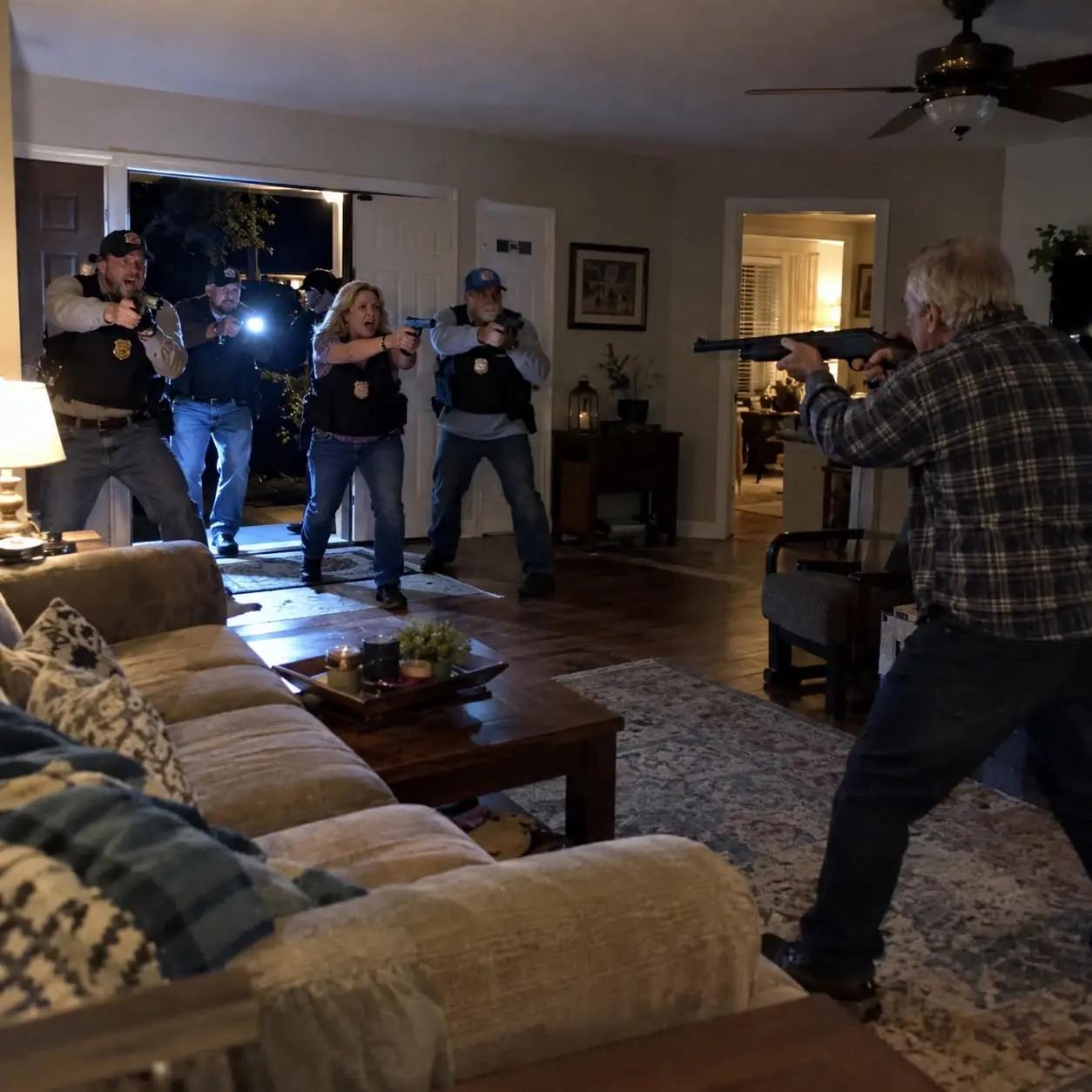
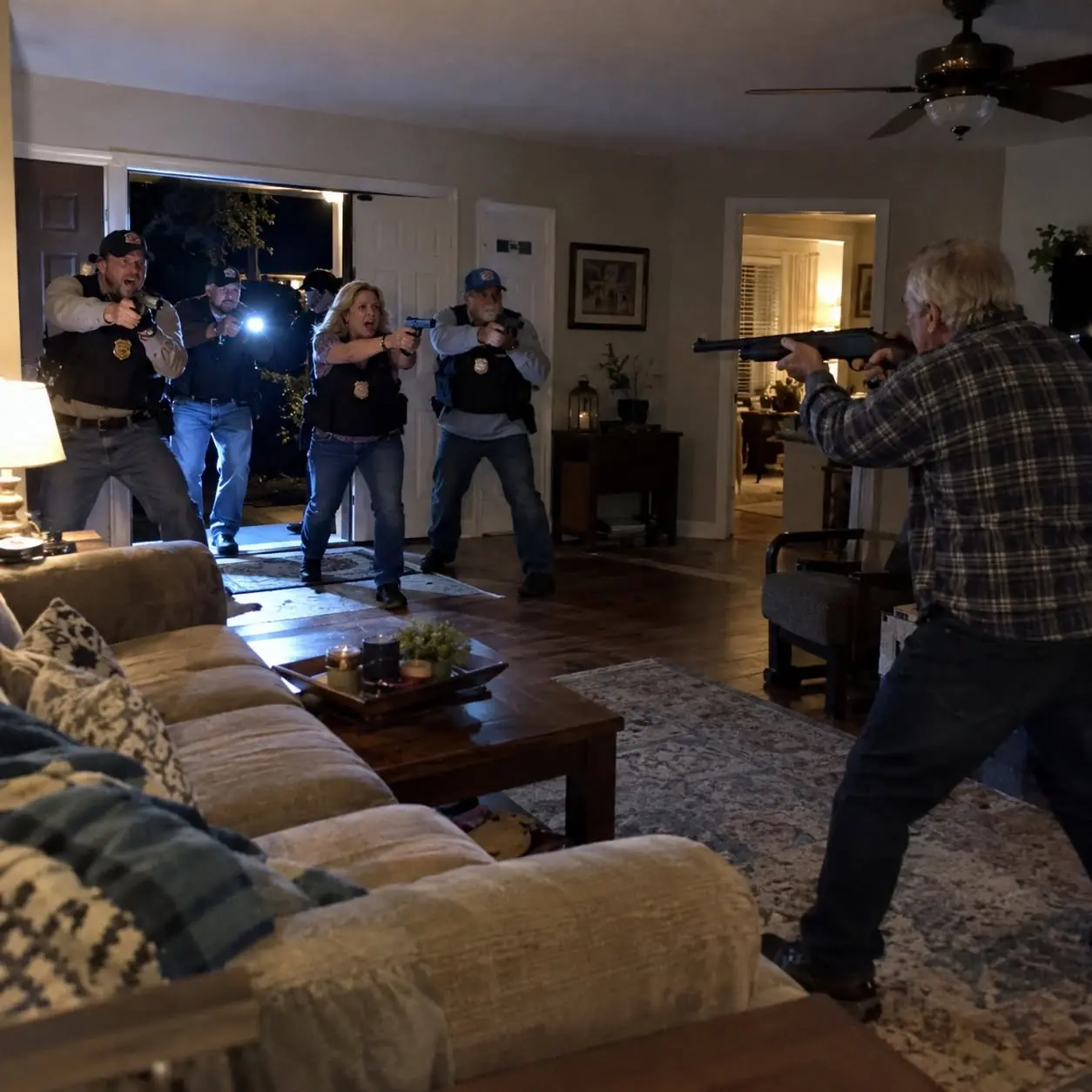
Harris told it again, the way he had told it to the grand jury, the way he had told it to Sheriff Whitaker, the way he had told it to Agent Calloway. He told them about the shout, the three blows against the siding, the security lights, the five men in matching navy shirts with HOA ENFORCEMENT UNIT written crooked across the backs. He told them about the crowbar, the bolt cutters, the plastic badge, the flashlight, and the short-handled shovel. He told them about the flowers crushed under their boots, the planter kicked off the porch, the photographs taken of his windows. He told them about coming downstairs in his plaid shirt with his shotgun, about holding his ground, about no one firing, about every camera and microphone recording, about the footage being copied offsite where no one could reach it.
His voice did not shake. It did not rise. It stayed calm and even, the voice of a man who had spent his career learning how to stay calm when other people were shouting. The jury watched him the way people watch a man who is telling them something they need to understand.
"Mr. Harris," the prosecutor asked, "what did you think when you saw those men in your yard?"
"I thought they were not police," Harris said. "Real authority rarely needs theater. Professionals do not scream about how powerful they are. They do not buy plastic badges. They do not invent titles. And they definitely do not storm a seventy-year-old man's backyard at one in the morning because they are angry about a mailbox. I knew they were not real officers. I also knew the tools in their hands were real, and the damage they were doing was real."
"Mr. Harris, can you tell the jury about the flowers?"
Harris paused for a moment. He had not expected the question to hit him the way it did, but it did. He thought about Eleanor in the garden in the spring, her gloves dirty, her hair tied back, telling him which flowers would bloom first and which ones needed more sun. He thought about the morning after the break-in, walking out into the yard and seeing the crushed stems, the petals scattered on the ground, the beds that had taken her months to plant destroyed in minutes by men who did not care.
"My wife Eleanor planted those flowers," he said, his voice a little quieter now. "She spent all spring growing them. She loved that garden. It was her place. After she died, I kept it going because it was a way to keep her close. Those men walked across it in their boots and crushed a row of them as if they were nothing. They kicked a planter off the porch. They did not just damage my property. They damaged something my wife had made with her own hands. That is not something I will forget."
The courtroom was very quiet. Laura, sitting in the gallery, wiped her eyes. Walter Briggs looked down at his hands. Even the judge was still for a moment.
"Mr. Harris," the prosecutor said softly, "thank you. I have no further questions at this time."
Veronica Lane's lawyer stood for cross-examination, and he tried to be gentle at first, then less gentle. He asked Harris if he had overreacted by coming downstairs with a shotgun. Harris said no, that he had held a shotgun to make it clear he would defend his home, and that he had not fired it, and that no one had been hurt by him that night. The lawyer asked if Harris had been angry about the HOA fine, and Harris said he had been angry about being fined for defending his home, yes, and that anger was reasonable. The lawyer asked if Harris had wanted revenge, and Harris said no, that he had wanted the law to work, and that was why he was in court. The lawyer tried to suggest that Harris, as a former marshal, had used his experience to make the case look worse than it was. Harris looked at him steadily.
"I did not make the case," Harris said. "The cameras made the case. The records made the case. The men who broke into my home made the case. I just told the truth about what happened."
The lawyer sat down. He had no more questions that would help his client.
Then the prosecutor stood again. "Your Honor," she said, "the government would like to play the security camera footage from the night of the break-in."
Judge Holloway nodded. "You may proceed. Bailiff, please dim the lights."
The lights in the courtroom dimmed. A large screen at the front of the room flickered on. For a moment there was only darkness, and then the image appeared, grainy and clear at the same time, the yard at night, the security lights snapping on, the five men crossing the property in their matching navy shirts. The room watched as Roy Beckett shouted, as Clint Foster raised the crowbar, as Eddie Marsh held the bolt cutters, as Glen Yates adjusted the plastic badge on his belt, as Paul Sorensen photographed the windows. The room watched as the flowers were crushed under their boots, as the planter was kicked off the porch, as the men moved toward the house like a discount tactical team. The room watched as the front door opened and James Harris stepped out in his plaid shirt holding a shotgun, standing his ground in his own living room, his face calm, his voice steady, telling them to leave his home. No one fired. The men hesitated, then backed away, shouting as they went, and the footage ended.
When the lights came back up, no one spoke for a long moment. The jury had seen it with their own eyes. They had seen the shirts. They had seen the tools. They had seen the flowers crushed. They had seen Harris standing alone against five men and not backing down. There was nothing left to argue about what had happened that night. The only question left was what the law would do about it.
The prosecutor then showed the jury the evidence, one piece at a time. The plastic badge, held up in a clear plastic bag, its cheap metal catching the light. The short-handled shovel, its handle worn, its blade still marked with dirt from Harris's yard. The crowbar. The bolt cutters. The photographs of the damaged flower beds. The HOA fine notice for twelve thousand four hundred dollars. The lien threat. The bank records showing the missing one hundred eighty thousand dollars. Each piece was entered into evidence, each piece was shown to the jury, each piece was another brick in a wall that was now too high for the defense to climb over.
Veronica Lane's lawyer tried to argue that the badge was a novelty, that the shovel was a gardening tool, that the shirts were just shirts. But when the jury looked at the footage again in their minds, when they remembered Beckett's testimony and Whitfield's records and Harris's calm voice, the arguments sounded thin. They sounded like what they were, excuses from people who had been caught.
Nathaniel Cross's lawyer tried to argue that Cross had never been at Harris's house, that he had never held a crowbar, that he had only been interested in buying land. The prosecutor answered by showing the emails and the text messages Whitfield and Beckett had provided, messages in which Cross discussed the price he would offer once Harris was frightened enough to sell, messages in which he called the lot essential for his access road, messages in which he told Veronica to keep the pressure on. Cross sat at the defense table and stared at the table, his face pale, his hands clasped so tightly that his knuckles were white.
By the end of the day, the government's case was complete. The defense called a few witnesses, neighbors who said Veronica Lane had been a good HOA president, a business associate who said Cross was an honest developer, a character witness for one of the younger defendants. They were polite people, and they meant well, but their testimony could not undo the footage, could not explain the missing money, could not make the plastic badge real. When the defense rested, Judge Holloway looked at the jury and told them they would hear closing arguments in the morning.
Harris walked out of the courtroom with Angela beside him, and the evening air outside felt cool after the long day inside. Laura and Tom were waiting on the steps, and Laura hugged her father hard, the way she had hugged him the night after the break-in, when she had sat with him until dawn.
"You did so well, Dad," she said. "You were so calm. Everyone could see it. Everyone could see who was telling the truth."
"I just told them what happened," Harris said. "That is all I have ever done."
Walter Briggs came down the steps behind them, shaking his head slowly. "I have lived in Pinewood Estates for thirty years," he said. "I have never seen a courtroom that quiet. When that tape played, you could have heard a pin drop. Those people on that jury, they saw it. They know now."
Frank Calloway joined them on the sidewalk, his hands in his pockets. "It is a strong case," he said. "The strongest I have seen in a long time. The footage is everything. You cannot argue with a camera that was recording the whole time."
Harris nodded. He thought about Eleanor again, about the garden, about the flowers that had been crushed and would one day be replanted. He thought about the plastic badge in its evidence bag and the shovel on the evidence table, objects that had once frightened him in his own yard and were now just exhibits in a courtroom, powerless. He thought about Veronica Lane sitting at the defense table, her confidence gone, and Nathaniel Cross staring at his hands. He did not feel joy. He felt the same relief he had felt when the grand jury had returned its indictments, only deeper now, because the whole community had seen the truth with its own eyes.
That night, Harris slept well. He dreamed, not of the break-in, but of Eleanor in the garden, kneeling in the dirt, smiling up at him as she planted something new. When he woke in the morning, the sun was coming through the curtains, and the house was quiet, and he knew that whatever the jury decided, he had done his part. He had told the truth. The tape had played. The evidence had been shown. The rest was in the hands of twelve ordinary citizens, and Harris trusted them to do what was right, because they had seen what he had seen, and they had heard what he had heard, and they knew, as he knew, that a man's home is his home, and no fake badge and no shovel and no shouted threat can change that.
---
Chapter 12 - The Tape Plays in Court