Chapter 1 - The Knock at One in the Morning
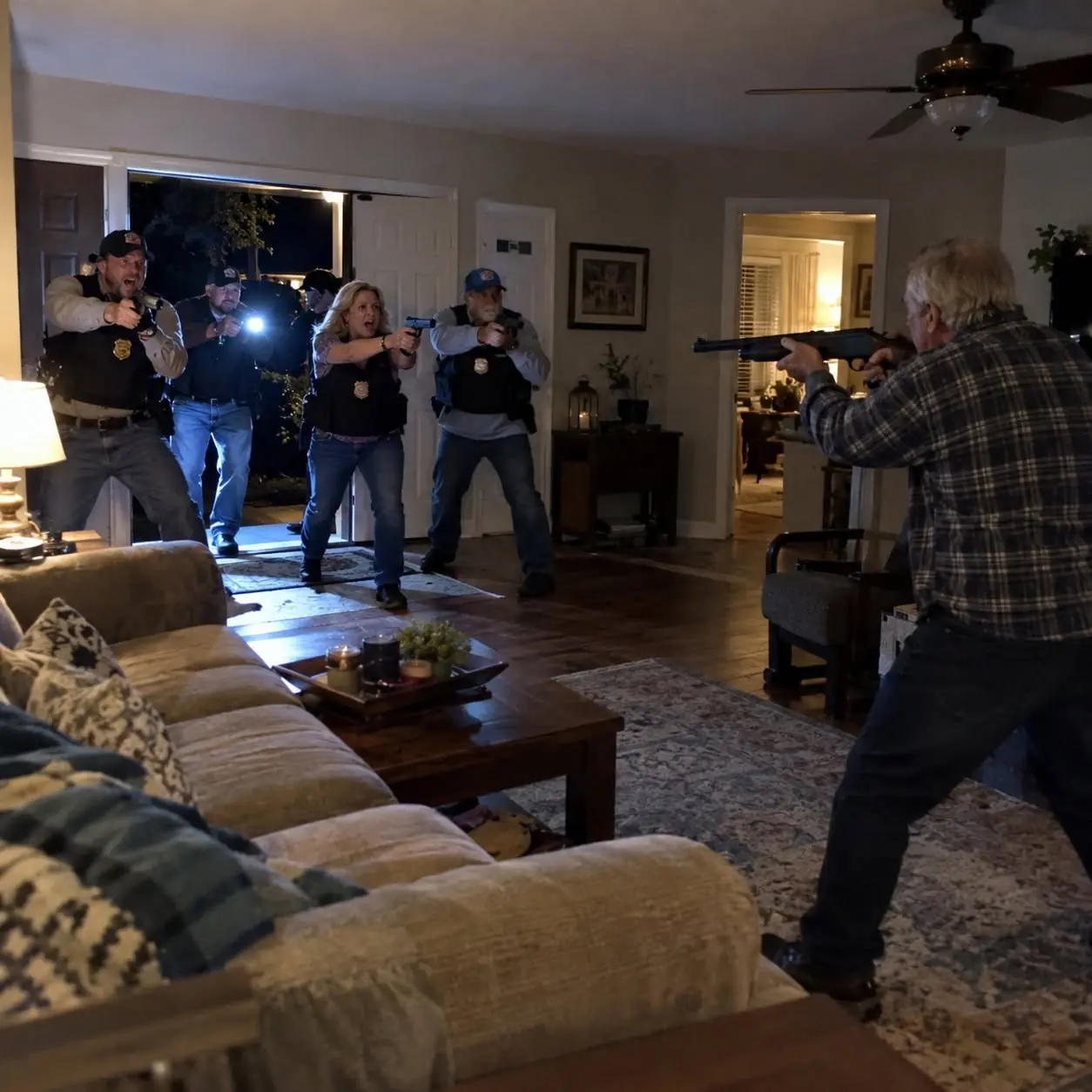
HOA ENFORCEMENT! OPEN THE DOOR!
The shout tore through the dark house at 1:07 in the morning, loud enough to shake James Harris out of a deep sleep and send his heart hammering against his ribs before his mind had even caught up with his body. For one stunned second he lay flat on his back in the darkness of his bedroom in Pinewood Estates, staring up at the ceiling, wondering if the sound had been part of a dream. Then it came again, closer and harder, three violent blows against the siding of his house that rattled the window glass in its frame.
Bang.
Bang.
Bang.
James sat up slowly, his breathing steady even as his pulse quickened, because this was not the first time in his life that someone had tried to frighten him in the middle of the night. He had spent four decades as a United States Marshal, working fugitive operations and federal investigations and interstate manhunts, and he had learned long ago that fear was a choice you made after you understood what you were facing. He reached for the lamp beside his bed but did not turn it on. He did not want to give whoever was outside any more information than they already had. Instead he swung his legs over the side of the bed and stood in his bare feet on the cool wooden floor, listening.
Outside, the security lights snapped on with a sharp click, flooding the front yard with white light. Through the thin gap in the bedroom curtains, James could see shadows moving across the grass, big men in dark shirts, moving with the clumsy confidence of people who believed no one would stop them. A voice shouted again, rough and angry, the voice of a man who enjoyed hearing himself give orders.
You have been warned! Open this door or we will enforce compliance ourselves!
James moved quietly to the window and looked through a narrow gap in the blinds. Five grown men were crossing his property wearing matching navy shirts with crooked white lettering across the backs. Even from a distance he could read the words.
HOA ENFORCEMENT UNIT.
One of them wore a plastic badge clipped to his belt, the kind of toy badge a child might buy at a dollar store. Another carried a crowbar, holding it down at his side like a weapon. A third had a pair of bolt cutters slung over his shoulder. The heaviest man in the group, the one who called himself their chief, was holding a flashlight in one hand and a short-handled shovel in the other, swinging the shovel as he walked as if he were already imagining what he would do with it.
They moved across his yard like a discount tactical team, stepping heavily, talking too loudly, tripping over their own feet in the dark. One of them crushed a row of flowers James had spent all spring growing, flowers his late wife Eleanor had planted with her own hands before she died three years ago. The man did not even look down. He ground the stems into the dirt under his boot and kept walking. Another kicked a planter off the edge of the porch, and it shattered on the walkway below, dirt and broken pottery scattering across the concrete. A third began photographing the windows with his phone, the flash popping in the darkness like a camera at a crime scene.
Then the man with the shovel looked toward the house and shouted again, his voice thick with triumph.
This is your last warning, Harris! You do not ignore HOA authority!
James stood there in the darkness and almost laughed. Almost. Because while the uniforms were ridiculous, the tools in their hands were real. The crowbar was real. The bolt cutters were real. The shovel was real. And the damage they were doing to his yard and his home was real. He had seen men like this before in his career, men who had no real power but who dressed up in borrowed authority and convinced themselves that a shirt and a shout made them the law. They were the most dangerous kind of amateur, because they believed their own performance.
What those men did not understand was that James Harris had spent four decades around people who actually knew how to conduct raids. He had worked fugitive operations. He had worked federal investigations. He had worked interstate manhunts. He had spent nights outside buildings where armed men were barricaded inside, waiting in the cold while negotiators talked and tactical teams prepared. He had walked into rooms where everyone present had a reason to lie and enough desperation to become dangerous. Those experiences teach you something very useful. Real authority rarely needs theater. Professionals do not have to scream about how powerful they are. They do not buy plastic badges. They do not invent titles. And they definitely do not storm a seventy-year-old man’s backyard at one in the morning because they are angry about a mailbox.
The five men outside his window thought they had finally cornered an old man who had been refusing to obey them. What they had actually done was walk, carrying their own tools and wearing identifying shirts, directly into the clearest criminal case James had seen in years. Every camera on his property was recording. Every microphone was active. Every face was visible. And the footage was being copied to a secure location offsite, somewhere they could never reach it, somewhere they could never delete it, no matter what they smashed or stole inside his house.
They believed they were raiding his home. They had no idea they were building the case against themselves.
James Harris was seventy years old, tall and lean despite his age, with gray hair cut short and hands that were still steady after forty years of holding a service weapon. He had retired from the United States Marshals Service five years earlier, after a career that had taken him across the country and into situations most people only saw in movies. He had come home to Pinewood Estates, a quiet suburb outside Atlanta, Georgia, because Eleanor had loved the house, loved the big oak in the front yard, loved the garden she had built bed by bed with her own hands. When she died three years ago, after a short illness that had taken her faster than anyone expected, James had stayed because leaving would have felt like leaving her behind.
He kept the house the way she had kept it. He mowed the lawn on Saturdays. He trimmed the hedges. He watered the flowers every morning before the Georgia heat settled in. He kept her rocking chair on the back porch, and her books on the shelf in the living room, and her photograph on the mantel above the fireplace. He was not a man who talked much about grief, but grief was in everything he did, quiet and steady, like a second heartbeat.
The men outside did not know any of that. To them, James Harris was just an address on a list, a stubborn old man who would not replace his mailbox, a problem to be solved with shouting and threats. They did not know that the old man they had targeted had once tracked fugitives through three states without sleeping, had once talked an armed man out of a standoff without firing a shot, had once testified in federal court while men who wanted him dead sat ten feet away and stared at him. They did not know that he had buried his wife and learned to live alone and had nothing left to be afraid of losing except his dignity, and that was not something he was prepared to give away to five men in matching shirts.
James stepped away from the window and moved silently through the dark house. He knew every floorboard, every creak, every shadow. He had lived here for twenty-two years, and the house was part of him now. He went to the gun safe in the bedroom closet, the same safe he had owned since his days on the job, and he took out his shotgun. He checked it with practiced hands, the way he had done ten thousand times before, and he loaded it with calm precision. He did not intend to fire it. He had not fired a weapon at a man in many years, and he did not want tonight to be the night that changed. But he also was not going to stand unarmed in his own living room while five men with a crowbar and bolt cutters tried to break into his home. Before he left the bedroom, he picked up his phone from the nightstand and called the Cedar County Sheriff, his voice low and clear, giving his name, his address, and the fact that five armed men were trying to force their way into his home. He asked for Sheriff Dan Whitaker by name, and the dispatcher promised help was on the way.
Downstairs, the shouting grew louder. The front door rattled in its frame as someone pounded on it with a fist. The doorbell rang, long and insistent. Then James heard the sound he had been waiting for and dreading at the same time, the sound of the front door being forced open. The lock gave way with a crack of splintering wood, and cold night air rushed into the hallway, carrying with it the smell of damp grass and the sound of heavy boots on his hardwood floor.
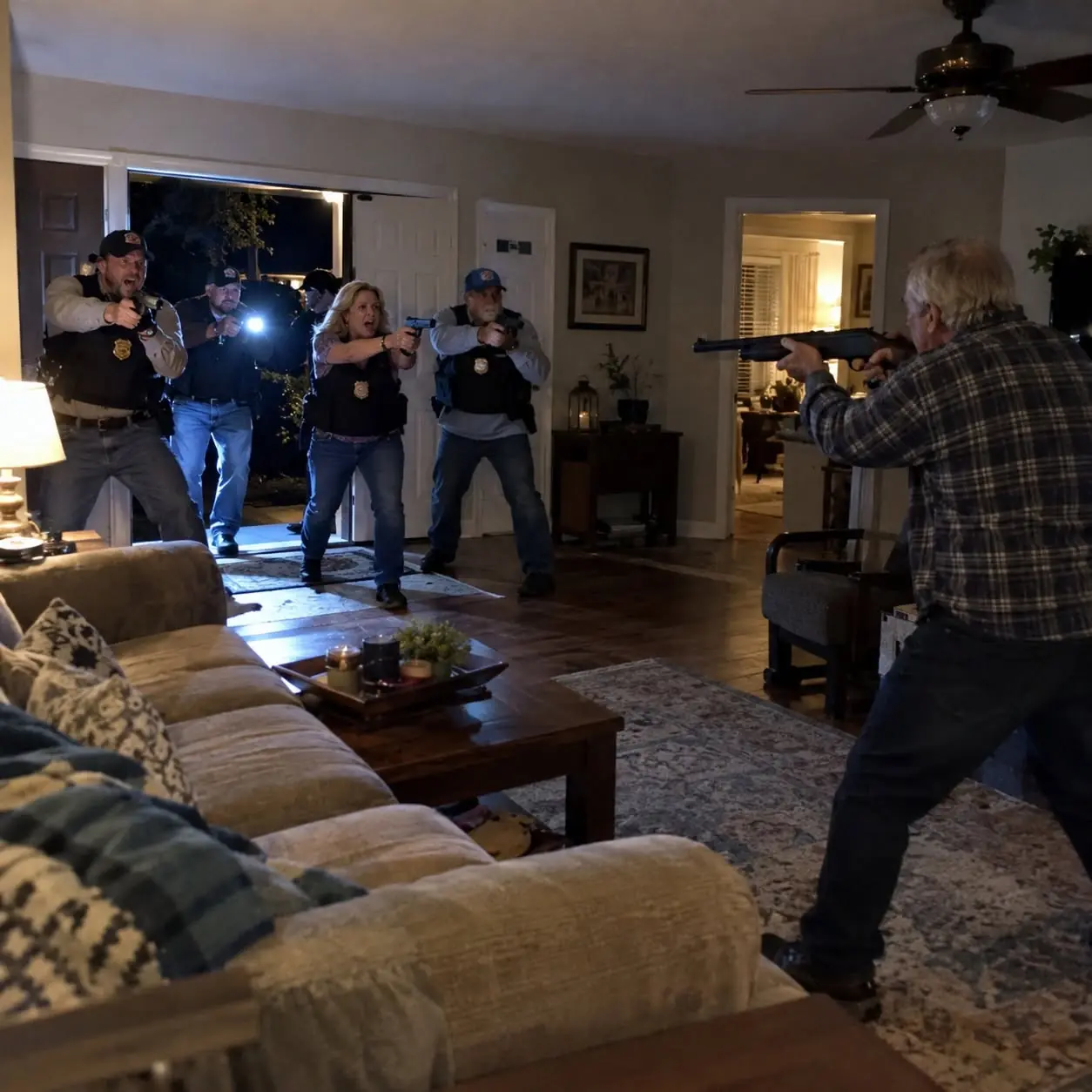
James was already in the living room by then, standing near the couch in his plaid shirt, his back to the fireplace, the shotgun held steady in both hands and pointed at the floor in front of him, not at any man, but ready. The room was dim, lit only by the lamp on the side table and the white security light spilling in through the open doorway. The five men crowded into the entrance, their faces flushed, their chests heaving, their eyes wide with adrenaline and surprise at finding the old man waiting for them instead of cowering in his bedroom.
Roy Beckett was in front, the heavyset chief, fifty-eight years old, his face red, his navy shirt stretched tight across his belly, the flashlight still in one hand and the short-handled shovel in the other. Behind him stood Clint Foster, forty-four, holding the crowbar up like a club. Eddie Marsh, thirty-nine, had the bolt cutters gripped in both hands. Paul Sorensen, fifty-two, still had his phone in his hand, the camera light glowing. And Glen Yates, forty-seven, stood at the back, his hand resting proudly on the plastic badge clipped to his belt, as if it were real.
For a moment, no one spoke. The only sound in the house was the ticking of the clock on the mantel and the heavy breathing of five men who had just run across a yard in the dark. James looked at each of them in turn, his expression calm, his voice low and even when he finally spoke.
Gentlemen, he said. You are in my home, in the middle of the night, with tools in your hands. You are on camera. Every camera on this property is recording, and every second of it is being saved somewhere you cannot reach. I suggest you think very carefully about your next move.
Roy Beckett laughed, but the laugh was thin and nervous, and it died quickly in the quiet room. You think a camera scares us? he said, taking a step forward, the shovel rising slightly in his hand. We are HOA Enforcement. We have authority here. You have ignored every warning. You have ignored every fine. Tonight, we enforce compliance.
James did not move. He did not raise the shotgun. He did not need to. His stillness was more powerful than any shout. He had seen men like Roy Beckett before, men who mistook volume for strength and a title they gave themselves for real power. He knew that the moment you shouted back, you lost control. The moment you panicked, you gave them what they wanted. So he stayed calm, and he let the silence do the work.
There is no such thing as HOA Enforcement, James said quietly. There is a homeowners association. There are fines. There are lawyers. There is a court. There is no unit. There is no chief. There is no right to break into a man’s home at one in the morning. What you are doing right now is called home invasion, and in the state of Georgia, that is a very serious crime.
Clint Foster shifted his weight, the crowbar dipping slightly. Eddie Marsh glanced at the open door behind him, as if he were already thinking about how fast he could get back through it. Paul Sorensen lowered his phone. Only Glen Yates stood his ground, his chin lifted, his hand still on his plastic badge.
We have a warrant, Glen said, but his voice cracked on the last word, and even Roy did not turn to back him up.
You do not, James said. You have a piece of paper from a homeowners association. That is not a warrant. A warrant comes from a judge. A warrant is served by law enforcement. You are not law enforcement. You are five neighbors who bought matching shirts and decided to play police. And you picked the wrong house.
The tension in the room was thick enough to cut. James could see it in their faces, the way bravado was giving way to doubt, the way the adrenaline that had carried them across the yard was starting to fade, leaving behind the cold realization that they were standing in a dark living room facing a man who was not afraid of them. He could see Roy Beckett calculating, weighing whether to push forward or back out, whether the shovel in his hand was worth what came next. He thought about Eleanor’s flowers crushed under their boots, about the planter shattered on his walkway, about the door they had just broken, and he felt anger rise in his chest, hot and sharp, but he pushed it down. Anger was what they wanted. Anger would give them an excuse. Calm was his weapon now, and he intended to use it.
Outside, a car passed slowly on the street, its headlights sweeping across the front windows. A dog barked somewhere down the block. The neighborhood was waking up, one light at a time, as neighbors peered through curtains at the strange scene unfolding at the Harris house. James knew that every minute these men stayed in his home, the worse it would be for them. He also knew that the longer they stayed, the greater the chance that someone would do something stupid, and he did not want anyone to get hurt tonight, not even them.
Put the tools down, James said, his voice still calm, still steady. Walk out of my house. Go home. If you leave now, I will let the sheriff decide what happens next. If you stay, you will have to live with whatever happens next, and I promise you, you will not like it.
Roy Beckett stared at him, his jaw working, his face turning a deeper shade of red. For a moment James thought the man might actually swing the shovel. He tightened his grip on the shotgun, ready to defend himself if he had to, praying he would not have to. Then, from somewhere in the darkness behind the men, a new sound cut through the standoff.
Sirens, distant at first, then growing louder, coming fast down the street toward Pinewood Estates.
Paul Sorensen turned pale. Eddie Marsh took a step backward toward the door. Clint Foster lowered the crowbar to his side. Glen Yates took his hand off his badge. Roy Beckett stood frozen, the shovel still in his hand, his eyes darting from James to the door and back again, as if he could not decide which threat was worse.
James allowed himself the smallest hint of a smile, though there was no humor in it. That will be Sheriff Dan Whitaker, he said. I called him before I came downstairs. He is not going to be happy about this. None of you are going to be happy about this. But you are going to have to explain yourselves to a real sheriff now, not to an old man you thought you could frighten in the dark.
The sirens wailed closer, red and blue light beginning to flash across the front windows, painting the living room in alternating colors. The five men stood in the doorway of James Harris’s home, trapped between the calm old man with the shotgun and the real law coming up the driveway, and for the first time that night, they finally understood what they had done. They had come to enforce compliance. Instead, they had walked into a trap they had built for themselves, one camera, one photograph, one broken flower at a time.
James did not lower the shotgun. He did not move. He simply waited, as he had waited so many times before in his career, for the professionals to arrive and take over. He had survived the night without firing a shot. Now the real work would begin.
Chapter 2 - The Mailbox War
Three months before five men broke into his house at one in the morning, James Harris stood at the end of his driveway on a bright Saturday in late spring, holding a letter from the Pinewood Estates Homeowners Association, and he knew, with the quiet certainty of a man who had spent forty years reading people, that this was not really about a mailbox at all.
The letter was printed on heavy white paper with the association’s logo at the top, a neat little drawing of pine trees and a house that looked nothing like any house in Pinewood Estates. It was addressed to Mr. James Harris, and it was signed by Veronica Lane, president of the Pinewood Estates HOA. The language was polite on the surface, but underneath the politeness there was a threat, the way there always was with Veronica Lane when she wanted something done her way.
Dear Mr. Harris, the letter began. This notice serves to inform you that your mailbox is in violation of Section 4.2 of the Pinewood Estates Covenants, Conditions, and Restrictions. Your current mailbox does not conform to the approved style, color, and placement standards. You are required to replace it with an approved model within fourteen days of receipt of this notice. Failure to comply will result in fines of fifty dollars per day until the violation is corrected.
James read the letter twice, then folded it carefully and put it in his shirt pocket. He looked at his mailbox. It was the same mailbox that had stood at the end of his driveway for twenty-two years, the same mailbox Eleanor had picked out when they first moved into the house, a sturdy black metal box on a wooden post that James had built himself and painted every spring. The paint was a little faded now, and one hinge squeaked when you opened it, but it was solid, and it worked, and the mail carrier had never complained about it. The numbers on the side were clear. The flag worked. There was nothing wrong with it except that it was not new, and it was not the exact model Veronica Lane had decided everyone in Pinewood Estates should have.
He had heard about the new mailbox rule at the last association meeting, a meeting he had not attended because he had been at the cemetery visiting Eleanor, placing fresh flowers on her grave on what would have been their forty-fifth wedding anniversary. Veronica Lane had stood up in front of the room and announced that Pinewood Estates needed a uniform look, that the neighborhood had to maintain its property values, that every home would be required to install the same approved mailbox, a sleek black box on a matching black post that cost one hundred and eighty dollars from a company Veronica Lane’s brother-in-law happened to own. No one had objected, because no one ever objected to Veronica Lane in public. She was sixty-one years old, sharp-eyed and sharp-tongued, with silver hair pulled back in a tight bun and a voice that could cut through a room like a knife. She had been president of the HOA for nine years, and she ran it the way she ran everything else in her life, as if it were her personal kingdom and everyone else was just living in it by her permission.
James had not thought much about the mailbox rule when he first heard about it. He had filed the notice away with the other association mail and gone back to his garden. He had more important things to think about than a mailbox. Eleanor’s flowers were coming up, the pink azaleas she had loved and the white gardenias that filled the yard with scent in the evenings, and he spent his mornings tending them the way she had taught him, talking to them softly as he worked, remembering her hands in the dirt beside his.
But Veronica Lane did not forget. Two weeks after the first letter, a second letter arrived. This one was less polite. The fine had started. Fifty dollars a day, the letter said. Your account is now past due in the amount of seven hundred dollars. Please remit payment immediately and replace your mailbox to avoid further penalties.
James sat at his kitchen table with the second letter in front of him, a cup of coffee growing cold beside him, and he did the math in his head. Seven hundred dollars for a mailbox that worked perfectly well. Seven hundred dollars because Veronica Lane wanted every mailbox in the neighborhood to match. He thought about Eleanor, about how she would have laughed at the absurdity of it, about how she would have told him to just buy the new mailbox and be done with it, because life was too short to fight over a box on a post. But Eleanor was gone, and James was not the same man he had been when she was alive. He had spent forty years enforcing the law, and he knew the difference between a lawful order and a bully with a letterhead. This felt like the second one.
He called Veronica Lane the next morning. He was polite. He was calm. He explained that his mailbox was functional, that it had been there for twenty-two years without a complaint, that he was a veteran and a retired federal law enforcement officer living on a fixed pension, and that he did not believe a fifty-dollar-a-day fine for a working mailbox was reasonable or fair. He asked if there was a way to appeal, if the board would consider a grandfather clause for long-time residents, if there was any room for common sense.
Veronica Lane listened without interrupting, and when he finished, she said, in a voice as cold as January rain, Mr. Harris, the rules are the rules. They apply to everyone. If you do not like them, you are free to move. Pinewood Estates is a community of standards. We do not make exceptions for sentiment.