It came on a Friday night, late, when the rain had started to fall in a thin, cold drizzle over Pinewood Estates. James had gone to bed just after ten, tired from a day of yard work and paperwork, and he had fallen into a deep sleep for the first time in weeks, the sleep of a man who believed the law had finally done its job. He woke to a sound he knew instantly, a sound that cut through the rain and the dark like a blade, the sharp crack of wood giving way downstairs. His eyes opened in the darkness, his heart hammering, and for a moment he lay still, listening, hoping he had dreamed it. Then he heard it again, a scuffling, a grunt, the sound of a man moving fast through his living room, and he knew that someone was in his house again, despite the restraining order, despite the sheriff, despite everything.
He moved without turning on a light, the way he had moved a hundred times in his working life, sliding out of bed in his shirt and trousers, his bare feet silent on the floor. He did not reach for the shotgun in its cabinet. He reached for the heavy flashlight on his nightstand and for his phone, and he slipped into the hallway, his back against the wall, listening hard. The rain drummed against the roof. A floorboard creaked below. Then a voice, low and furious, muttered something James could not quite make out, and he knew that voice. He had heard it shouting through his door at one in the morning. Clint Foster, forty-four years old, the man with the crowbar, was in his house again, alone this time, or so it seemed, and he was not here to deliver a notice.
James came down the stairs slowly, one step at a time, keeping his weight on the edges of the treads so they would not groan. The living room was dark except for the faint glow of the porch light coming through the curtains, and in that glow he could see the shape of a man near the front door, a crowbar in his hand, his shoulders hunched as he worked at the door frame. James switched on the flashlight, and the beam cut across the room like a searchlight, landing full on Clint Foster's face. Foster froze, his eyes wide, his mouth open, the crowbar raised halfway. James spoke in a voice that was low and steady and carried all the authority of forty years in federal law enforcement. He told Foster to put the crowbar down, to step away from the door, to leave his house right now, and he told him the police were already on their way. It was a lie, but it was the right lie, and for a second James thought it might work.
Foster did not put the crowbar down. He lunged instead, fast and desperate, swinging the crowbar in a wide, clumsy arc toward James's head. James threw up his left arm to block it, and the steel caught his shoulder with a force that drove him back a step, pain exploding down his arm and into his chest. He stumbled, his foot catching on the edge of the rug, and he went down hard on one knee, the flashlight clattering across the floor, its beam spinning wildly across the ceiling. Foster came at him again, shouting now, his face red with anger and fear, and James, seventy years old and hurt and on the floor of his own living room, did what forty years of training had taught him to do. He did not panic. He drove forward with his good shoulder, catching Foster low around the waist, and the two men went down together in a tangle of arms and legs on the rug Eleanor had chosen years before.
They struggled on the floor, Foster thrashing, James holding on, the crowbar clattering away across the wood. Foster was younger and stronger, but James was heavier in the way that mattered, and he had spent a lifetime learning how to hold a man who did not want to be held. He got an arm around Foster's neck, not to choke him but to control him, and he pinned him with his weight, talking the whole time in a low, furious voice, telling him to stop, telling him it was over, telling him the sheriff was coming. Foster bucked and twisted, his elbow catching James across the forehead, opening a cut that bled hot and fast down into his eye, blinding him on one side. James felt the blood, felt the pain in his shoulder growing sharper with every movement, but he did not let go. He held Foster down on the floor of his living room, both men breathing hard, the rain still falling outside, the flashlight still rolling in a slow circle on the floor, until the sound he had been waiting for finally came, the wail of a siren growing louder down the street.
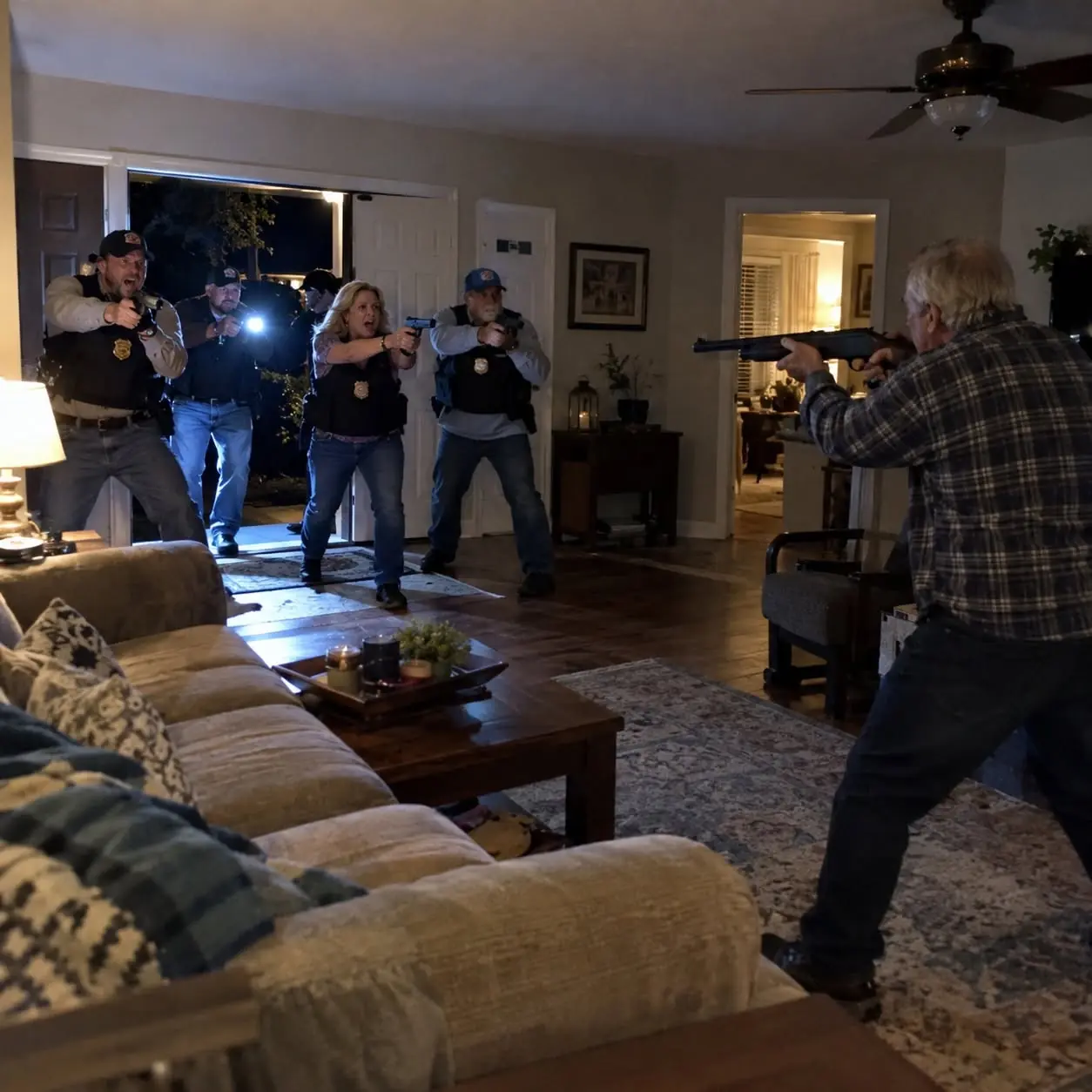
Deputy Rosa Delgado came through the front door first, her weapon drawn, her voice sharp and clear, ordering both men to freeze. Behind her came another deputy, and behind him came Sheriff Dan Whitaker himself, his face grim in the flashing light. James let go of Foster slowly, raising his good hand, his other arm hanging useless at his side, blood running down his face from the cut on his forehead. Delgado moved fast, pulling Foster to his feet, turning him around, snapping handcuffs on his wrists while he shouted that James had attacked him, that he had only come to talk, that this was all a misunderstanding. No one in the room believed him. The crowbar lay on the floor beside the broken door frame. The cameras in the corners blinked their red lights, recording everything. The sheriff looked at James, at the blood and the swelling shoulder, and his face hardened into something James had seen before, the face of a lawman who had just watched a court order get torn up in front of him.
The paramedics came next, and they sat James down on his own sofa, the same sofa where he had sat with Eleanor a hundred evenings, and they cleaned the cut on his forehead, pressing gauze against it until the bleeding slowed. They examined his shoulder carefully, moving his arm gently, asking him to rate the pain, and they told him he was lucky. The shoulder was badly bruised, not broken, and the cut on his forehead would need stitches but was not life threatening. James nodded, wincing as they worked, and he told them he was fine, that he had been hurt worse in his working life, and the paramedic smiled a little and told him that seventy-year-old men were not supposed to wrestle intruders on their living room floor. James almost laughed, and then he winced again, because laughing hurt his shoulder. He asked about Foster, and Delgado told him Foster was in the back of the patrol car, under arrest for burglary and violation of the restraining order and assault, and that he would be spending the night in the county jail.
Then Delgado told him the other part, the part that made James's jaw tighten despite the pain. Foster had not come alone. A second man had been waiting outside in a car at the end of the street, watching the house, ready to drive if things went wrong. When the sirens came, that man had started the car and driven away fast, too fast for the deputies to catch in the rain. Delgado did not need to name him. James knew. Roy Beckett, fifty-eight years old, heavyset, the self-styled chief of the fake enforcement unit, the man with the flashlight and the short-handled shovel, had fled the scene while his man was inside the house. He had left Clint Foster behind to face the sheriff alone, and James understood exactly what that meant. Beckett was not a leader. He was a coward who sent other men to do his work and ran when the work got dangerous.
Sheriff Whitaker stayed with James after the paramedics left, sitting across from him in the living room, the broken door frame behind them, the rain still falling outside. He told James that Foster would be charged, that the violation of the restraining order alone would be serious, and that the assault would add to it. He told him that Beckett's flight would not help Beckett, that running from a crime scene told a jury everything it needed to know. He asked James if he wanted to go to the hospital, and James said no, that he would go in the morning if the shoulder got worse, that right now he wanted to stay in his own house. Whitaker nodded, and he posted a deputy outside for the rest of the night, and he told James to call him directly if anything else happened, day or night. Before he left, Whitaker looked at the cameras in the corners of the room and said that James's footage would be the backbone of the case, and James nodded, because he knew it was true.
Laura arrived just before dawn, her husband Tom driving, her face white with fear when she saw the blood on her father's forehead and the way he held his shoulder. She hugged him carefully, afraid to hurt him, and she cried a little, and James held her with his good arm and told her he was all right, that it looked worse than it was, that the cut would heal and the shoulder would heal, and that Foster was in jail where he belonged. Tom shook his hand hard, and his eyes were wet too, and James understood that his family had spent the night afraid for him, and that no court order and no camera could take that fear away completely. Walter Briggs came over as soon as the sun was up, moving faster than James had seen him move in years, and he stood in the living room looking at the broken door frame and the blood on the rug, and he said nothing for a long time. Then he said that Roy Beckett had better hope the sheriff found him before the neighbors did, and James told him, firmly, that no one was to go looking for Beckett, that the law would handle it, and Walter nodded, though his hands were shaking with anger.
By morning, the whole of Pinewood Estates knew. The second break-in, the injury, the arrest, the flight, it moved through the neighborhood faster than any HOA notice ever had, and this time there was no dividing line, no quiet looking away. Neighbors James had barely spoken to came to his door with food and offers of help, and the man across the street who had watched his house from his window came over and apologized, saying he had been wrong to stay silent. James thanked them all, his shoulder throbbing, his forehead stitched and bandaged, and he told them the same thing he had told Walter, that the law would handle it, that no one needed to take matters into their own hands. But underneath the gratitude, underneath the pain, James felt something else settling in his chest, something cold and certain. The men who had come to his house had stopped pretending this was about a mailbox. They had come back after a judge told them to stop, they had hurt him in his own living room, and one of them had run. Whatever happened next, James knew, would not be a neighborhood dispute anymore. It would be a reckoning, and Roy Beckett, wherever he was hiding, had just made it inevitable.
Chapter 10 - The Developer
Carl Whitfield did not come to James Harris's house. He came to Angela Price's office, on a Tuesday morning when the rain had finally stopped and the air over Cedar County smelled clean again, and he came alone, without a lawyer, without a phone call beforehand, his hands shaking so badly that he could barely hold the door open. Angela's assistant tried to stop him in the lobby, but Angela heard his voice from her office, heard the panic in it, and she came out herself and looked at him for a long moment. Carl Whitfield was the treasurer of the Pinewood Estates homeowners association, a man in his sixties who had always been quiet at board meetings, the man who signed the checks and kept the books and never raised his voice. Now his face was gray, his shirt was damp with sweat, and his eyes kept darting toward the door behind him, as if he expected someone to follow him in. Angela brought him into her office, closed the door, offered him water, and told him to sit down. He sat, and he did not drink the water, and he said, in a voice that cracked, that he needed to tell the truth before it was too late.
James arrived twenty minutes later, his shoulder still stiff from the fight with Clint Foster, the stitches in his forehead still fresh under a small bandage, moving a little slower than usual but his eyes sharp. Angela had called him the moment Whitfield sat down, and James had driven straight to her office, his mind already working through what this could mean. A frightened treasurer did not walk into a lawyer's office alone unless he had something to confess, and a man who had kept the books for an association with a hundred and eighty thousand dollars missing had a great deal to confess. James sat across from Whitfield, not speaking, letting Angela lead, the way a good investigator let a witness find his own way to the truth. Whitfield looked at James, at the bandage, at the bruised shoulder held carefully against his side, and his face crumpled. He said he was sorry. He said it twice, and he meant it, and James believed him, because sorry from a frightened man sounded different from sorry from a guilty man trying to save himself. This was the sound of a man who had finally understood what he had helped to do.
Whitfield started at the beginning, and the beginning was not a mailbox. The beginning, he said, was a map. He had seen it in Veronica Lane's office more than a year earlier, spread across her desk, a developer's map of the land around Pinewood Estates, with a new subdivision drawn in careful lines on the far side of the neighborhood. The development needed an access road, a wide, straight road that would run from the main highway through to the new houses, and the only route that made sense, the only route that would not cost a fortune in land and permits, ran straight through the edge of Pinewood Estates. It ran, Whitfield said, looking down at his hands, straight through James Harris's lot. His house sat on the corner where the road needed to turn, and his yard, the yard where Eleanor had planted her flowers, was the exact piece of ground the developer needed to make the whole project work. Without that lot, the road would have to bend around the neighborhood, adding cost and time and cutting the number of houses the developer could build. With that lot, the road was simple, and the profit was enormous.
The developer's name was Nathaniel Cross. Whitfield said it slowly, as if the name itself were heavy, and Angela wrote it down. Cross was a property developer from Atlanta, a man who built subdivisions all over Georgia, a man with money and connections and no patience for obstacles. He had come to Veronica Lane a year ago, Whitfield said, with an offer that was not really an offer. He would buy James Harris's lot, but only if he could buy it cheap, far below what it was worth, because a man who was forced to sell did not get to name his price. Cross had told Veronica Lane that if she could make life in Pinewood Estates unbearable for James, if she could fine him and threaten him and frighten him until he wanted to leave, Cross would pay for the trouble. He would pay the association, and he would pay Veronica Lane personally, and the money would be hidden in the association's accounts, moved through fake repairs and inflated contracts and vendor payments that never bought anything at all.
James listened without moving, his good hand resting flat on the table, his face giving away nothing, though inside he felt the pieces falling into place with a terrible clarity. The mailbox dispute, the fines, the twelve thousand four hundred dollars, the lien threat, it had never been about a mailbox. It had been about a road. It had been about a developer who wanted his land and a homeowners association president who was willing to sell her neighbor's peace to get a share of the profit. Whitfield went on, his voice shaking, describing the payments, small at first and then larger, money that came in from companies tied to Nathaniel Cross, money that went out again to Veronica Lane and to men who did her work, money that never appeared in the reports shown to the homeowners. A hundred and eighty thousand dollars, Whitfield said, and the number hung in the air between them, the same number James and Angela had found in the records, the same number that had never added up. It was not a mistake. It was not bad bookkeeping. It was kickbacks, paid to force a seventy-year-old widower out of the house he had shared with his late wife.
Angela asked the questions then, calmly, one after another, the way she had questioned witnesses in court. How much had Veronica Lane received. Whitfield said he did not know the exact split, but he had seen transfers, and he had signed papers he should not have signed, and he believed Veronica Lane had taken the largest share. How much had Roy Beckett and the others received. Whitfield said Beckett had been paid to organize the enforcement unit, to recruit the men, to make the threats, to do the work that Veronica Lane did not want to do herself. Clint Foster and Eddie Marsh and Paul Sorensen and Glen Yates had been paid smaller amounts, enough to make them feel important, enough to make them believe they were real law enforcement. Whitfield said he had warned Veronica Lane, more than once, that the plan would go too far, that men like Beckett did not know when to stop, but she had laughed at him, and she had told him that James Harris was just an old man, and that old men gave up easily. She had been wrong about that, Whitfield said, looking at James, and she had been wrong about a great many things.
Whitfield told them about the night of the break-in, that Veronica Lane had known the men were going to James's house, that she had approved the plan, that she had told Beckett to scare James badly enough that he would start thinking about selling. He told them about the tires and the note, that Beckett had reported back proudly, that Veronica Lane had called it progress. He told them about the court hearing, that Veronica Lane had been furious about the restraining order, that she had hired the slick lawyer from Atlanta with money from the association, and that she had told Beckett the order did not matter, that judges did not run Pinewood Estates. He told them about the second night, that Foster had gone back on Beckett's orders, that Beckett had waited in the car outside, and that when the sirens came Beckett had driven away and left Foster to be arrested alone. Whitfield's voice broke when he said that part, because he had a son Foster's age, and he had finally understood that the men he had helped pay were not a team. They were tools, and Veronica Lane and Nathaniel Cross had been willing to throw them away.
When Whitfield finished, the room was silent. Angela looked at James, and James looked at Whitfield, and for a moment no one spoke. Then James spoke, quietly, his voice steady despite the pain in his shoulder and the anger rising in his chest. He asked Whitfield why he was telling them this now, why today, after all this time, and Whitfield looked up at him with wet eyes and said that Clint Foster was in jail, that James had been hurt in his own living room, that Roy Beckett had run, and that he could not sleep anymore. He said he had joined the board to help his neighbors, not to help a developer steal a man's home, and that he had watched it go too far and had done nothing, and that doing nothing had made him part of it. He said he was ready to tell the truth to the sheriff, to the FBI, to anyone who would listen, and that he had brought papers to prove it, bank records and emails and copies of the map, hidden in a bag under his car seat because he was afraid to keep them at home.
Angela took the bag, and she and James looked through the papers together, page after page of transfers and messages and invoices that told the story Whitfield had just told, in black and white, in numbers that could not be argued with. There was the developer's map, with James's lot marked in red. There were emails from Nathaniel Cross to Veronica Lane, polite on the surface, ruthless underneath, talking about timelines and acquisitions and the need to resolve the Harris problem. There were payments to companies that did not exist, and payments from those companies to accounts controlled by Veronica Lane. There was a message from Veronica Lane to Roy Beckett, telling him to increase the pressure, to make James understand that Pinewood Estates did not want him anymore. James read each page slowly, his jaw tight, and he thought about Eleanor, about the flowers crushed in the yard, about Laura followed home from the grocery store, about the blood on his own living room rug, and he understood, finally and completely, that none of it had been random. It had all been a plan, and the plan had a name at the top of it. Nathaniel Cross.
That afternoon, Angela called Sheriff Dan Whitaker, and Whitaker called Special Agent Frank Calloway, and by evening the three of them were sitting in Angela's office with Whitfield, going through the papers again, this time with a federal agent taking notes. Calloway listened to Whitfield's story without interrupting, asking short, precise questions, the questions of a man who had built a hundred cases just like this one. He told Whitfield that coming forward was the right thing to do, and that cooperating fully was the only way to protect himself now, and Whitfield nodded, his hands still shaking but his voice a little steadier. Calloway told James and Angela that the case had changed again, that it was no longer just about impersonation and a break-in, that it was now about a conspiracy to force a man from his home for profit, about fraud and kickbacks and the misuse of a homeowners association to serve a developer. He said the FBI would move carefully but quickly, that they would verify the papers, follow the money, and prepare charges against Veronica Lane and Nathaniel Cross and Roy Beckett, and against anyone else the evidence touched.