As the sun set over Cedar County, James stood outside Angela's office with Frank Calloway, his shoulder aching, his forehead throbbing under the bandage, looking out at the street where ordinary people were driving home from ordinary days. Frank put a hand on his good shoulder, carefully, and told him that this was the hardest part of a case, the waiting, the moment when the truth was known but the arrests had not yet been made. He told James to stay close to home, to keep his cameras running, to let the sheriff and the FBI do their work, and to trust that the men who had tried to take his house were about to learn what real law enforcement looked like. James nodded, and he thanked Frank, and he thought about the house waiting for him in Pinewood Estates, the house he had shared with Eleanor, the house with the new seedlings in the flower bed and the broken door frame waiting to be repaired. It was still his house. It had always been his house. And now, for the first time since the night the five men had come through his door, James Harris believed that the people who had tried to take it from him were finally going to answer for it, not in a neighborhood meeting, not in a courtroom argument about a mailbox, but in a federal case that would follow the money all the way to the top.
Chapter 11 - The Grand Jury
The federal courthouse in Atlanta did not look like a place where a man could get his life back. It looked like a place where lives were sorted into files and filed away. James Harris stood on the sidewalk outside it on a Tuesday morning in late spring and looked up at the stone facade, the tall windows, the flag moving slow in the warm Georgia air. He had been inside buildings like this a hundred times in his career, sometimes as a witness, sometimes as the marshal who brought a prisoner through the side door, sometimes as the man who stood at the back of the courtroom while a judge read a sentence. He had never stood outside one as a victim, waiting to tell a grand jury what five men had done to him in his own living room at one in the morning. He was seventy years old, and he had thought his days of testifying were finished. He had thought he had retired to Pinewood Estates to grow his late wife Eleanor's flowers and to be quiet. He was wrong about the quiet part. He was not wrong about the flowers. He would get back to them, but first he had to finish this.
Angela Price stood beside him, holding a leather folder against her chest, her dark suit crisp despite the heat. She had been his lawyer since the night the HOA had tried to fine him twelve thousand four hundred dollars for defending his own home, and she had become something more than a lawyer in the weeks since. She was the person who called him back. She was the person who explained what would happen next before it happened. She was the person who had won the temporary restraining order that had kept Veronica Lane and her people away from his door while the larger case was built. Now she looked at the courthouse the way a carpenter looks at a house she has helped frame. She knew every beam in it.
"You do not have to be nervous," she said. "You have told this story to Sheriff Whitaker. You have told it to Agent Calloway. You have told it to me. A grand jury is just another room with people listening."
"I am not nervous," Harris said. "I am impatient. I have waited a long time for this part."
Frank Calloway came down the steps to meet them, his suit jacket open, his tie loosened a little, looking like a man who had been in the building since before dawn. He and Harris had worked fugitive operations together decades earlier, when they were both young men who could run up stairs without thinking about their knees. Calloway had opened the federal angle when the local case had grown too big for a county sheriff's office alone, when the impersonation of law enforcement and the conspiracy and the fraud had all braided together into something that belonged in federal court. He shook Harris's hand the way old colleagues do, firm and brief, no wasted motion.
"They are ready for you," Calloway said. "The prosecutor will walk you through it. Answer what you know. Do not guess. Do not add color. The facts are enough. The facts have always been enough."
Inside, the air was cool and smelled faintly of floor polish and paper. They went through security, through a hallway lined with portraits of judges Harris did not know, and into a waiting room where a young woman with a notepad offered Harris a cup of water. He took it and held it in both hands. His shoulder still ached sometimes where Clint Foster had slammed him against the doorframe during the second break-in, and the cut on his forehead had healed to a thin pale line that he could feel when he frowned. He did not mind the scar. It was a reminder that he had held his ground twice in his own house and that he was still standing.
Angela sat beside him and opened her folder. Inside were copies of the documents that had built the case piece by piece. The HOA fine notice for twelve thousand four hundred dollars. The lien threat. The bank records Carl Whitfield had turned over, showing about one hundred eighty thousand dollars that could not be accounted for. The photographs of the crushed flower beds Eleanor had planted. The still frames from the security cameras, showing five men in matching navy shirts with HOA ENFORCEMENT UNIT written crooked across the backs, carrying a crowbar and bolt cutters and a short-handled shovel, one of them with a plastic badge clipped to his belt. The footage had been copied offsite the night it happened, and every copy was intact. That was the part Harris was proudest of, though he would never say so out loud. He had spent four decades learning how evidence worked, and on the worst night of his retirement he had remembered every lesson.
"The grand jury will hear from you first," Angela said quietly. "Then from Whitfield. Then from Sheriff Whitaker and Agent Calloway. The prosecutor has the financial records ready. She has the camera footage ready. She has the text messages and the emails Whitfield gave us, the ones that show Veronica Lane and Nathaniel Cross planning to force you out so Cross could buy your lot cheap for an access road. It is a strong case, James. It is not a close case."
Harris nodded. He thought about Eleanor, about the way she had loved that garden, about the spring mornings when she had knelt in the dirt with her gloves on and told him which flowers would bloom first. He thought about the night the men had crushed those flowers under their boots as if they were nothing. He thought about his daughter Laura, thirty-eight years old, a mother herself now, who had driven to his house in the middle of the night after the first break-in and sat with him at the kitchen table until dawn because she was afraid to leave him alone. He thought about Tom Bennett, his son-in-law, who had fixed the broken lock on the back door without being asked. He thought about Walter Briggs, seventy-two, his neighbor, who had stood on his own porch with a flashlight and watched the street after the tires were slashed and the threatening note was left. All of those people were part of this case too, even if they would never sit in the witness chair. They were the reason it mattered.
When the door opened and a clerk called his name, Harris stood up straight, set the empty water cup down, and followed her into the grand jury room. It was a plain room, no windows, a long table, twenty-three citizens sitting in rows, some older, some younger, all of them looking at him with the careful attention of people who knew they were being trusted with something serious. The prosecutor, a woman named Diane Mercer, stood and introduced him. She was calm and direct, and she did not waste time on speeches.
"Mr. Harris," she said, "please tell the jury what happened on the night of the break-in, in your own words."
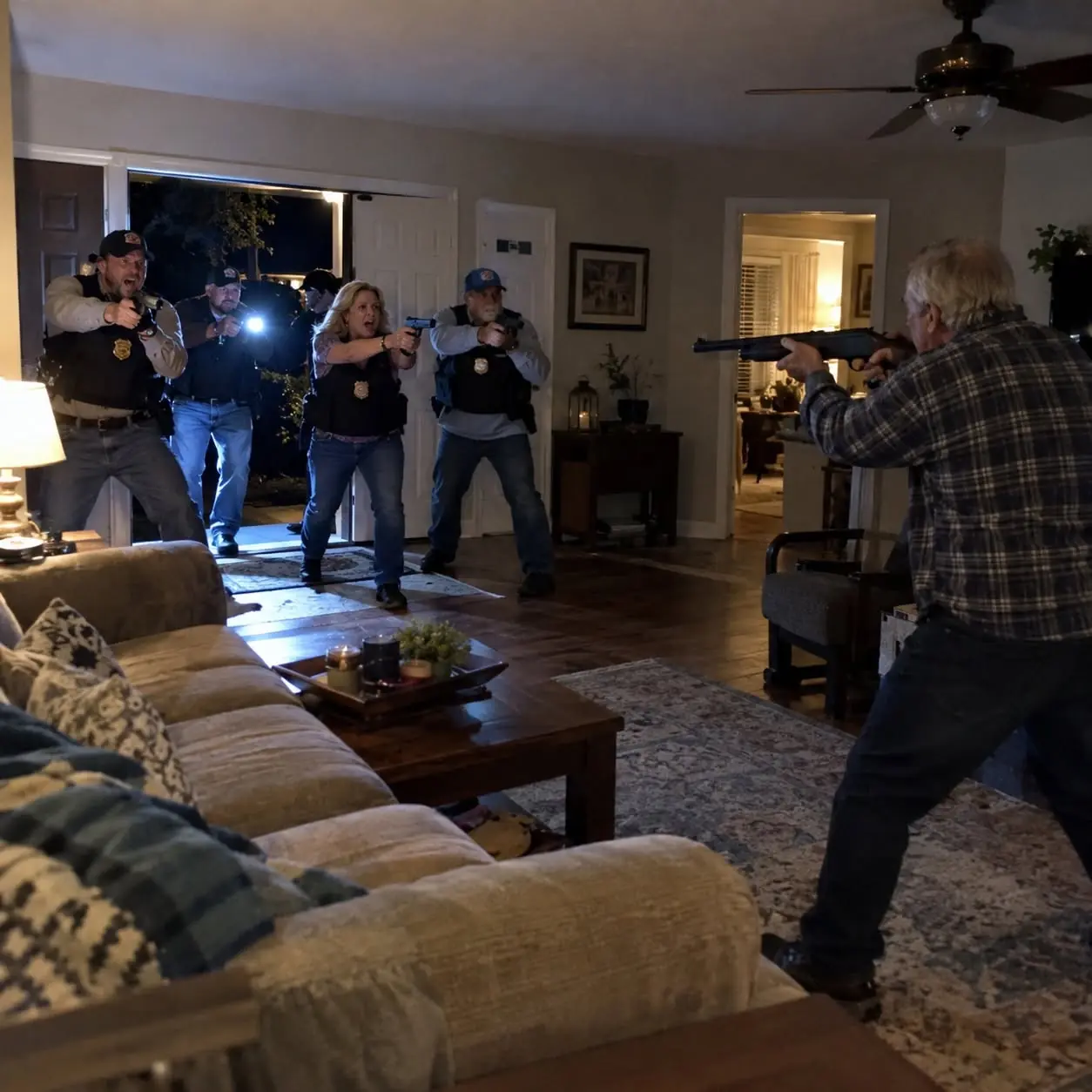
Harris told it the way he had told it before, slowly and clearly, without exaggeration. He told them about the shout at a little after one in the morning, the three blows against his siding, the security lights snapping on, the five men crossing his yard in matching navy shirts. He told them about the crowbar in Clint Foster's hands, the bolt cutters in Eddie Marsh's hands, the plastic badge on Glen Yates's belt, the flashlight and the short-handled shovel in Roy Beckett's hands. He told them about the flowers crushed under their boots, the planter kicked off the porch, the photographs taken of his windows. He told them about the moment he had come downstairs in his plaid shirt with his shotgun, not to shoot anyone, but to make it clear that he was not a frightened old man who would open his door and surrender his home. He told them that no one had fired, that he had held his ground, that every camera and microphone had been recording, and that the footage had been copied somewhere the intruders could never reach.
The jurors listened without interrupting. One woman in the second row wrote something down. An older man in the back nodded slowly when Harris described the plastic badge. When Harris finished the account of that first night, the prosecutor asked him about what had come after. He told them about the fine and the lien threat, about the tires slashed in his driveway, about the threatening note left on his door, about Laura being followed when she came to check on him. He told them about the second break-in, when Clint Foster had come back alone and Harris had suffered the bruised shoulder and the cut forehead, and how Foster had been arrested that night while Roy Beckett had fled. He told them about Carl Whitfield, the HOA treasurer, who had finally come forward and told the truth about the missing money and about Veronica Lane and Nathaniel Cross and the plan to force him out so Cross could buy the lot cheap for an access road.
"Mr. Harris," the prosecutor asked, "in your forty years as a United States Marshal, did you ever see real law enforcement officers conduct a raid the way these men conducted theirs?"
"No, ma'am," Harris said. "Real authority rarely needs theater. Professionals do not scream about how powerful they are. They do not buy plastic badges. They do not invent titles. And they definitely do not storm a seventy-year-old man's backyard at one in the morning because they are angry about a mailbox."
A few of the jurors smiled at that, just a little, and then caught themselves. Harris did not smile. He was not there to be charming. He was there to be believed.
"Thank you, Mr. Harris," the prosecutor said. "That is all for now."
Harris stood, thanked the jury, and walked out. In the hallway, Angela was waiting with Calloway. Neither of them asked him how it went. They could see it in his face. He had told the truth, and the truth had landed.
Carl Whitfield went in next. Harris did not see him go in, but Angela told him later what had happened. Whitfield had been nervous, his hands shaking when he took the oath, but once he started talking about the books, about the money that had disappeared, about the meetings where Veronica Lane had told him to move funds and not ask questions, about the conversations with Nathaniel Cross about the access road and the price they would offer for Harris's lot once he was frightened enough to sell, his voice had steadied. He had brought records. He had brought dates. He had brought the names of accounts. He had done what a cooperating witness is supposed to do, which is to tell the truth completely, even when it makes him look bad, because the truth is the only thing that can save him now.
Sheriff Dan Whitaker testified after Whitfield, describing the investigation, the arrests, the evidence collected at the scene, the way the five men had been identified from the camera footage, the way Foster had been arrested during the second break-in. Deputy Rosa Delgado had been with him on some of those calls, and her reports were part of the file. Whitaker was a plainspoken man, and the grand jury liked plainspoken men. He did not dress anything up. He told them what he had found and what he had done.
Calloway testified last, laying out the federal charges in clear language. Impersonating law enforcement officers. Burglary. Conspiracy. Fraud. He explained how the fake enforcement unit had been used not only to frighten Harris but to give cover to a scheme to steal HOA funds and to force a homeowner out so a developer could profit. He explained that the missing one hundred eighty thousand dollars was not a bookkeeping error. It was kickbacks, moved through accounts Whitfield had helped to hide, paid to people who had agreed to look the other way while Veronica Lane and Nathaniel Cross took what they wanted.
By the time the grand jury went into deliberations, it was late in the afternoon. Harris and Angela and Calloway waited in the hallway, drinking bad coffee from paper cups, saying very little. Harris thought about all the times he had waited outside a courtroom in his career, waiting to hear whether a jury believed what he had seen. He had learned long ago that waiting was part of the job. You did the work, you told the truth, and then you waited for other people to do their part.
The call came just before five o'clock. The prosecutor came out into the hallway, her face calm, her folder tucked under her arm.
"The grand jury has returned true bills on all counts," she said. "Indictments for Veronica Lane, Nathaniel Cross, Roy Beckett, Clint Foster, Eddie Marsh, Paul Sorensen, and Glen Yates. Impersonation, burglary, conspiracy, and fraud, as charged. The United States Attorney has authorized the arrests."
Harris felt something loosen in his chest, something that had been tight since the night the men had shouted at his door. It was not joy. It was relief, the kind that comes when a long road finally turns toward home.
"When will they be arrested?" Angela asked.
"Veronica Lane will be arrested at the HOA meeting tonight," the prosecutor said. "She scheduled it herself. She thinks it is a routine meeting about the budget. The marshals and the sheriff's deputies will be there. We want it done in front of the community she tried to control, so there is no confusion about what happened. Mr. Cross will be arrested at his office at the same time. The others are already in custody or will be picked up tonight."
Calloway nodded. "That is the right way to do it," he said. "Let the neighbors see it. Let them see that the law still works."
Harris drove home that evening with Angela following in her own car to make sure he got there safely. The sun was going down over Pinewood Estates, turning the pine trees gold at the edges. The streets were quiet. Children were riding bicycles. A dog barked somewhere down the block. It looked like an ordinary suburb on an ordinary evening, and for the first time in months, Harris allowed himself to believe it might become one again.
He did not go to the HOA meeting. Angela had advised him not to, and he agreed. He did not need to watch Veronica Lane be led away in handcuffs. He had already seen enough of her. He sat on his front porch instead, in the chair Eleanor had liked, and listened to the evening sounds. Walter Briggs came over from next door with two glasses of iced tea and sat down without asking.
"Well?" Briggs said.
"The grand jury indicted them all," Harris said. "Veronica gets arrested tonight at the meeting. Cross too."
Briggs let out a long breath. "Good," he said. "It is about time."
They sat in silence for a while, drinking their tea, watching the light fade. Down the street, Harris could see cars pulling into the parking lot near the community center where the HOA meeting was held. He could imagine the room inside, the folding chairs, the agenda printed on cheap paper, Veronica Lane at the front table with her gavel, acting as if she still ran the neighborhood. He could imagine the moment the doors opened and Sheriff Whitaker and Deputy Delgado walked in with federal marshals behind them, and the room went quiet, and Veronica realized that the authority she had pretended to have was gone, and the real authority had arrived.
He did not feel sorry for her. He felt sorry for the neighbors who had trusted her, for the people who had paid their dues and believed the money was being used to maintain the community, for the families who had been frightened into silence. Those were the people the indictments were for. Those were the people who deserved to see justice done in the open.
Later that night, Angela called him. Her voice was steady, but Harris could hear the satisfaction underneath it.
"It is done," she said. "Veronica Lane was arrested at the HOA meeting in front of the full board and about forty residents. She did not resist. She asked for her lawyer. Nathaniel Cross was arrested at his office. He tried to argue, but it did not help. The news is already spreading through the neighborhood."
"How did the neighbors react?" Harris asked.
"Some of them cheered," Angela said. "Some of them cried. One woman stood up and said she had been afraid to speak for months. Now she is not afraid anymore."
Harris closed his eyes for a moment. He thought about Eleanor again, about the garden, about the way she had always believed that a neighborhood was supposed to take care of its people. He thought about Laura and Tom and the grandchildren, about the life he still had ahead of him at seventy years old. He thought about the grand jury, twenty-three ordinary citizens who had listened and believed and done their duty.
"Thank you, Angela," he said. "Thank you for believing me from the start."
"You made it easy," she said. "You told the truth, and you had the evidence to prove it. That is what wins cases."
After he hung up, Harris sat on the porch a little longer. The night was warm, and the crickets were loud. The security lights were on, but they were just lights now, not a warning. The cameras were still recording, but they were just cameras now, not the only thing standing between him and men with crowbars. He was still a retired marshal. He was still a widower who missed his wife. He was still a father and a grandfather. But tonight, for the first time since that night at one in the morning, he was also something else. He was a man whose case had been heard, whose story had been believed, and whose fight was finally moving toward an ending he could live with.
Inside the house, the living room was quiet. The shotgun was locked away where it belonged. The plaid shirt he had worn that night was folded in a drawer. The flowers outside were still damaged, still waiting to be replanted, but they would be replanted. That was a promise he had made to himself, and to Eleanor, and he intended to keep it. The grand jury had done its part. The trial would come next. And after the trial, there would be a garden again, and a neighborhood again, and a home again. Harris stood up, finished his tea, and went inside to sleep. For the first time in a long time, he slept without listening for footsteps in the yard.
Roy Beckett, meanwhile, was sitting in a holding cell in Atlanta, frightened in a way he had never been frightened before. He was fifty-eight years old, heavyset, a man who had liked to call himself chief and to carry a flashlight and a shovel as if they were weapons of authority. He had liked the feeling of five men following him across a yard in matching shirts. He had liked shouting at an old man's door. Now the shouting was over, and the cell was quiet, and the only sound was the hum of the lights and the distant echo of a door closing somewhere down the hall. His lawyer had come to see him that afternoon, after the indictments had been returned, and had told him the truth in plain language. The evidence was overwhelming. The camera footage alone would convict him. The financial records would convict him. Whitfield's testimony would convict him. The only way to help himself now was to tell the truth about Veronica Lane and Nathaniel Cross, to turn witness against the people who had used him and his men as a tool to frighten Harris and steal money.
Beckett had not wanted to believe it at first. He had told himself that Veronica would protect him, that Cross had money and lawyers, that the HOA would stand behind him. But as the hours passed in that cell, and as he thought about the years he might spend in prison if he stayed loyal to people who had never been loyal to him, the truth settled in. He had been used. He had been the loudest voice and the biggest man in the room, but he had never been in charge. Veronica Lane had been in charge. Nathaniel Cross had been in charge. He had been the man they sent to do the frightening, and now they would let him take the fall if he let them.
When the prosecutor's investigator came to see him the next morning, Beckett was ready to talk. He told them about the meetings where Veronica had described Harris as a problem who needed to be handled. He told them about the night she had given him the shirts and told him to make Harris understand that the HOA was serious. He told them about the money Cross had promised him if Harris sold the lot cheap. He told them about the phone calls, the instructions, the way Veronica had smiled when he reported back that Harris had not opened the door. He told them everything, because he finally understood that the only way out of the cell was through the truth.
Angela heard about Beckett's decision later that day, and she called Harris to tell him. "Beckett has turned witness," she said. "He is cooperating fully. He will testify against Veronica and Cross at trial. It strengthens our case even more."