James thanked her for her time and hung up the phone. He stood in his kitchen for a long time, looking out at the garden, at the flowers Eleanor had planted, at the oak tree in the front yard that had been a sapling when they moved in. He thought about what Eleanor would have said. She would have said that some fights were not worth fighting, and some were. She would have said that a man had to decide which was which, and then stand his ground. James decided that this was one of the fights worth fighting, not because of the mailbox itself, but because of what it represented. If he gave in to a seven-hundred-dollar fine for a mailbox that worked, what would come next? A fine for the color of his front door? A fine for the flowers in his yard? A fine for the rocking chair on his back porch? He had seen this pattern before, in his work and in life. Bullies did not stop when you gave them what they wanted. They stopped when you stopped giving it to them.
He wrote a letter back to the HOA, polite and firm, stating that he would not pay a fine for a mailbox that was in good working order, and that he requested a formal hearing before the board as provided for in the association bylaws. He sent it by certified mail, so there would be a record. He kept a copy for himself, in a folder in his desk drawer, next to Eleanor’s letters and his retirement papers from the Marshals Service.
The hearing never happened. Instead, the fines kept coming. Fifty dollars a day became one thousand dollars. One thousand became two thousand. Each letter was a little angrier, a little more threatening. The third letter warned of a lien against his property. The fourth letter said his case had been referred to the association’s attorney. The fifth letter, hand-delivered by Carl Whitfield, the HOA treasurer, a thin nervous man in his sixties who would not meet James’s eyes when he handed over the envelope, said that the board had voted to pursue all available remedies, including legal action and foreclosure proceedings if necessary.
Carl Whitfield lingered on the porch after he delivered the letter, shifting from one foot to the other, and finally said, in a low voice, James, I am sorry about this. I voted against the fines. I told Veronica this was going too far. But she controls the board, and no one will stand up to her. She has something she wants, and she will not stop until she gets it. Be careful. She is not just angry about a mailbox. I do not know what it is, but there is something else going on.
James thanked Carl for the warning and watched him walk back down the driveway, his shoulders hunched, his steps quick, like a man who was afraid of being seen talking to the enemy. James folded the letter and put it in the folder with the others. He was beginning to understand that this was not a misunderstanding. This was a campaign.
Over the next few weeks, the pressure increased in small, petty ways. A notice appeared on his front door saying his grass was a quarter of an inch too long, even though he had mowed it the day before. Another notice said his trash cans were visible from the street, even though they were behind the side of the house where they had always been. A third notice said his front porch light was the wrong color temperature, a violation James had never heard of and could not find in any of the covenants when he searched them that night at his kitchen table, reading every page by lamplight until his eyes ached.
Neighbors began to avoid him. People he had known for twenty years crossed the street when they saw him coming. At the grocery store, a woman he had chatted with for years turned her cart around and went down another aisle. At church, the pew where he usually sat was suddenly empty around him, as if his stubbornness were contagious. James understood what was happening. Veronica Lane was not just fining him. She was isolating him, turning the neighborhood against him, making him an example of what happened to people who did not obey. It was an old tactic, and it worked on most people. Most people would have paid the fine, bought the mailbox, and apologized just to make it stop.
James was not most people. He had spent forty years standing alone in rooms full of people who wanted him to back down, and he had never backed down when he believed he was right. He kept mowing his lawn. He kept watering Eleanor’s flowers. He kept writing letters and keeping copies. He kept a log of every notice, every phone call, every visit, with dates and times and names, the way he had been trained to keep a case file. He did not know yet what case he was building, but he knew that records mattered, and that the truth had a way of coming out if you wrote it down carefully enough and waited long enough.
His daughter Laura called him from Atlanta, where she lived with her husband Tom Bennett. She was thirty-eight years old, a schoolteacher, with her mother’s kind eyes and her father’s stubborn streak, and she was worried. She had heard about the fines from a neighbor, and she had driven out to Pinewood Estates to see him, to sit at his kitchen table and ask him what was going on.
Dad, she said, holding his hand across the table, this is crazy. Just pay the fine. Just buy the mailbox. It is not worth losing your house over. It is not worth your health. Mom would not want you to fight this fight.
James looked at his daughter, at the worry in her eyes, and he felt a pang of guilt for putting her through this. He loved Laura more than anything in the world, and he did not want her to worry. But he also knew that if he gave in now, he would be teaching her the wrong lesson. He would be teaching her that it was okay to let a bully take your money and your dignity because it was easier than standing up.
Laura, he said gently, I am not fighting over a mailbox. I am fighting because if I let Veronica Lane fine me two thousand dollars for a mailbox that works, then tomorrow she will fine me for something else, and the next day something else, until I have nothing left. Your mother loved this house. She loved this yard. She planted those flowers with her own hands. I am not going to let anyone bully me out of my own home. I am going to handle this the right way, with the law, with records, with patience. I need you to trust me.
Laura did not like it, but she trusted her father. She always had. She hugged him before she left, and she made him promise to call her if things got worse. He promised, and he meant it, but he did not tell her how bad he thought things might get. He did not tell her about the feeling in his gut, the old instinct from his years on the job, the feeling that told him when a case was about to turn dangerous.
That feeling grew stronger in the weeks that followed. Roy Beckett started showing up in the neighborhood, driving slowly past James’s house in his pickup truck, staring at the yard, taking photographs with his phone. Roy was fifty-eight, heavyset, a former construction worker who had appointed himself Veronica Lane’s enforcer, and he had started talking loudly at the local diner about how someone needed to teach the old marshal a lesson. Clint Foster, Eddie Marsh, Paul Sorensen, and Glen Yates began showing up with him, a little group that called themselves the HOA Enforcement Unit, wearing matching navy shirts they had ordered online, practicing their stern faces in the mirror and telling each other stories about how tough they were going to be when the time came.
James watched them from his window, the way he had watched suspects for forty years, noting their routines, their vehicles, their habits, and he kept his notes in the folder with the letters. He did not confront them. He did not threaten them. He simply watched, and waited, and kept his cameras recording, and kept his shotgun locked in the safe, hoping he would never need it.
On the last night of May, a month before the raid, James sat on his back porch in the dark, listening to the crickets and looking at the stars, and he thought about Eleanor. He thought about the night they had moved into the house, young and full of hope, carrying boxes up the front steps and laughing when they dropped one. He thought about the years they had spent there, raising Laura, building a life, growing old together. He thought about the promise he had made to her on her last day, when she had taken his hand in the hospital and whispered, Take care of our home, James. Take care of our garden. Do not let anyone take it from you.
He had promised her he would. He intended to keep that promise, no matter what Veronica Lane and her enforcement unit tried to do. He did not know then that they would come at one in the morning with a crowbar and bolt cutters and a shovel, ready to break down his door. He did not know how far they were willing to go. But he knew that whatever came next, he would face it the way he had faced everything else in his life, calmly, patiently, and without backing down.
The mailbox was still standing at the end of the driveway that night, black and solid and a little faded, the numbers clear, the flag working. James looked at it for a long time before he went inside, and he smiled, just a little, because a mailbox that had survived twenty-two years of Georgia weather and one stubborn old marshal was not going to be defeated by a woman who wanted everyone to match. The war had started over a mailbox, but James knew it would end over something much bigger. He just did not know yet what that something was.
Chapter 3 - Every Camera Was Recording
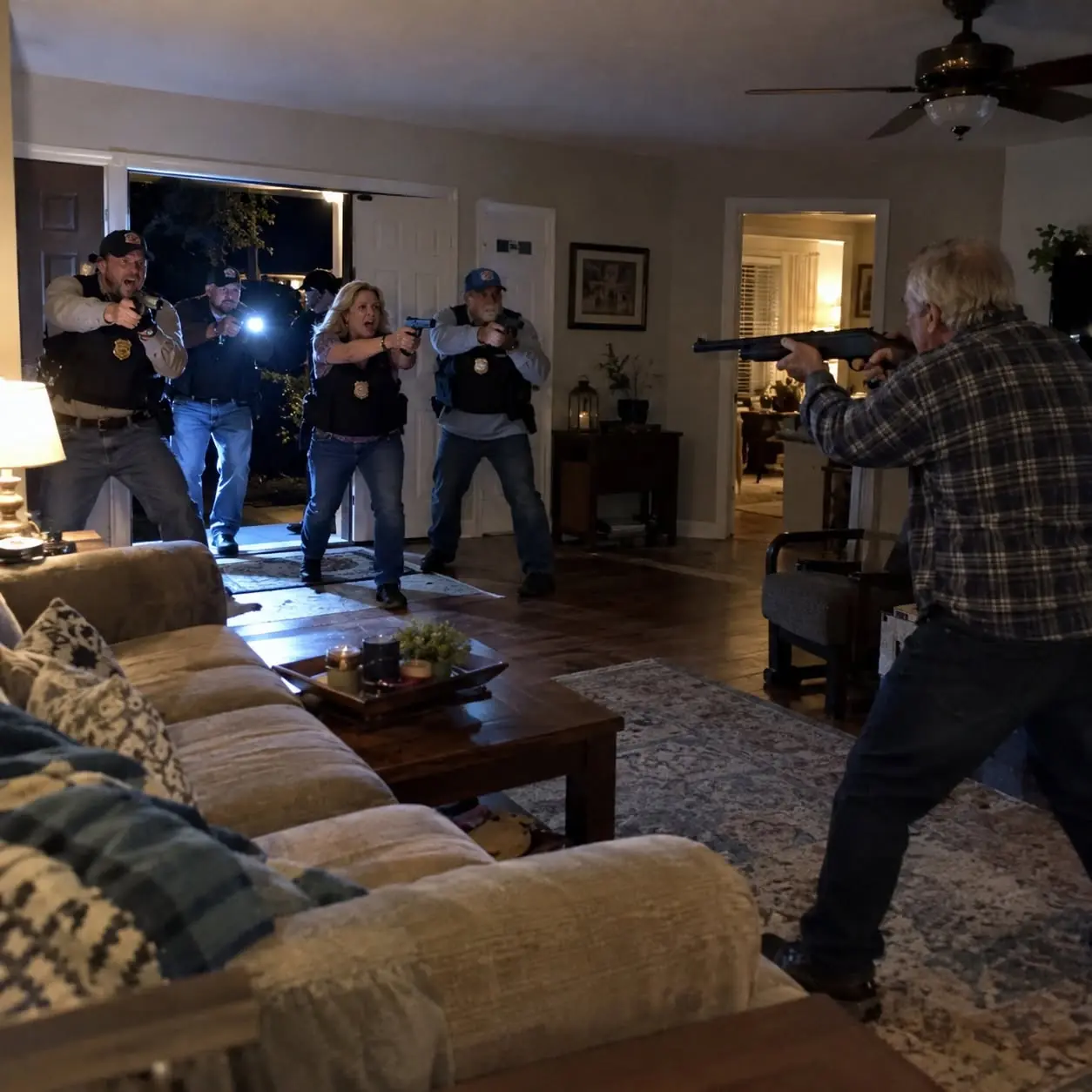
The red and blue lights were still flashing across the front of James Harris’s house when Sheriff Dan Whitaker stepped through the broken front door, and the first thing he saw was an old man in a plaid shirt standing calmly in his own living room, holding a shotgun pointed at the floor, facing five grown men in matching navy shirts who looked like they wished the floor would open up and swallow them whole.
Whitaker was a big man in his late fifties, with a weathered face and tired eyes that had seen every kind of trouble Cedar County could produce, from drunk drivers to domestic disputes to the occasional meth lab hidden in a trailer out in the woods. He had known James Harris for years, had shared coffee with him at the diner, had listened to his stories about the Marshals Service, and he respected him. He also knew Roy Beckett, and Clint Foster, and the rest of them, and he did not respect them at all. He took one look at the scene, at the crowbar on the floor, at the bolt cutters still in Eddie Marsh’s hands, at the short-handled shovel leaning against the wall, at the plastic badge clipped to Glen Yates’s belt, and his face went hard.
Nobody move, Whitaker said, his voice filling the room. Put the tools down. Hands where I can see them. Deputy Delgado, get these men outside and separate them. Now.
Deputy Rosa Delgado came in right behind him, young and sharp, her hand on her holster, her eyes moving quickly from face to face as she assessed the room. She was thirty-two, smart, thorough, and she had a reputation for not missing details. She motioned for the five men to step outside onto the porch, one by one, and they went without arguing, their earlier bravado gone, replaced by the sullen silence of men who knew they were in deep trouble.
James slowly lowered the shotgun, unloaded it with practiced hands, and set it on the coffee table. He looked at Whitaker and nodded, the way one professional nods to another when there is no need for words. Whitaker nodded back, then looked around the living room, at the broken door, at the muddy footprints on the hardwood floor, at the lamp that had been knocked sideways on the side table.
You all right, James? Whitaker asked quietly.
I am all right, James said. No one fired a shot. No one was hurt. But they broke my door, Sheriff. They came onto my property at one in the morning with tools. They crushed Eleanor’s flowers. They kicked a planter off my porch. They threatened me in my own home.
Whitaker pulled out a small notebook and started writing, his pen moving quickly. Tell me everything, he said. From the beginning. Do not leave anything out.
James told him. He told him about the shouting that had woken him, about the three blows against the siding, about the security lights and the five men crossing his yard in matching shirts, about the crowbar and the bolt cutters and the shovel and the flashlight and the plastic badge, about the flowers and the planter and the photographs of his windows, about the threats and the broken door and the standoff in the living room. He spoke calmly, clearly, in order, the way he had given statements a hundred times before in his career, and Whitaker wrote it all down, asking questions only when he needed a detail clarified.
When James finished, Whitaker looked up from his notebook. Is there any video? he asked.
James nodded toward the hallway. Every camera on this property was recording, he said. Front yard, back yard, porch, driveway, living room, hallway. Audio and video. And it is all backed up offsite, automatically, every thirty seconds. They cannot delete it, Sheriff. They could smash every camera in the house and the footage would still be safe.
Whitaker raised an eyebrow. You have cameras inside the house too?
I do, James said. After Eleanor died, I lived alone. I wanted to be safe. I installed a full system. I have been in law enforcement long enough to know that evidence disappears if you do not protect it.
Good, Whitaker said. Then let us go look at it.
They went into the small office off the kitchen, where James kept his computer and his security monitor. On the screen, the night was laid out in perfect detail, camera by camera, angle by angle. Whitaker leaned in close, his eyes narrowing as he watched the five men cross the yard, their faces clear in the white security light, their shirts easy to read, their tools easy to identify. He watched Roy Beckett crush the flowers. He watched Clint Foster kick the planter. He watched Paul Sorensen photograph the windows. He watched them pound on the door, and force it open, and crowd into the living room. He watched James standing calmly with the shotgun, never raising it, never threatening, only telling them to leave.
Jesus, Whitaker muttered. They did this to themselves. On camera. With their names on their shirts.
James opened a folder on the computer and showed Whitaker the backup log, time-stamped entries showing every clip uploaded to a secure server in another state, far from Pinewood Estates, far from anyone who might want to make it disappear. Whitaker nodded slowly, impressed despite himself.
That is good police work, James, he said. That is the kind of evidence that makes a prosecutor smile.
Outside, Deputy Delgado was working her way through the five men, one by one, taking their names, their statements, their versions of the night. She started with Paul Sorensen, who was the most nervous, his hands shaking as he held his phone, his voice cracking as he tried to explain that they were only there to enforce HOA rules, that they had a letter, that they thought they had the right to enter the property. Delgado listened without interrupting, then asked him to show her the letter. He fumbled in his pocket and produced a folded piece of paper from the HOA, signed by Veronica Lane, authorizing the enforcement unit to take necessary action to achieve compliance. Delgado read it twice, then slipped it into an evidence bag.
A letter from the HOA is not a warrant, Mr. Sorensen, she said quietly. A letter from the HOA does not give you the right to break into a man’s home at one in the morning. Do you understand that?
Paul nodded miserably, his face pale. I did not think it through, he said. Roy said it would be fine. Roy said Veronica had cleared it. I just wanted to help. I did not want anyone to get hurt.
Delgado moved on to Eddie Marsh, who was sullen and defensive, his arms crossed, his jaw set. He said they were only there to cut the lock on the side gate, that the crowbar and bolt cutters were just tools, that no one had meant to hurt anyone. When Delgado asked him why they needed bolt cutters to enforce a mailbox fine, he had no answer. When she asked him why they came at one in the morning instead of in daylight, he looked away.
Clint Foster was next, and he was angry, his face red, his voice loud. He said James Harris was a stubborn old man who thought he was above the rules, that someone had to teach him a lesson, that the HOA had been patient long enough. Delgado let him talk, writing down every word, and when he finished, she asked him a simple question.
Mr. Foster, she said, if someone broke into your home at one in the morning with a crowbar, would you call that enforcement?
Clint opened his mouth, then closed it. He had no answer for that either.
Glen Yates was quiet, almost apologetic. He said he had only come along because Roy had asked him to, that he thought the plastic badge made it official, that he had believed they were doing something legal. When Delgado asked him where he got the badge, he admitted he had ordered it online for twelve dollars. Delgado wrote that down too, and she did not smile, though part of her wanted to.
Roy Beckett was last, and he was the hardest. He stood with his chest out, his chin up, still holding the flashlight and the shovel, as if he were still the chief of something. He told Delgado that he was the head of HOA Enforcement, that Veronica Lane had appointed him, that he had the authority to enter any property in Pinewood Estates to enforce compliance. He said James Harris had been warned many times, that the fines had not worked, that stronger action was necessary. He said he was not afraid of the sheriff, or the law, or James Harris.
Delgado looked at him calmly. Mr. Beckett, she said, do you understand that you broke into a retired United States Marshal’s home, on camera, with witnesses, carrying a crowbar and bolt cutters? Do you understand that what you did tonight could be charged as burglary, criminal trespass, and home invasion?
Roy’s face went white, then red again. He opened his mouth, but no words came out. For the first time that night, the chief of HOA Enforcement had nothing to say.
By dawn, the neighborhood was awake and buzzing. Neighbors stood on their porches in bathrobes, whispering to each other, pointing at the sheriff’s cars in James’s driveway, at the five men sitting in the back of patrol cars, at the broken front door and the crushed flowers. Walter Briggs, seventy-two years old, a veteran neighbor who lived two doors down and had known James and Eleanor for twenty years, walked over with a cup of coffee for James, his face grim.
James, he said, I heard the shouting. I saw the lights. I called the sheriff too, as soon as I realized what was happening. Are you all right?
James took the coffee and thanked him. I am all right, Walter. No one was hurt. But it was close. Too close.
Walter shook his head. Those fools, he said. Everyone in this neighborhood knows Veronica Lane has gone too far. People are afraid to say it out loud, but they know. This mailbox business was never about a mailbox. People are starting to ask questions, James. They are starting to wonder what she is really after.
James looked at his neighbor, at the worry and the anger in his old friend’s eyes, and he knew Walter was right. The raid had been a disaster for Roy Beckett and his men, but it had also been a turning point for Pinewood Estates. The neighborhood had watched five men break into an old man’s home in the middle of the night, and they had seen who the real criminals were. The fear that Veronica Lane had used to control them was beginning to crack, and in its place, something else was growing. Curiosity. Anger. A demand for answers.
Whitaker came back inside as the sun was coming up, his notebook full, his face tired but determined. He sat down at James’s kitchen table and laid out the situation plainly. The five men would be arrested and charged, he said. Burglary, criminal trespass, destruction of property, and more, depending on what the district attorney decided. The video evidence was strong, maybe the strongest he had ever seen in a case like this. But he also warned James that this was not over. Veronica Lane would not go quietly. She would hire a lawyer. She would claim the men acted on their own. She would claim James had provoked them. She would try to turn the neighborhood against him again.
Let her try, James said quietly. I have the truth on my side, Sheriff. I have it on video. I have it backed up. I have it in writing. I am not afraid of her.
Whitaker nodded, and for a moment, the two men sat in silence, drinking coffee as the morning light filled the kitchen, both of them knowing that the night had changed everything, and that the fight for Pinewood Estates was only just beginning.
Later that morning, after the patrol cars had left and the neighborhood had gone quiet again, James walked slowly around his yard, taking stock of the damage with the careful eye of a man who had documented crime scenes for forty years. The crushed flowers were the worst of it, Eleanor’s pink azaleas flattened into the mud, their petals torn and scattered across the grass like confetti after a storm. He knelt down beside them, his knees aching, and gently lifted one broken stem, holding it in his hand for a long moment before setting it down again. He would replant them, he decided. He would replant every one, even if it took all summer, because Eleanor’s garden was not something five foolish men could destroy in one night. The broken planter could be replaced. The front door could be repaired. But the flowers mattered most, because they were hers, and he would not let the men who had crushed them believe they had won anything.