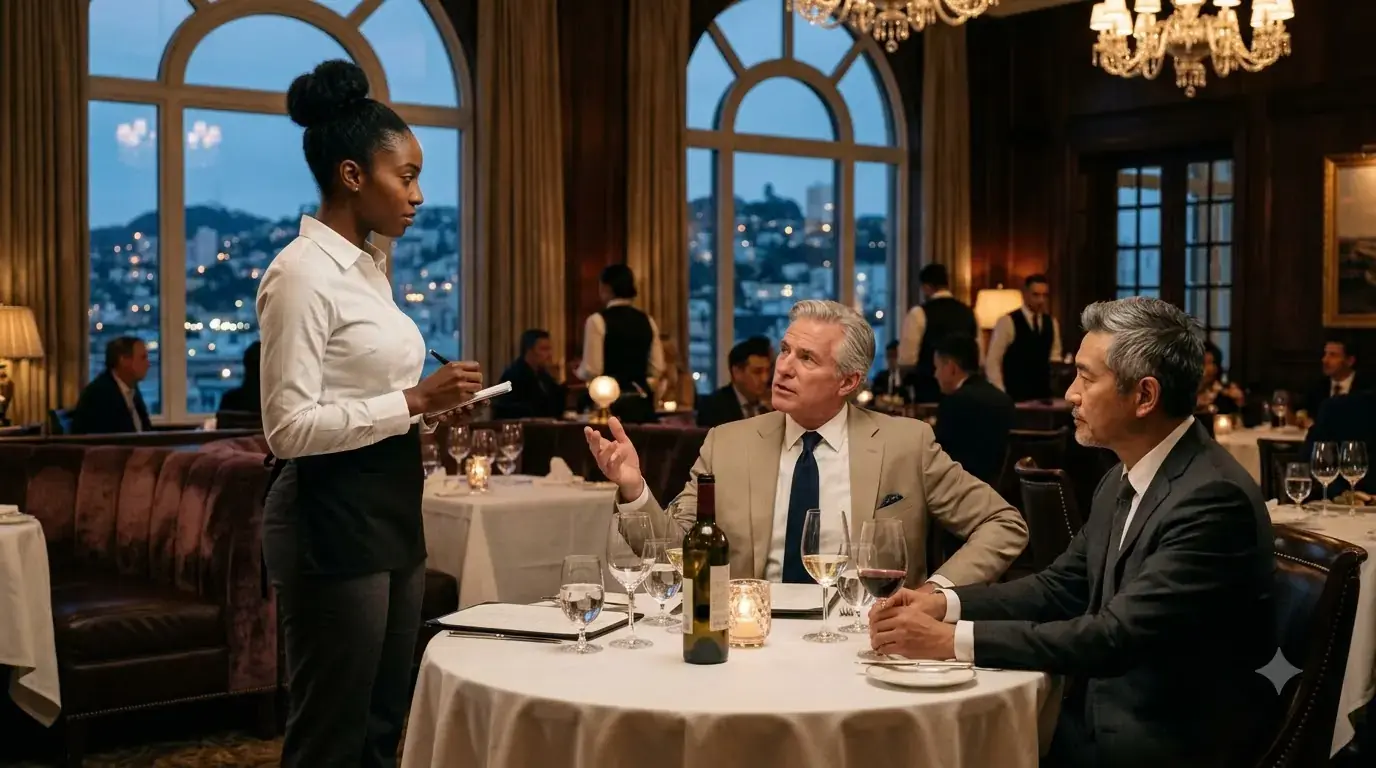
He was fifty-two, with neatly combed black hair, a serious face, and an expensive charcoal suit. His English name was Raymond Lam, though I knew that his family and many of his colleagues called him Lam Wai-keung.
He was chairman of Jade Harbor Infrastructure, a privately held investment group with interests in shipping, clean-energy technology, warehouses, and transportation networks across Asia and North America.
Mr. Lam had barely spoken during the previous ten minutes.
He had been reviewing a leather-bound contract folder while Whitmore drank sparkling water and complained about the restaurant's service.
Now he watched me carefully.
I couldn't read his expression.
Perhaps he was embarrassed.
Perhaps he was curious.
Perhaps he was trying to understand why a man who wanted him to invest millions of dollars was wasting time humiliating a waitress.
Whitmore snapped his fingers in front of me.
"Hey. I'm talking to you."
I felt my jaw tighten.
"Yes, sir."
He grinned.
"Good. So you do understand English."
A few people near the table shifted uncomfortably.
Whitmore leaned back.
"You heard the wager. Four hundred thousand dollars. All you have to do is speak Cantonese."
I glanced at the menu on the floor.
Then back at him.
"Sir, I came to take your order."
He laughed.
"And I'm giving you an opportunity to earn more money in five seconds than you've probably made in your entire life."
His business associate, a nervous-looking man in a gray suit, smiled uncertainly.
Mr. Lam said nothing.
Whitmore leaned closer.
"Go ahead. Say something."
I could feel the entire room watching.
The restaurant occupied the upper floor of a luxury hotel, with enormous windows overlooking San Francisco Bay. Afternoon sunlight poured across cream-colored walls, polished tables, crystal glasses, and silver cutlery.
Every detail had been designed to communicate wealth.
The linen napkins were thick enough to resemble handkerchiefs.
The chairs were covered in soft leather.
Fresh flowers stood in hand-blown glass vases.
And the private dining room had a separate service corridor so wealthy guests wouldn't have to watch employees moving between the kitchen and their tables.
I had worked long enough in expensive restaurants to understand that architecture.
Luxury often involved making labor invisible.
Servers appeared when summoned.
Plates arrived without anyone seeing the kitchen.
Wine glasses filled without guests noticing who poured them.
And when someone needed to clean a spill, staff were expected to do it quietly enough that the interruption barely registered.
Most guests were courteous.
Some were generous.
A few treated us with genuine warmth.
But men like Charles Whitmore seemed to believe that the more they paid for an experience, the less they needed to recognize the humanity of the people providing it.
He picked up a thick envelope from the table.
Slapped it against his palm.
Then placed it beside the contract folder.