"Corporate compliance?"
I nodded.
"Yes."
He looked up.
"Why are you applying to wait tables?"
I gave a careful answer.
"I have previous hospitality experience. I'm looking for dependable work while considering my next professional steps."
He studied me.
"You understand this isn't an office job?"
"Yes."
"Long shifts. Demanding guests. Weekend work."
"I understand."
He glanced at my education.
"Berkeley?"
I nodded.
"Yes."
He leaned back.
For a moment, I thought he was impressed.
Then he gave a small smile.
"Well, around here, nobody cares where you went to school when a customer needs another bottle of wine."
I smiled politely.
"Of course."
He nodded.
"Good."
Then he asked about my availability.
I told him.
He offered me a trial shift.
Within two weeks, I was working full-time.
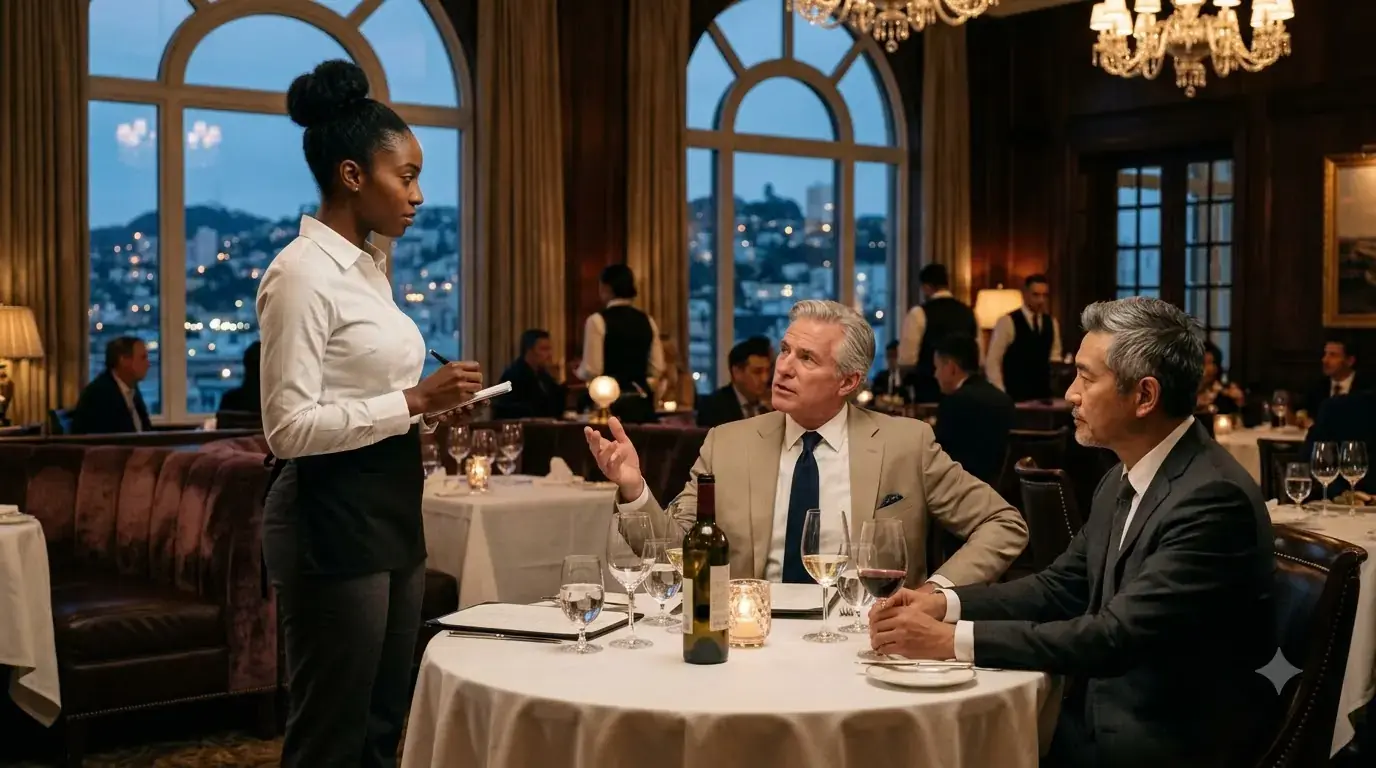
The Sequoia Room was different from the hotel restaurant where I'd worked during college.
The prices were higher.
The guest list included investors, technology executives, politicians, and wealthy international travelers.
The staff were experienced.
The kitchen was exceptional.
And the standards were demanding.
I learned the service procedures quickly.
Studied the menu.
Memorized wine pairings.
And became skilled at anticipating what guests needed without hovering over them.
Some coworkers assumed I was overqualified.
Others didn't care.
They were too busy.
One of the senior servers, a Black American woman named Teresa Walker, took me under her wing.
She was forty-six, married, and raising two teenagers.
She had worked in luxury restaurants for nearly two decades.
She knew which guests tipped well.
Which ones complained.
Which managers protected staff.
And which customers used money as a weapon.
On my third shift, she watched me return from a table with my jaw clenched.
"What happened?"
I sighed.
"Customer called me sweetheart six times and asked whether I was old enough to serve wine."
Teresa smiled knowingly.
"Did he order?"
"Eventually."
She nodded.
"Then breathe."
I looked toward her.
She continued.
"Some people come here to eat. Others come here to feel important."
I laughed softly.
She touched my arm.
"Don't confuse their performance with your worth."
That became one of the most useful lessons I learned at the restaurant.
Teresa never pretended bad treatment was acceptable.
She encouraged employees to document serious incidents.
She challenged managers when necessary.
But she also understood that not every rude guest deserved access to our emotions for the rest of the evening.
I admired her.
We became friends.
Sometimes after closing, we sat in the employee dining area drinking tea and talking about our families.
She knew about my previous career.
Not every detail.