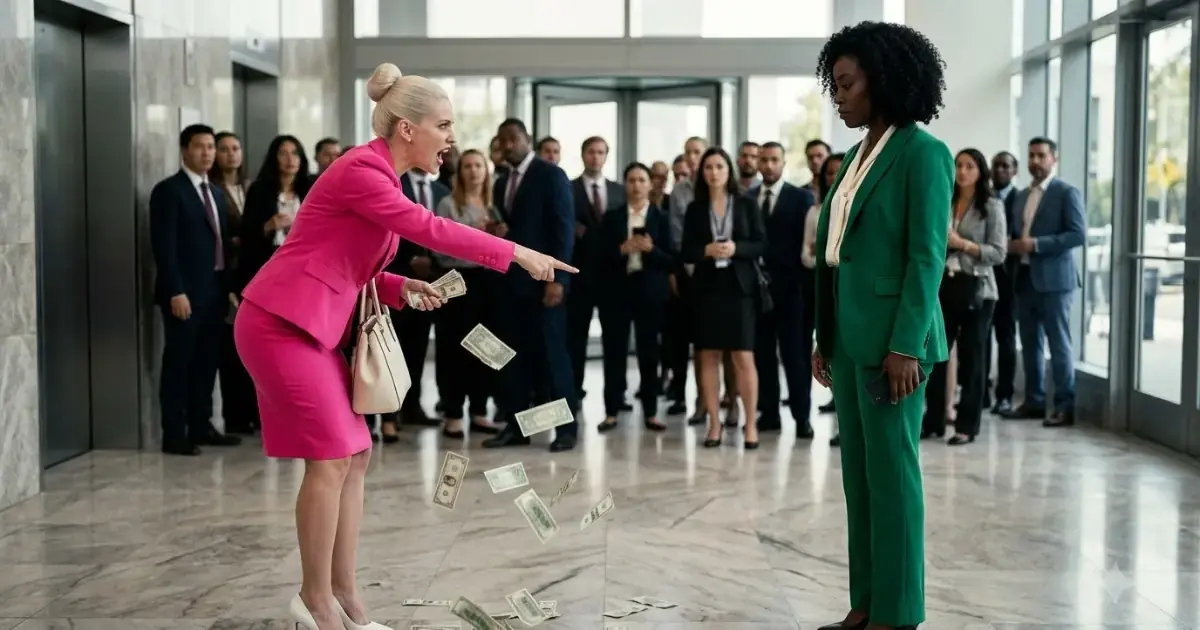
The first dollar bill landed against Angela Brooks’s shoe.
The second fluttered across the polished marble floor.
Then came a handful more, scattering beneath the crystal chandeliers of one of Manhattan’s most prestigious corporate headquarters.
“Go ahead,” the blonde woman said, smiling as though she had just told the funniest joke in the world. “Pick it up. That’s probably more money than you make in a week.”
A few people laughed nervously.
Others looked away.
Angela stood perfectly still, her emerald-green pantsuit immaculate, her black curls framing a face that betrayed almost nothing. She held a slim leather portfolio in one hand and watched the money settle around her feet.
Across from her, Vanessa Whitmore adjusted the sleeves of her hot-pink designer blazer.
Vanessa was forty-six, wealthy by marriage, and accustomed to being treated as though every room she entered belonged to her. Her platinum-blonde hair was arranged in an elaborate bun, her diamond earrings glittered beneath the lobby lights, and her expression carried the effortless cruelty of someone who had rarely been told no.
“Did you hear me?” Vanessa demanded. “Or do I need to explain it more slowly?”
Angela looked down at the scattered bills.
Then she raised her eyes.
“I heard you perfectly.”
Vanessa gave a short, contemptuous laugh.
“Well, then. What are you waiting for?”
Angela’s voice remained calm.
“I’m waiting to see how far you're willing to go.”
Vanessa threw back her head and laughed.
She had no idea that those eleven words would mark the beginning of the worst day of her professional life.
And she certainly had no idea who the woman standing in front of her really was.
Three hours earlier, Angela had been sitting at the kitchen table of her childhood home in Brooklyn, drinking coffee from a chipped blue mug that had belonged to her mother.
The house was small compared with the penthouses and luxury residences she could easily afford. Its wooden floors creaked, the kitchen cabinets were older than most of her employees, and the little garden outside still contained the rosebushes her father had planted nearly thirty years earlier.
Angela loved every inch of it.
Her mother, Evelyn Brooks, had died six years before, but the house remained full of her presence. There were recipe cards written in her careful handwriting, photographs of family birthdays, and a faded yellow curtain Evelyn had insisted made the kitchen feel cheerful even during the coldest New York winters.
On the refrigerator, held in place by a small magnetic butterfly, was a photograph of Angela at twelve years old.
She was standing beside her mother outside a downtown office building.
Evelyn wore a plain navy cleaning uniform and carried a canvas lunch bag.
Angela wore a school uniform and a smile wide enough to light up the entire picture.
Her mother had cleaned offices for nearly twenty-five years.
Every evening, while executives went home to comfortable houses and expensive dinners, Evelyn emptied their trash cans, scrubbed their conference tables, and polished the floors beneath their feet.
She had never considered the work beneath her.
But some of the people whose offices she cleaned certainly had.
Angela remembered one winter evening when she had accompanied her mother to work because the school heating system had broken and classes had been dismissed early.
She had been ten years old.
An executive carrying a leather briefcase stepped out of an elevator and nearly collided with them.
He looked at Evelyn’s uniform, then at Angela.
“Employees shouldn’t bring their children into professional spaces,” he said sharply.
Evelyn apologized, although Angela knew her mother had done nothing wrong.
The man walked away without looking back.
Later, while they were riding the subway home, Angela had asked a question she had carried inside her ever since.
“Mom, why did he talk to you like that?”
Evelyn had smiled sadly.
“Because some people mistake a job title for a measure of a person's worth.”
“But you work harder than he does.”
“Maybe I do, baby. But that's not the point.”
“Then what is?”
Her mother had taken her hand.
“The point is that every person deserves respect before anyone knows their name, their money, or what they do for a living.”
Angela had never forgotten those words.
She carried them through college, through business school, through twenty-hour workdays, and through every rejection she encountered while building a small technology consulting firm into a national corporation.
Now, at fifty-two, Angela was the founder and majority owner of Meridian Global Holdings, a multibillion-dollar company with interests in commercial real estate, logistics, technology, and business services.
Her company employed more than eighteen thousand people across the United States.
And on that particular Monday morning, she was preparing to visit the Manhattan headquarters of Meridian's newest acquisition, Sterling & Vale.
The company had been purchased six weeks earlier in a deal worth nearly nine hundred million dollars.
Sterling & Vale possessed valuable commercial property, a strong client portfolio, and an established name in the luxury corporate services industry.
But something was wrong inside its executive offices.
For months before the acquisition, Angela’s financial team had identified suspicious expenditures, unusually high employee turnover, and a pattern of complaints that seemed to disappear before reaching senior management.
Several complaints mentioned the same person.
Vanessa Whitmore.
Vanessa was Sterling & Vale’s executive vice president of corporate relations, a title that sounded impressive but offered little explanation of what she actually contributed to the business.
Her husband, Richard Whitmore, was a longtime investor and former board adviser.
His connections had protected Vanessa from consequences for years.
Now the company belonged to Angela.
And Angela wanted to understand exactly what she had purchased.
She had deliberately kept her photograph off the announcement distributed to Sterling & Vale employees. Her ownership was publicly documented, but her schedule and personal appearance had not been circulated internally.
That decision had not originally been intended as a test.
Angela simply disliked elaborate ceremonies.
She preferred meeting people in ordinary circumstances, before expensive flowers appeared on reception desks and executives began rehearsing speeches about their commitment to excellence.
Her personal assistant, Daniel Foster, had suggested arriving with a security escort.
Angela refused.
“If people only behave properly when they know the owner is watching,” she told him, “then I haven't learned anything useful.”
Daniel had worked with her for eleven years.
He knew better than to argue when she spoke in that particular tone.
Still, he insisted that the building’s interim president, Michael Reeves, be informed that she would arrive sometime that morning.
Angela agreed, with one condition.
“No announcements. No special reception. I want to see the company as it really is.”
At 8:40 a.m., she stepped out of a black sedan wearing her favorite green suit.
The suit had been tailored in London, but its color reminded her of the church dress Evelyn had worn on Angela’s college graduation day.
Her mother had stood in the audience crying so hard that she nearly missed Angela walking across the stage.
Angela touched the small gold bracelet on her wrist.
It had belonged to Evelyn.
Then she entered Sterling & Vale headquarters.
The building was magnificent.
Forty-three stories of glass and limestone rose above the busy Manhattan street. Inside, the lobby stretched upward beneath enormous circular chandeliers, while pale marble floors reflected the morning sunlight.
Fresh white orchids stood in sculpted arrangements near the reception desk.
A massive digital display featured the Sterling & Vale logo.
Everything suggested confidence, wealth, and sophistication.
Angela noticed something else.
A young maintenance worker was quietly cleaning a spill near the revolving doors.
Several employees walked around him without acknowledging his presence.
A woman in a cream-colored coat nearly bumped into his cart, then glared as though he had deliberately inconvenienced her.
The worker lowered his eyes and apologized.
Angela stopped.
“Good morning,” she said.
The young man looked up, surprised.
“Morning, ma'am.”
“Looks like someone gave you a busy start.”
He smiled.
“Coffee accident. Happens more often than you'd think.”
“Thank you for taking care of it.”
His expression changed.
Not dramatically.
Just enough for Angela to notice.
“You're welcome, ma'am.”
His name tag read MARCUS.
Angela made a mental note.
At the reception desk, a young woman named Emily Parker greeted her with a professional smile.
“Good morning. Welcome to Sterling & Vale. How may I help you?”
“I have a meeting with Mr. Reeves.”
“Of course. May I have your name?”
“Angela Brooks.”
Emily typed into her computer.
A moment later, her expression shifted.
“Oh. Yes, Ms. Brooks. We've been expecting you.”
There was no recognition of Angela’s true position, only confirmation that her name appeared on the visitor schedule.
“Mr. Reeves is finishing another meeting. Would you like to wait in the executive lounge?”
“The lobby is fine.”
“Can I get you coffee or water?”
“Water would be lovely. Thank you.”
Emily smiled and stepped toward the refreshment station.
Angela walked to a seating area near the center of the lobby.
She had barely sat down when the sharp clicking of expensive heels echoed across the marble.
“Emily!”
The voice was loud enough to turn heads.
“Emily, where is my conference packet?”
Angela looked toward the reception desk.
A blonde woman in a hot-pink suit marched through the lobby, followed by a younger assistant struggling to keep pace.
Vanessa Whitmore.
Angela recognized her immediately from the executive personnel files.