The laughter came before anyone had a chance to stop her.
It was sharp, loud, and deliberately cruel, the kind of laughter meant not merely to express amusement but to make another human being feel small.
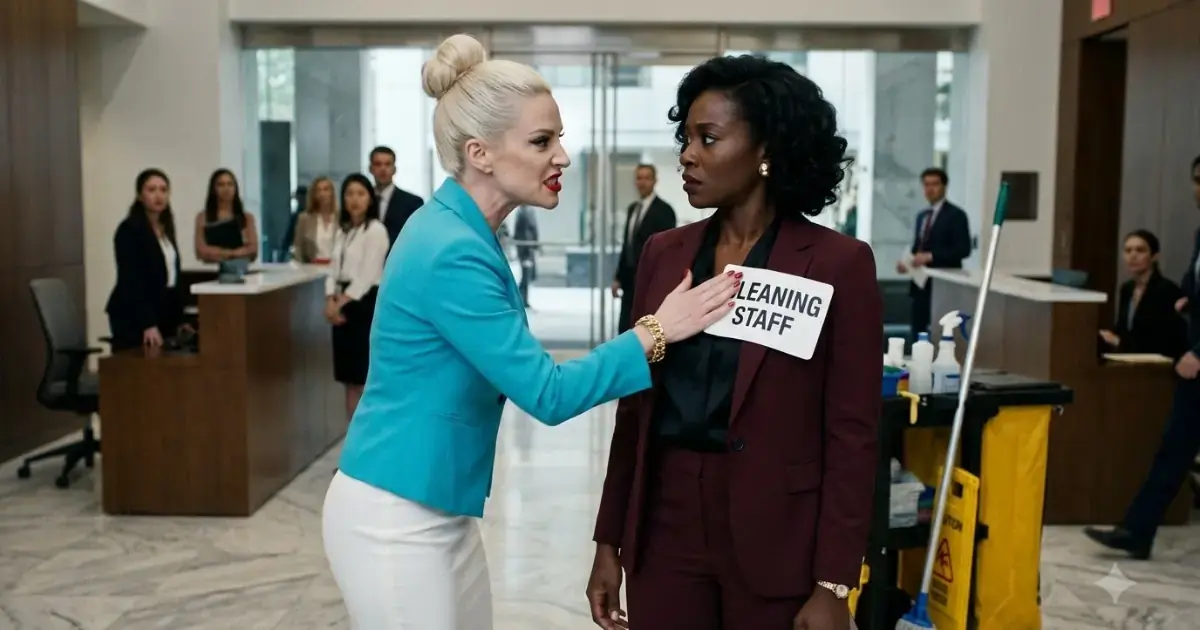
In the magnificent marble lobby of Sterling & West Corporate Holdings, a blonde woman in a bright turquoise blazer stood directly in front of a Black woman wearing an elegant burgundy business suit.
The blonde woman's name was Vanessa Whitmore.
She was thirty-six years old, the regional director of corporate operations, and one of the most feared managers in the entire building.
Her heels clicked against the polished marble floor as she stepped closer to the woman in burgundy.
Between two fingers, Vanessa held a white rectangular label.
Printed across it in large black letters were two words:
CLEANING STAFF.
Vanessa looked at the label, then at the woman standing before her, and burst into laughter.
"Oh, this is perfect," she announced.
The woman in burgundy did not smile.
Her name was Evelyn Carter.
She was forty-eight years old, impeccably dressed, with natural dark curls framing a composed, intelligent face.
She carried a simple black leather portfolio, wore no extravagant jewelry, and stood with the quiet confidence of someone who had never needed expensive accessories to prove her worth.
Vanessa glanced at Evelyn's face and sneered.
"What's wrong? Don't you appreciate being properly identified?"
Several employees walking through the lobby slowed down.
A receptionist looked up from her desk.
Two members of the maintenance team stopped beside their equipment cart.
Near the elevators, a young administrative assistant named Rachel Miller paused with a folder pressed against her chest.
Everyone could sense that something ugly was happening.
Nobody seemed eager to interfere.
Vanessa lifted the label higher.
"Here. Since you apparently don't understand how things work around here, I'll make it easy for everyone."
Before Evelyn could move, Vanessa pressed the label against the front of her burgundy blazer.
The adhesive caught the expensive fabric.
Vanessa smoothed it with the palm of her hand.
Then she stepped backward and examined her work.
"There," she said triumphantly. "Much better."
A few nervous chuckles escaped from the people nearby.
Vanessa laughed even harder.
"Now people won't mistake you for someone important."
Evelyn looked down at the label.
For a moment, the entire lobby seemed to fall silent around her.
She slowly raised her eyes.
"Is that what you believe?" she asked.
Vanessa tilted her head.
"Excuse me?"
"That people who clean this building aren't important?"
Vanessa rolled her eyes.
"Oh, please. Don't turn this into some dramatic speech. Everyone has a position. Some people run companies. Other people clean up after the people who run companies."
She pointed toward a yellow cleaning cart standing near the reception area.
"Your equipment is over there."
Evelyn did not move.
Vanessa leaned forward.
"Did you hear me?"
"I heard you perfectly."
"Then why are you still standing here?"
"Because I have an appointment."
Vanessa threw her head back.
"An appointment? With whom? The head janitor?"
She laughed at her own joke.
Evelyn studied her carefully.
"With the chairman's office."
Vanessa's smile widened with disbelief.
"The chairman's office?"
"Yes."
"Sweetheart, people like you don't simply walk into executive meetings."
Evelyn's expression changed almost imperceptibly.
Not with anger.
Not with embarrassment.
But with the recognition of something deeply familiar.
She had encountered this kind of person before.
Someone who confused authority with superiority.
Someone who believed a title gave them permission to humiliate others.
Someone who assumed that the world could be neatly divided into people who mattered and people who did not.
"People like me?" Evelyn repeated.
Vanessa folded her arms.
"You know exactly what I mean."
"No," Evelyn replied. "I'd like you to explain."
Vanessa's jaw tightened.
"Don't test me."
"I'm asking a simple question."
"You're causing a disturbance."
Evelyn glanced around the lobby.
"I believe you started this conversation."
Vanessa took another step forward.
Her perfume was overwhelming.
Her expression carried the smug certainty of someone accustomed to having the last word.
"Listen carefully," she hissed. "I have a board presentation in twenty minutes. I don't have time to babysit someone who wandered into the wrong part of the building."
She tapped the label on Evelyn's blazer.
"Go find your supervisor."
Evelyn looked toward the reception desk.
The receptionist immediately lowered her eyes.
Then Evelyn looked toward the two maintenance employees.
One was an older man with silver hair and a tired face.
The other was a younger woman wearing a navy work uniform.
Both looked deeply uncomfortable.
Evelyn turned back to Vanessa.
"Before I go anywhere, I'd like to know your name."
Vanessa smiled.
"Oh, you really are new."
She straightened her shoulders.
"Vanessa Whitmore. Regional Director of Corporate Operations."
She emphasized every word.
"And you would be?"
"Evelyn Carter."
Vanessa gave a dismissive wave.
"Wonderful. Evelyn Carter. Now get back to work."
Evelyn repeated the name quietly.
"Vanessa Whitmore."
"That's right."
"Regional director."
"Yes."
"Corporate operations."
Vanessa narrowed her eyes.
"Are you making fun of me?"
"No," Evelyn said. "I'm making sure I remember."
Vanessa laughed again.
It would be the last time she laughed comfortably in that building.
But to understand why, it was necessary to understand the woman she had just humiliated.
Evelyn Carter had not always owned a corporate empire.
Thirty years earlier, she had been an eighteen-year-old girl riding a crowded city bus at five o'clock in the morning, carrying a secondhand briefcase and wondering whether she would ever escape the exhausting life her mother had endured.
Her mother, Lorraine Carter, had worked as a cleaner in office buildings for nearly twenty-five years.
She cleaned marble floors, emptied trash cans, polished conference tables, and washed coffee cups abandoned by executives who rarely learned her name.
Lorraine was a widow raising two children.
She had never attended college.
Her hands were rough from cleaning chemicals, and her knees often hurt so badly that she struggled to climb the stairs to their apartment.
Yet every morning, before leaving for work, she made certain her children had breakfast.
Every evening, regardless of how tired she felt, she asked about their homework.
Her favorite saying was simple.
"Never measure a person's worth by the work they do. Measure it by how they treat someone who can do nothing for them."
Evelyn heard those words so often that they became part of her character.
When she was eleven, she once accompanied her mother to an office building because the babysitter had canceled.
While Lorraine cleaned the conference room, Evelyn sat quietly beside a window and completed her school assignments.
A senior executive entered the room carrying a cup of coffee.
He barely glanced at Lorraine.
Instead, he placed the cup on the polished conference table, spilling coffee across the surface her mother had just cleaned.
"Somebody needs to do this properly," he complained.
Lorraine apologized.
Evelyn knew she had done nothing wrong.
After the man left, Evelyn angrily asked why her mother had apologized.
Lorraine continued wiping the table.
"Because sometimes keeping your dignity means refusing to fight someone who doesn't understand what dignity is."
"But he was wrong."
"Yes, baby. He was."
"Then why didn't you tell him?"
Lorraine paused.
She looked at her daughter with tired but determined eyes.
"Because I need this job. But someday, when you have the power to speak, I hope you'll speak for the people who can't afford to."
Evelyn never forgot that moment.
She studied relentlessly.
She earned scholarships, worked part-time jobs, and graduated from college with honors.
Her first professional position was as a junior financial analyst at a struggling real estate investment firm.
The company was small.
Its office furniture was outdated.
Its accounting systems were unreliable.
And its founder, a sixty-two-year-old businessman named Arthur Sterling, had taken a chance on a young woman whom several other employers had rejected.
Arthur recognized something extraordinary in Evelyn.
She asked better questions than anyone in the room.
She studied problems until she understood their underlying causes.
And when she found a mistake, she corrected it regardless of whether the correction made her popular.
Within five years, she had helped the company restructure its most unprofitable operations.
Within eight years, she had become chief financial officer.
By thirty-five, she was a partner.
When Arthur retired, he offered Evelyn the opportunity to acquire a controlling interest in the company through a carefully structured ownership agreement.
She accepted.
Over the following decade, Evelyn expanded the business into commercial real estate, logistics, corporate property management, and technology infrastructure.
She built partnerships across multiple states.
She purchased struggling companies and transformed them into profitable operations.
She created scholarship programs, employee development funds, and community investment initiatives.
By forty-eight, she controlled one of the most successful privately held corporate groups in the region.
Yet relatively few employees had ever met her.
Evelyn deliberately avoided becoming a celebrity executive.
She disliked expensive publicity campaigns.
She rarely appeared in promotional photographs.
She believed a company's reputation should depend on the quality of its work, not the visibility of its owner.
Her leadership team handled most public appearances, while she concentrated on long-term strategy, investments, and organizational culture.
Her employees knew her name.
Many had read her annual letters.
But thousands had never seen her face outside an old photograph.
That anonymity occasionally created unusual situations.
It also allowed Evelyn to see how people behaved when they believed she was an ordinary visitor.
And on this particular Monday morning, it was revealing something she had feared for months.
Sterling & West had been receiving disturbing reports.
Employee turnover had increased.
Maintenance workers were reporting unexplained schedule changes.
Several administrative assistants had resigned without completing their notice periods.
An anonymous letter described public humiliation by senior management.
Another alleged that employees were threatened with dismissal for reporting safety concerns.
A third reported that certain managers had created an informal hierarchy in which receptionists, cleaners, and security personnel were treated as second-class members of the organization.
Vanessa Whitmore's name appeared repeatedly.
At first, Evelyn had instructed the human resources department to investigate.
The reports returned with reassuring conclusions.
No substantiated misconduct.
No policy violations.
No evidence of systemic mistreatment.
The findings troubled her.
Not because she assumed every allegation was true.
But because the conclusions seemed inconsistent with the volume and detail of the complaints.
Several employees who had submitted concerns had resigned shortly afterward.
Others had withdrawn their statements.
One had written a second anonymous message containing only six words.