Stiff from years of being stored. But still intact. Still whole. The room started to shift. Not all at once.
Not dramatically. But like dominoes falling one by one. As men saw what she was holding. And started to understand that they just made a mistake. The back panel came into view first.
The death's head with wings. The logo that hadn't been used in over 40 years. Below it in careful stitching. Iron Ghosts MC's 1959 Ohio. The laughter died.
Not slowly. All at once. Like someone had cut the sound. And then they saw the signatures. Six names.
Handwritten in faded ink. Stitched into the leather like a prayer. An older man near the bar set his beer down. Slowly. Carefully.
Like any sudden movement might shatter something fragile. His name was Marcus Kincaid. Though most people called him Wrench. 65 years old, gray beard, hands scarred from decades of wrenching on bikes and fighting and surviving in a world that didn't hand out second chances. He stared at the vest, at the signatures, at the stitching style that hadn't been used since before most of the men in this room were born.
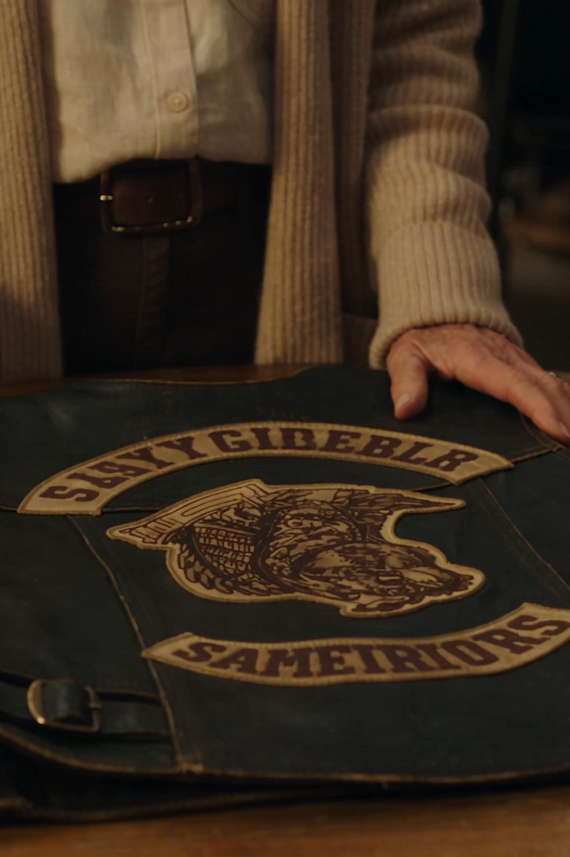
Where did you get that? His voice was barely above a whisper. Eleanor looked at him, really looked at him, and she saw it. The shape of his jaw, the set of his eyes, the way he held himself. You're Lawrence's son, she said.
It wasn't a question. Wrench's face went white. How did you My husband was one of the original six, Eleanor said. Her voice carried across the silent room. Dalton Calloway.
Silas Brennan gave me this vest the night we buried him. Told me to keep it safe. Told me that when the time came, I'd know what to do. Complete silence. Not a breath, not a cough, just the hum of the refrigerator behind the bar and the distant sound of traffic outside.
Cole Brennan stood up from his booth, slowly, like a man who'd just been hit and was still trying to figure out from which direction. He crossed the room, stopped in front of Eleanor, stared down at the vest, at the signatures, at one signature in particular. Silas Brennan. That's my uncle's name, Cole said. His voice was rough, tight, like the words were being dragged out of him against his will.
Eleanor met his eyes. I know. How? She reached into the bag again, pulled out the envelope, held it out to him. Silas died 3 weeks ago, she said.
Pancreatic cancer. Before he passed, he asked me to bring this to you, to all of you. Cole took the envelope with shaking hands, opened it, read. His face changed from anger to confusion to something that looked almost like shame. When he finished, he looked up at Eleanor.
Chapter 4
What do you want from us? Nothing, Eleanor said. I'm just delivering a message. What message? Eleanor turned the vest around.
Let every man in the room see the signatures. See the date. See the proof that once, before any of them were born, six men had stood together and built something that meant more than power or money or reputation. Your uncle wanted you to remember, Eleanor said. That's all.
Just remember. Cole stared at her, then at the vest, then at the letter in his hands. And for the first time in years, maybe decades, his face cracked. The enforcer took a step forward. Boss, you want me to Get out, Cole said.
The enforcer blinked. What? I said get the hell out. Cole's voice was thunder, raw, broken. Now.
The enforcer looked around waiting for someone to tell him this was a joke. Nobody did. He left. So did the young prospect. So did half the room.
The ones who didn't understand. The ones who didn't want to. Eight men stayed. The old guards. The ones who'd been around long enough to recognize history when it walked through the door.
One by one they placed their hands over their hearts. An old gesture. A sign of respect that hadn't been used in this clubhouse in over a decade. Cole removed his president's patch, laid it on the bar, not in surrender, in reverence. Then he did something Eleanor didn't expect.
He knelt right there in front of her, in front of everyone. And one by one the others followed. Eight men, hard men, dangerous men, men who'd spent their lives taking what they wanted and breaking anyone who got in their way, kneeling in front of a 73-year-old woman in a cardigan who'd driven 400 miles to remind them of something they'd forgotten. Wrench stepped forward, pulled something from his wallet, a photograph, faded, water damaged at one corner. He held it out to Eleanor with trembling hands.
It was a Polaroid, 1959, six young men standing in front of a garage, cigarettes, leather, motorcycles gleaming in the sun. "This is my father," Wrench said. His voice broke. "Lawrence Kincaid, third from the left. He died when I was eight, motorcycle accident.
My mother burned everything, his cut, his photos, everything. She didn't want me following his footsteps." He looked at the vest, at the signatures. "I kept this, found it in her toolbox after she died. It's the only picture I have of him."
Eleanor took the photo, looked at the young man with the easy smile and the capable hands. "Lawrence was the toughest man my husband ever rode with," she said softly, "and the kindest. Dalton used to say Lawrence would give you the shirt off his back, and if you crossed him, he'd use that same shirt to choke you out." She smiled, a sad smile. "But he never had to, because people respected him, really respected him, not because they were afraid, because he earned it."
Wrench's shoulders shook. He covered his face with his hands. Cole stood, walked to the wall where a cheap brass plaque hung. The chapter's founding date, fake, meaningless, the kind of thing you buy at a trophy shop to make yourself feel legitimate. He took it down, looked at it for a long moment, then threw it in the trash.
He took the vest from Eleanor's hands, mounted it on the wall in its place, under glass, under light, where every man who walked into this clubhouse would see it the moment they entered and remember. Eleanor didn't say goodbye. She just turned and walked out the same way she'd walked in, alone, calm, caring nothing but the knowledge that she'd kept her promise. Behind her, the bar stayed silent for a long time. Some men cried, some just stared.