The cane made a dry scraping sound as Sergeant Dale Morris pulled Evelyn away from the grocery store entrance.
Marcus Hayes heard it before he fully understood what he was seeing.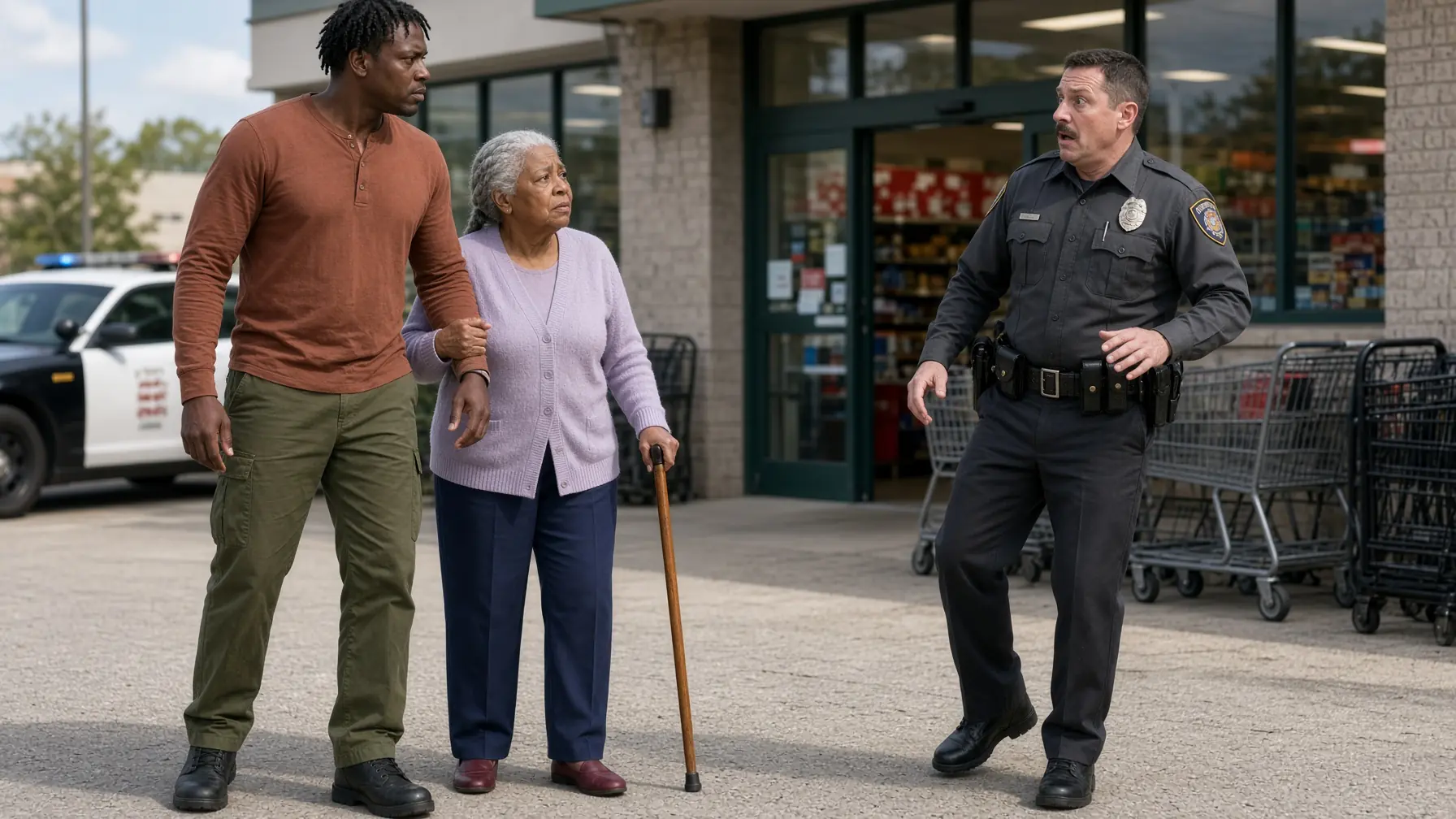
His mother’s burgundy shoe shifted sideways. Her pale lavender cardigan stretched beneath the sergeant’s fingers, and her free hand tightened around the wooden cane as she tried to place it securely on the pavement.
Morris kept pulling.
Marcus crossed the space between them.
“Take your hand off my mother.”
The sergeant turned his head and looked up.
Marcus was exceptionally tall, lean enough that his height appeared even more pronounced beside the patrol car. His faded rust henley and olive canvas trousers were ordinary clothes, but there was nothing uncertain about the way he planted his black boots beside his mother.
Morris’s hand remained on her arm.
That was the only thing Marcus was looking at.
The morning had begun with Evelyn informing him that she intended to choose her own groceries.
She did not make the announcement as a challenge.
She made it while standing in her kitchen with a list in one hand and the cane resting against the table beside her.
Marcus had arrived carrying an empty reusable bag and an offer to save her the trip.
At seventy-five, Evelyn appreciated offers.
She preferred them to remain offers.
He understood that in principle. In practice, he sometimes saw the distance from a parking space to a store entrance and imagined every awkward curb between them before his mother had put on her shoes.
She could read that calculation on his face.
“You can carry the bags,” she told him. “I’ll handle deciding what goes in them.”
Marcus looked at the list.
It contained more items than he expected.
“I thought you needed three things.”
“I remembered some others.”
“How many others?”
“Enough that I’m glad you’re here.”
He smiled despite himself.
She folded the list and put it in her purse.
That ended the discussion more efficiently than another explanation would have.
Evelyn was short and full figured, with silver hair gathered into a low braid. She had put on navy trousers, practical burgundy shoes, and the cardigan she liked for stores that seemed determined to keep their customers colder than their vegetables.
The cane was part of going out.
She no longer treated it as something to apologize for carrying.
Marcus had watched that change happen gradually.
At first, she left it behind on days when she felt better. Then she carried it without using it much. Eventually, she accepted that an object could make a journey easier without making the person using it less capable.
He had needed to learn a related lesson.
Helping did not mean anticipating every movement until she had no movement left to make herself.
He had been told that more than once.
Now he took the bag, waited while she collected the cane, and opened the door without offering an arm she had not requested.
Outside, the daylight was clear.
A breeze moved along the front path, lifting the edge of the cardigan before settling it against her trousers again.
Evelyn paused at the step.
Marcus waited.
She placed the cane, brought one foot down, and followed with the other.
The entire movement took only a few seconds.
Years earlier, he might have filled those seconds with unnecessary encouragement.
Now he understood that watching patiently could be more respectful than turning every ordinary action into an achievement.
At the car, he opened the passenger door.
She settled herself, brought the cane in beside her, and arranged her purse where it would not slide.
Then she looked up at him.
“You can stop supervising.”
“I’m opening a door.”
“You’re opening it very attentively.”
He laughed and closed it once she was ready.
Their relationship had acquired that kind of exchange over the years.
Affection carried inside correction.
Concern softened by humor before it became suffocating.
Marcus knew his mother could still do a great deal without him.
He also knew she sometimes concealed discomfort because she disliked seeing people reorganize themselves around it.
Both things could be true.
Learning to respond to the person in front of him, rather than to every worry he could imagine, required attention.
He was trying.
The drive to the grocery store was short enough that they did not need to turn it into a conversation about anything important.
Evelyn asked whether he had eaten.
He said yes.
She asked whether that meant a meal or something he had consumed while standing.
Marcus looked at the road.
“That sounds like two questions.”
“It’s one question with standards.”
“A meal.”
She accepted the answer with the expression of someone reserving the right to remain unconvinced.
At a traffic light, he glanced toward her and noticed a loose strand of silver hair near her temple.
She had braided the rest neatly.
That small detail reminded him of mornings when she had been the one hurrying him toward a door, checking that he had remembered what he needed while he insisted he was perfectly capable of remembering it himself.
He understood those mornings differently now.
Concern could become a habit so deep that it continued after the practical reasons changed.
His mother still wanted to know he had eaten.
He still wanted to know she would not have to negotiate an awkward curb alone.
Neither of them was likely to stop entirely.
They had simply learned to object with affection.
Evelyn looked out at a garden as they passed.
Someone had planted flowers along a fence in a pattern she admired and apparently believed could be improved.
She explained the improvement.
Marcus listened.
He did not pretend to know more about the plants than he did.
His mother noticed the attention and continued for another block, describing how the arrangement would look in a different season.
By the time they reached the store, they had discussed flowers, a loaf of bread she hoped would be fresh, and a meal she intended to make later.
Nothing in the conversation required a uniform.
Nothing required permission from a stranger.
The small grocery store sat behind a modest parking area, its entrance framed by carts and a window crowded with ordinary advertisements.
Marcus found a place that did not require Evelyn to cross the busiest part of the lot.
He turned off the engine and came around to her side.
She already had the cane positioned.
He opened the door and stepped back.
Evelyn rose carefully, waited until her balance settled, and adjusted the purse strap against her shoulder.
Marcus collected the reusable bags from the back.
Then they walked toward the entrance together.
He matched her pace without making the matching obvious.
That was something he had learned too.
Slowing dramatically could feel like impatience disguised as assistance.
Walking with her meant letting the journey take the time it took.
Near the carts, one wheel caught against another.
Marcus freed it and pulled a cart clear.
Evelyn tested the handle.
It rolled straight.
A small nod confirmed that it would do.
She kept the cane in one hand and guided the cart with the other, using the arrangement that felt comfortable to her.
Marcus remained beside her rather than taking the cart away.
Inside, the air was cooler.
Evelyn looked at him.
He glanced at the cardigan.
“You were right.”
“I usually am about refrigeration.”
The comment made him smile.
A cashier looked up as they entered and returned Evelyn’s greeting.
There was nothing elaborate about the recognition.
A familiar customer.
A person working.
The exchange offered a small ease at the beginning of the trip.
Marcus appreciated stores where his mother could be familiar without being managed.
They began with produce.
Evelyn took out the list, unfolded it, and considered the display as though the tomatoes required careful judgment.
They did.
She picked one up, examined it, and returned it.
Marcus waited.
He had offered to buy everything for her, but this was part of what she meant when she said she intended to choose.
A list could tell him what kind.
It could not tell him exactly what she would consider right when she saw it.
There were decisions inside an ordinary grocery trip that belonged to the person who would later stand in the kitchen using the food.
He did not need to take them away to be useful.
He held the bag while she made the selection.
A woman nearby was doing much the same thing.
She noticed Evelyn’s inspection and smiled.
They exchanged a few words about the produce without discussing anything more significant than whether it looked better than it had the previous week.
Marcus remained quiet.
He liked seeing his mother in conversations that did not center on him.
She had a life of small recognitions, preferences, and familiar faces that existed independently of his attention.
It was easy for an adult child to forget that.
Easy to see a parent primarily through the needs that involved you.
Evelyn had been a person long before Marcus had become someone capable of worrying about her.
She remained one when he was not standing nearby.
They moved into the next aisle.
He reached for something on a higher shelf after she indicated the one she wanted.
She thanked him.
He put it in the cart.
The help was simple.
Requested.
Completed.
Neither of them needed to make it mean anything about her age or his strength.
At the end of the aisle, a shopper had left a cart angled across the narrowest point.
Evelyn stopped.
Marcus could have moved it immediately.
He waited long enough for the person to notice.
The shopper turned, apologized, and pulled it aside.
Evelyn thanked him and continued.
The entire exchange remained ordinary because someone recognized that another person needed space.
Later, Marcus would remember that.
A stranger with groceries had managed something the sergeant would refuse to do.
Notice.
Make room.
Allow the other person to continue.
In the bread aisle, Evelyn found the loaf she wanted behind one that looked nearly identical.
Marcus could not see the difference.
She showed him.
He listened with the seriousness the explanation deserved.
That made her laugh.
He had been hoping it would.
The sound relieved some of the concern he had carried into the trip.
She was enjoying herself.
That mattered.
A grocery store was not an exciting destination, but independence often lived in places nobody thought to celebrate.
Choosing bread.
Comparing prices.
Changing the plan because something looked better than expected.
He wanted her to keep those ordinary freedoms as long as she could.
At the dairy case, she paused to rest.
Not dramatically.
She simply stopped beside the cart and looked at the list while the cane took a little more of her weight.
Marcus noticed.
He did not ask whether she was tired in a tone that would make her deny it.
Instead, he checked the next item and offered to get it.
She agreed.
He went a short distance, returned, and placed it where she indicated.
The pause had given her enough time.
They continued.
There was a jar she added although it had not been on the list.
Marcus looked at it.
She looked back.
“I remembered.”
“You remembered while looking directly at it?”
“That happens.”
He put it in the cart.
She smiled with satisfaction.
The trip was taking longer than doing it himself would have.
He did not mind.
Speed was not the purpose.
He had come with his mother, not merely to complete a task in her name.
That distinction made the time worthwhile.
At checkout, Evelyn chose the line that looked slower.
Marcus glanced toward the shorter one.
She followed his eyes.
“That one has a problem.”
He looked again.
A customer was searching through a bag while the cashier waited.
Evelyn had noticed before he did.
He nodded and began placing heavier items onto the belt.
She arranged the bread and the things she wanted kept separate.
The cashier greeted them.
Evelyn answered.
Questions were asked about bags and whether they had found everything.
Nothing in the exchange required an argument.
The cashier spoke directly to Evelyn rather than turning to Marcus for every answer.
He appreciated that more than he would have thought necessary years earlier.
People sometimes saw an older woman with a son beside her and began treating the son as the only person capable of deciding.
Evelyn had little patience for that.
Today, she did not need to correct anyone.
She paid.
Checked the amount.
Put the card away.
The receipt was folded and placed inside the purse.
Marcus finished arranging the bags.
He distributed the weight so the fragile items would not be crushed and the heavier ones would be easier to lift.
Evelyn watched him.
“You’ve improved.”
“At what?”
“Not putting everything heavy in one bag.”
“I’ve received feedback.”
“Clearly useful feedback.”
He smiled.
They moved toward the entrance.
Outside, the daylight seemed brighter after the store.
The air felt pleasant against Evelyn’s cardigan, and she paused near the side of the doorway while Marcus adjusted a bag handle that had become caught beneath another.
They were clear of the path people used to enter.
A cart stood nearby.
Beyond it, cars moved slowly through the parking area.
Marcus looked toward their vehicle.
He could carry the bags there and return for his mother.
That would avoid making her walk while he tried to manage everything at once.
It would also leave her free to take the short distance at her own pace.
He explained the plan.
Evelyn agreed.
She did not require him to prove he knew she could walk.
He did not require her to demonstrate it unnecessarily.
The arrangement was practical.
He took the bags.
She settled the cane.
He went toward the car.
At first, she watched him.
Then she turned slightly toward the store window, where a notice had caught her attention.
She could read most of it without moving closer.
The rest could remain unread.
She was not going to lean awkwardly against glass to satisfy a minor curiosity.
A customer passed carrying flowers.
Evelyn looked at them with appreciation.
The customer noticed and smiled.
For a moment, they shared the ordinary pleasure of something bright being taken somewhere.
Then the customer continued.
Evelyn waited.
Her cane stood securely beneath her hand.
There was enough space.
Her son would be back shortly.
No part of the scene required intervention.
The patrol car arrived while Marcus was placing the bags in the vehicle.
He noticed it without paying much attention.
Police cars went places.
A car entering a grocery lot did not automatically make the lot a place to fear.
He set the last bag down, made certain the eggs were secure, and closed the door.
Across the lot, Sergeant Dale Morris stepped out.
He was forty-eight, lean and angular, with a dark crew cut and a mustache that emphasized the hard line of his mouth.
His charcoal uniform looked neat.
His duty belt moved against his hips as he headed toward the entrance.
Marcus saw the direction but not the purpose.
His mother remained beside the doorway.
He began walking back.
The distance was short.
A vehicle moved across the lane between them, and he paused to let it pass.
That interruption lasted only a few seconds.
When the way cleared, Morris was already standing near Evelyn.
Marcus slowed slightly, expecting an ordinary exchange.
Perhaps the sergeant needed directions.
Perhaps something near the entrance required attention.
Evelyn turned toward him.
She appeared to answer a question.
Marcus could not hear the words from where he stood.
He continued.
Near the door, the sergeant’s posture changed.
His shoulders angled toward Evelyn, and one hand moved in a gesture that looked less like explanation than instruction.
She looked toward the parking area.
Then back at him.
Her cane shifted slightly.
Marcus knew that movement.
She was preparing to step, not refusing.
She needed to place the support before moving her weight.
Morris reached for her upper arm.
Even from several yards away, Marcus could see the difference between offering assistance and taking control.
An offered hand waited.
This one closed.
The lavender cardigan gathered beneath the fingers.
Evelyn’s body turned farther than her feet had prepared to turn.
The cane scraped.
That sound reached Marcus across the remaining space.
It stopped being an ordinary afternoon.
He moved immediately.
The concern that had accompanied him through curbs, carts, and crowded aisles changed into something clearer and colder.
His mother was being pulled.
She had not set the cane.
The sergeant was continuing anyway.
Marcus did not shout from a distance.
He needed to reach her.
Needed to see where her feet were.
Needed to stop the next movement from becoming a fall.
He came beside her and looked directly at the gripping hand.
“Take your hand off my mother.”
His voice was firm enough to carry.
Not wild.
Not breathless.
The statement contained everything necessary.
Morris turned.
The height difference became immediate.
Marcus towered over him, his short twists and clean-shaven face catching the clear daylight above the sergeant’s line of sight.
For one moment, the officer appeared to assess the man’s size rather than the request.
His hand remained on Evelyn.
Marcus watched it.
His mother had steadied the cane, but her weight was still arranged around the direction of the pull.
He did not want to add another force by reaching for the sergeant’s arm.
He wanted the hand removed.
That was the simplest correction available.
Morris chose another movement.
He planted his free hand against Marcus’s chest and pushed.
The pressure struck the faded rust henley.
Marcus took one steadying step.
His boots held the pavement.
He did not push back.
The decision was visible in the way his shoulders settled rather than surged forward.
“Back off,” Morris said. “Unless you want cuffs too.”
The threat hung between them.
Marcus looked at the sergeant’s face.
The mustache.
The raised chin.
The effort to make the push appear like control rather than a reaction to being challenged.
He was angry enough that his attention felt painfully precise.
He did not let that anger leave his hands.
Instead, he moved one hand beneath Evelyn’s free elbow.
Support.
Not a pull.
She could lean into it without being moved somewhere she had not chosen.
Her balance improved immediately.
Marcus felt the small shift.
He knew from the way her arm settled that she had found the pavement again.
That was the first thing accomplished since he reached them.
The sergeant’s grip remained.
Marcus’s eyes returned to it.
Evelyn looked toward her son.
His expression was controlled, but she could see the effort beneath it.
She had known that face before it could conceal much.
She knew when stillness required work.
The officer seemed to see only the height and the refusal to retreat.
That made the situation more dangerous.
A man who mistook restraint for a challenge could keep answering the movement he expected rather than the one actually happening.
Marcus remained beside his mother.
He did not crowd Morris closer to the patrol car.
Did not step between the sergeant and an exit.
He kept his body positioned so Evelyn had support and the officer could plainly see where both his hands were.
One hand held her elbow.
The other remained free.
Nothing in either hand justified the threat of cuffs.
Morris glanced toward the store entrance.
Several people had slowed.
They were not close enough to interfere.
They were close enough to see.
That seemed to stiffen the sergeant’s posture rather than moderate it.
Marcus recognized the change.
The officer now had an audience for a choice he could still correct.
He appeared more interested in avoiding the appearance of correction than in making the choice sensible.
Evelyn’s cardigan was still caught beneath his hand.
Marcus spoke again.
“You’ve got one chance to let her go.”
The sentence was quiet.
It carried no explanation of who he was.
No name beyond the one he had lived with all his life.
No occupation.
No affiliation.
No claim that his mother deserved consideration because someone important might eventually ask about her.
He was asking the officer to stop doing something that should never have required a second request.
Morris tried to maintain the sneer.
The effort showed.
His eyes moved over Marcus’s face and shoulders, then returned to the hand beneath Evelyn’s elbow.
The threat he had offered had not made the taller man retreat.
It had not made him lose control either.
That left the sergeant with fewer easy responses than he seemed to expect.
He reached toward his handcuffs.
The movement was familiar enough that several watching people became more still.
Evelyn saw it.
Her grip tightened around the cane.
Marcus did not turn his attention toward the belt.
He kept it on Morris’s face.
The officer had not released her.
Whatever he intended to do next would begin with that fact unchanged.
The afternoon traffic continued beyond the parking area.
A car door closed.
The grocery entrance opened and shut behind a customer who stopped once outside.
The ordinary sounds made the encounter feel more exposed.
It was happening in daylight.
Beside a small store.
In front of people carrying food home.
There was no complicated setting in which the simple question could be lost.
Why was the sergeant still holding her?
Evelyn raised her face.
Until then, she had been occupied with balance.
The cane.
The direction of the pull.
The need to keep her feet beneath her.
Now she could look directly at the man whose hand remained on her arm.
Her silver braid rested against the back of the lavender cardigan.
Her expression held no smile.
She lifted her chin just enough that Morris could no longer look past her without making the choice visible.
“Dale,” she said. “Look at me.”
The first name stopped him.
His hand paused near the cuffs.
His eyes moved toward her face.
For a fraction of a second, the expression remained irritated.
Then it changed.
Morris looked at her properly.
Not at the cane.
Not at the cardigan.
Not at a woman whose age made her slower than the instruction he had given.
At her.
His gaze held.
The sneer weakened.
Then disappeared.
Evelyn did not supply another word.
She did not help him place her.
Did not offer a memory or an explanation.
She held his eyes while his face did the work.
Marcus felt his mother remain steady beneath his supporting hand.
He did not look away.
The officer’s attention shifted sharply toward him.
This time, the look was different.
It did not begin with his height.
It reached his face with a suddenness that suggested something in Evelyn’s words had rearranged what the sergeant was seeing.
Marcus returned the stare.
Silent.
Unmoving.
Morris looked down briefly.
At Marcus’s hands.
One still beneath his mother’s elbow.
The other open and empty.
Then his eyes returned to the clean-shaven face above him.
Whatever thought moved through him remained unspoken.
Marcus gave him nothing to interrupt.
The sergeant’s mouth tightened.
His throat moved.
His hand left Evelyn’s arm.
The cardigan fell back into place.
The release was small enough that someone watching only faces might have missed it.
Marcus did not.
Neither did Evelyn.
The pressure disappeared.
Her arm settled closer to her body.
She adjusted the cane without the sergeant controlling the direction of her weight.
For the first time since he approached, her movement belonged entirely to her again.
Morris lowered the hand that had been reaching toward the cuffs.
He took one step backward.
The retreat opened space between them.
Not much.
Enough.
Marcus used it carefully.
Keeping his eyes on the sergeant, he guided his mother a little behind him, his support remaining gentle beneath her elbow.
He did not drag her.
Did not make her turn quickly.
She took the small step at her own pace and settled where his body now stood between her and Morris.
The cane found the pavement securely.
Marcus could feel that before he let his hand ease.
His mother was steady.
The officer was no longer touching her.
Those facts mattered more than anything the man might eventually say.
Morris looked at Evelyn over Marcus’s shoulder.
Then back at Marcus.
His face had lost the practiced authority with which he had entered the scene.
The uniform remained the same.
The duty belt remained in place.
The patrol car stood beside him.
None of it seemed to restore the certainty he had possessed moments earlier.
He swallowed.
The movement was visible beneath the mustache.
Marcus waited.
He did not repeat the warning.
It had been heard.
He did not explain the silence that now seemed to disturb the sergeant more than anger would have.
That was not his responsibility.
The store doors moved again.
A shopping cart rattled against another near the entrance.
Someone farther away continued loading groceries, unaware that the sound carried into a space where nobody was speaking.
Evelyn stood behind her son with the cane planted beside her burgundy shoe.
The lavender cardigan no longer stretched beneath a stranger’s grip.
Morris’s eyes moved once more toward Marcus’s hands.
Then his face.
The pause lengthened.
Marcus held the stare without stepping forward.
There was no satisfaction in his expression.
No invitation.
He was waiting for a man who had found it easy to issue threats to decide whether he could now find words.
Morris swallowed again.
And before he spoke, the fear he was trying to hide had become clearer than the sneer he could no longer maintain.