I shoved the homeless man hard enough to knock him sideways outside the diner, and when two police officers came running, the waitress screamed that I had attacked someone who had only asked for a place to sit.
The paper bag hit the sidewalk first.
Then his shoulder.
Then mine.
I heard coffee cups clatter behind the restaurant window and somebody shout, “Get off him!” But I wasn’t on him. I was on one knee beside him, trying to pull my jacket loose without dragging it across his face.
His body had begun jerking.
The older officer reached us with one hand raised. His partner moved toward my shoulder.
“Back away.”
“Look behind him.”
“Sir. Back away.”
I raised both hands and shifted aside. The officer knelt where I had been. His partner caught my wrist, and a woman under the diner awning started recording.
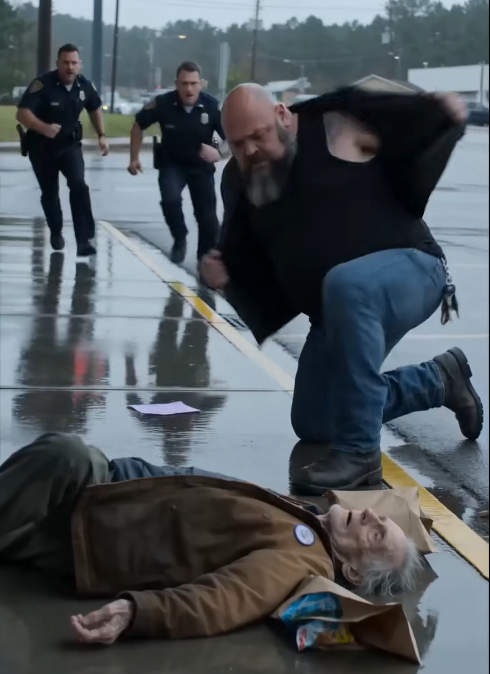
Everybody had seen the shove.
My name is Ray Dawson. I was fifty-six that spring, six-foot-four, and close to two hundred eighty-five pounds, with tattooed forearms, a shaved head, and a beard that had gone gray faster than the rest of me wanted to admit.
I owned a diesel repair shop outside Knoxville. The men I rode with called me Hammer. That morning, my black Harley was parked between a delivery van and a pickup with a broken taillight.
I had come for eggs.
The man on the pavement wore a brown coat with one sleeve repaired in darker fabric. His shoes were tied with different laces. Before he fell, he had been carrying a grocery bag folded carefully at the top, as though whatever was inside deserved better weather than he did.
Now the bag lay open beside the curb.
A purple paper placemat was sliding toward a puddle.
“Don’t let that go,” I said.
The officer holding my wrist looked at me.
“The paper.”
“Stay where you are.”
A waitress stepped forward and put her shoe on the edge before it reached the water. She bent, picked it up, and stared at the crooked flowers drawn around its border.
The man’s coat had opened at his wrist. There was a narrow metal bracelet beneath the cuff. The kneeling officer noticed it, then spoke into his radio.
His voice changed.
Behind us, the diner manager kept saying the same thing.
“I told him he couldn’t stay by the door.”
Nobody answered him.
The morning smelled of frying bacon, wet pavement, and the sharp dust left by something broken. A loose strip of yellow tape tapped against the wall in the breeze.
The officer beside me finally looked past my shoulder.
He went still.
I watched his eyes travel from the place where the man had been standing to the place where he was lying now.
For the first time, he loosened his grip.
“Was he coming this way?”
“Yes.”
The waitress pressed the purple paper against her apron.
“Oh, God.”
I didn’t want her to say that. I didn’t want anybody to decide the next minute belonged to me. The man was still on the ground, and there were too many faces above him.
“Give him some room,” the kneeling officer told the crowd.
People moved back reluctantly, as though distance might cost them the ending.
I stayed nearby until the officer asked what I had seen. I told him the man had stopped answering, that his hand had tightened around the bag, and that everything after that had happened faster than I could explain cleanly.
Then the jerking stopped.
The officer kept speaking to him quietly while we waited for the ambulance.
When the man finally opened his eyes, he looked frightened by all of us.
“Your name, sir?” the officer asked.
His mouth moved before any sound came.
Then he whispered, “Did I miss her?”
The waitress lowered her eyes to the placemat.
On its dry underside, beneath the flowers, someone had written a name and a time—and suddenly the man on the pavement had somewhere he was supposed to be.
Part 2 — The Space Between Him and the Glass
Ten minutes before the shove, I had been arguing with Boone about toast.
He believed white toast was a food group. I believed a man who had recently been told to improve his diet ought to stop putting jelly on things before tasting them.
Across the booth, Luis was reading an invoice and refusing to participate.
The diner was called the Copper Kettle. It sat beside a service road outside Knoxville, close enough to the highway that trucks rattled the sugar dispensers when they passed.
There was a problem at the entrance that morning.
A delivery cart had struck the old fixed sidelight beside the door. The lower portion of its glass pane had broken, leaving an irregular section still held in the frame. The manager had called someone to repair it and stretched yellow tape around two orange cones.
One cone had been moved to let a delivery through.
Nobody had put it back.
An opening had appeared where a barrier should have been.
From our booth, I could see the entrance at an angle. The jagged glass caught the light when the door swung inward. It wasn’t a pile on the floor anymore. Someone had swept most of that away.
What remained was worse to look at: a sharp, broken edge projecting from a fixed frame at roughly the height of a falling person’s neck.
The man in the brown coat arrived carrying his paper bag.
He didn’t shake a cup. He didn’t knock on the windows. He stood beneath the awning, checked the door, and smoothed the folded top of his bag with one palm.
A waitress named Abby opened the door.
I heard him ask whether he could sit inside.
The manager answered from behind her.
“We’re serving customers.”
“I understand.”
“You buying something?”
The man looked down at his hand. There were coins in it, but not many.
“Someone’s meeting me.”