Wayne said nothing for a moment.
Then he said something Tomson did not expect.
“Because you contacted Eddie.”
“I did not.”
“Someone from your production account did.”
Tomson knitted his brows.
Wayne continued.
“They asked whether the Desert Eagles still had breakfast there on the first Saturday of every month.”
The memory came back to Tomson.
Two weeks earlier, he had told an assistant to find a biker gathering for the prank.
His assistant had messaged several restaurants.
“So?”
“Eddie recognized your last name.”
Tomson finally understood.
“He told you.”
“Yes.”
“And you realized who I was.”
“Yes.”
Tomson let his head rest against the seat.
“So you were waiting for me.”
“We knew you might come.”
“And you let me destroy your motorcycles?”
“No. We expected you to walk into the diner.”
“To do what?”
“I hoped to introduce myself.”
Tomson came close to laughing.
Instead, he brought his hands over his face.
All morning he had believed he had surprised the Desert Eagles.
The truth was stranger.
Wayne had been waiting to tell him about his father.
Tomson had arrived holding paint.
“Where’s the letter?”
“With me.”
“I want it.”
“You can have it.”
“Today.”
“Yes.”
They met that evening at Eddie’s.
The diner was closed to customers.
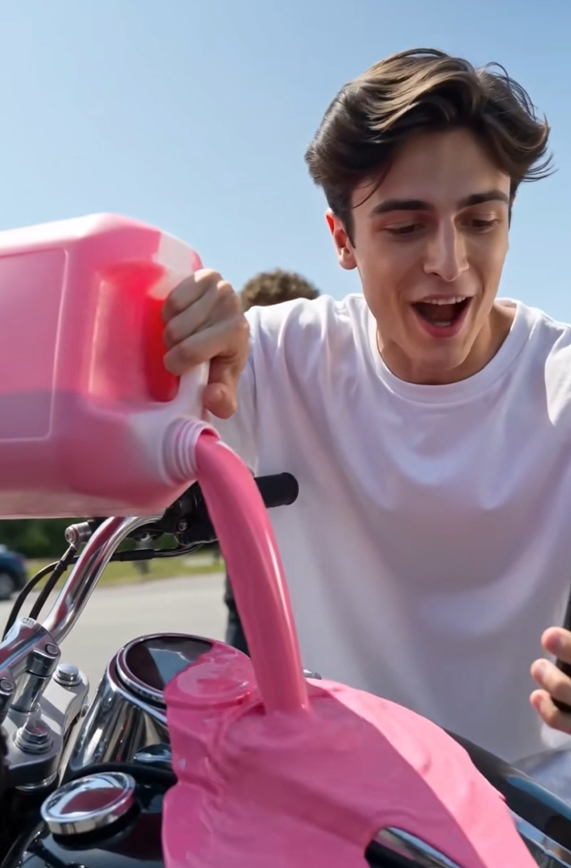
Several of the damaged motorcycles had been moved to Bear’s repair shop, but Wayne’s Harley remained in the parking lot because the paint removal needed to be handled carefully.
In the fading light, the pink looked darker.
Almost red.
Tomson came to a stop next to it.
“I’m sorry.”
Wayne, who stood a few feet away, studied him.
Tomson studied the motorcycle.
“I should’ve said that this morning.”
“Yes.”
Tomson gave a small nod.
“I’m sorry I damaged it. And I’m sorry I kept filming after you told me about Ellen.”
Wayne’s jaw tightened at his wife’s name.
Tomson kept reading.
“I can pay.”
“The estimates are higher than you think.”
“I’ll pay.”
“You may not be able to immediately.”
“I’ll figure it out.”
Wayne nodded a single time.
Not forgiveness.
Recognition.
Those were not the same thing.
Inside, Eddie poured coffee for both of them.
Tomson left his own cup untouched.
Wayne removed an envelope from the inside pocket of his jacket.
It was yellowed slightly at the edges.
Tomson knew his father’s handwriting immediately.
For Tomson.
No address.
No stamp.
“When did he write it?”
“Three weeks before he died.”
Tomson stretched out his hand for it.
Wayne kept his fingers on the envelope.
“There’s something I need to tell you first.”
“What?”
“Your father regretted leaving every day I knew him.”
Tomson stared back at him.
“That doesn’t make it okay.”
“No.”
Wayne released the letter.
“It doesn’t.”
Tomson opened the envelope.
The paper inside was folded twice.
He began reading.
His father did not make excuses.
That came as a surprise.
Daniel wrote that he had spent years believing he needed to become successful before returning, because he could not bear for his son to see him as a failure.
By the time he understood that absence was worse than failure, so much time had passed that he no longer knew how to cross the distance.
He wrote about watching Tomson’s early online videos.
Funny school sketches.
Short comedy clips.
A video in which sixteen-year-old Tomson repaired an old bicycle.
You looked happy when you made something work again, Daniel had written.
Then came the paragraph Tomson read four times.
I made the mistake of believing a man’s value came from whether people thought he was successful. I spent years performing competence while feeling like a failure. If you ever read this, I hope you don’t make the same mistake with a different audience. Being seen is not the same as being known.
Tomson lowered the sheet of paper.
Wayne remained silent.
Tomson kept reading.
The final lines were simple.
If Wayne gives you this, ask him to show you the photograph from Arizona. He’ll pretend he doesn’t want to. Don’t believe him.
Tomson lifted his gaze.
Wayne smiled for the first time.
“He was annoying until the end.”
“You have the photograph?”
Wayne slipped a hand into his wallet.
The picture showed five younger men beside motorcycles on a desert highway.
Wayne was there.
Bear was there.
Doc was there.
Daniel stood in the middle, sunburned and laughing.
Tomson had never seen his father look that happy.
He touched the edge of the photograph.
“What happened in Arizona?”
“Your father saved my marriage.”
Tomson lifted his gaze.
Wayne chuckled at his surprise.
“Ellen and I had been fighting for months. I was spending too much time on the road and not enough at home. During that Arizona trip, Daniel told me something.”
“What?”
“He said, ‘Don’t confuse having somewhere to escape with having somewhere to belong.’”
Tomson looked back at the picture.
“My father said that?”
“Then he borrowed fifty dollars and lost his sunglasses.”
Tomson burst out laughing.
It slipped out unexpectedly.
Wayne joined him in laughter.
For several minutes, grief occupied the room differently.
Not as emptiness.
As evidence that someone had once been there.
Later, Tomson asked about the charity ride.
Wayne told him the Desert Eagles had started it eleven years earlier after Doc’s granddaughter was treated at Sunrise Children’s Hospital.