"I told you bacon isn't allowed in this neighborhood."
Barbara's voice carried across my front yard with the sharp confidence of someone who had forgotten that an HOA was not a government and a cul-de-sac was not a country. She stood at the bottom of my porch steps in a bright floral blouse, white cropped pants, and expensive sandals, one hand planted on her hip while the other held a stack of pink violation slips. Behind her, three neighbors pretended to check their mailboxes even though I had watched all three of them collect their mail an hour earlier.
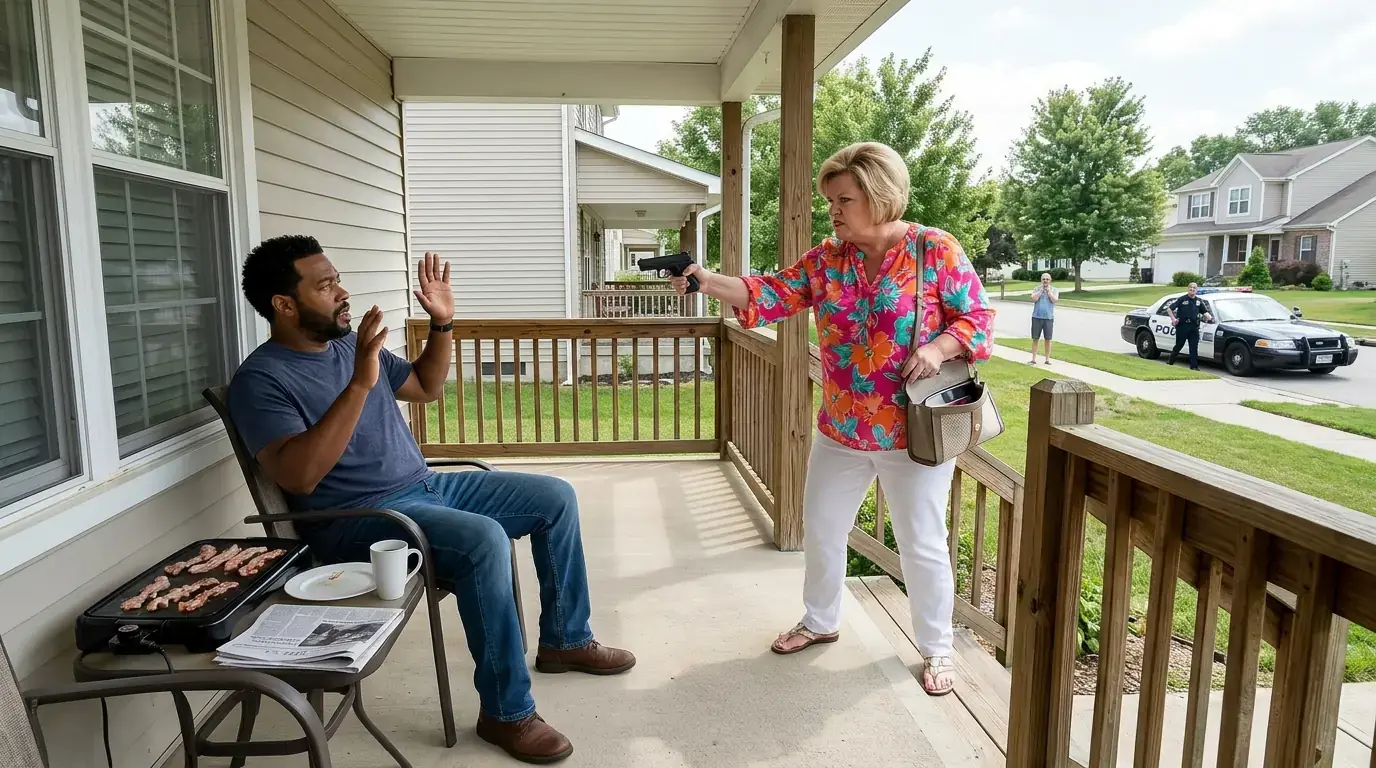
I had a cast-iron skillet on a portable burner beside my porch chair. Bacon hissed in it. A steak rested under foil on a plate. I was not hungry enough to justify either one, but hunger had stopped being the point several days earlier.
"Barbara," I said, "I have the right to eat whatever I want on my own property."
Her mouth tightened.
"You are in violation of the community health directive."
"There is no community health directive. There is a newsletter you wrote."
"The board recognizes it."
"The board won't even look at me when you say that."
The nearest neighbor lowered his head immediately, which proved my point better than anything I could have added.
Barbara stepped closer. "You think this is funny."
I looked at the pink slips in her hand. One accused me of PUBLIC PROTEIN DISPLAY. Another cited INTENTIONAL FOOD-BASED PROVOCATION. A third, which I had received the previous morning, used the phrase AGGRESSIVE CHEWING.
"I think you have lost perspective."
That was not the sentence she wanted. Her eyes changed, not dramatically, just enough for me to notice. The little smile she wore when she believed she had an audience disappeared.
"We'll see," she said.
Then she turned and walked back toward the white HOA vehicle idling at the curb.
At the time, I thought the worst thing she could do was send another fine.
That was the mistake I made over and over with Barbara. I kept judging her by the last line she had crossed instead of asking what the next one might be.
For years, she had been annoying in ways that most of us considered survivable. She measured mailbox posts. She photographed trash cans that stayed at the curb ten minutes past the collection window. She left stickers on windshields if a tire touched the white edge of a visitor space. She once called an emergency board meeting because two teenagers had parked bicycles on a front lawn during a birthday party.
People laughed about her when she was not around. That made living with her easier.
Barbara was the kind of HOA president who mistook attention for respect. If five people argued with her, she heard five people acknowledging her authority. If nobody argued, she treated silence as consent. Either way, she walked away feeling confirmed.
The neighborhood had learned to manage her the way people manage a dog that barks at delivery trucks. Close the blinds. Wait for the noise to pass. Avoid unnecessary eye contact.
I did the same for a long time.
I had bought my house because I wanted quiet. The street was lined with maples, the lots were large enough that you could grill without smoking out your neighbor, and most evenings ended with bicycles, sprinklers, and somebody mowing too late because they had put it off all weekend. I liked that ordinary rhythm.
I did not care whether somebody's mailbox leaned three degrees left.
Barbara did.
At first, she seemed ridiculous rather than dangerous. She would arrive at meetings with a binder thick enough to stop a door and colored tabs sticking from every side. She wore bright floral blouses so often that I began thinking of them as part of the uniform. Coral flowers meant landscaping complaints. Yellow flowers meant parking. Blue flowers seemed to appear whenever she intended to rewrite a rule no one had asked her to touch.
I am not proud of how often I laughed.
The first time she tried to regulate food, I assumed she was joking too.
It happened at a monthly HOA meeting in the clubhouse, on a Tuesday evening when the air conditioner had stopped working properly. About thirty homeowners sat in metal folding chairs while a ceiling fan moved hot air in slow circles over us. Barbara sat behind a plastic table with the other four board members, a wooden gavel resting beside her binder.
Most of the agenda was ordinary. Fence paint. A drainage complaint. A request to replace dead shrubs near the entrance sign.
Then Barbara cleared her throat.
"Before we close, I want to address an issue affecting community wellness."
Someone behind me whispered, "Here we go."
Barbara raised a printed sheet.
"Several residents have expressed concern about strong cooking odors, particularly pork products, traveling from private lots into common airspace."
I looked around the room.
Nobody looked like a resident who had expressed concern.
Barbara continued. "We are therefore adopting a temporary restriction on outdoor preparation and visible consumption of bacon, pork sausage, ribs, ham, and related products pending review."
There was a pause.
A man in the back said, "You're banning bacon?"
Barbara nodded.
A few people laughed.
Then, to my amazement, two residents near the front clapped. I still do not know whether they supported the rule or thought it was satire. The sound seemed to energize Barbara. She picked up the gavel and struck the table once.
"Order."
That was when I stopped smiling.
"What authority are you using for this?" I asked.
Barbara looked over the room until she found me.
"The HOA has a duty to preserve the health, safety, and peaceful enjoyment of the community."
"By deciding what protein adults can cook?"
"Pork is unclean," she said. "And I want the community to be clean."
The room went silent.
It was not simply what she said. It was how calmly she said it. No joke. No hesitation. No awareness that she had crossed from nuisance regulation into personal belief.
One of the board members shifted in his chair.
"Barbara," he said quietly, "we did not vote on dietary restrictions."
She turned to him. "We authorized temporary health measures last year during the pool contamination issue."
"That was about closing the pool after a water test."
"The authority is broad."
"Not that broad."
She ignored him.
I raised my hand even though I was already speaking. "Where is the legal opinion?"
"We don't need one for an interim directive."
"Then where is the vote?"
"Leadership sometimes requires acting before everyone is comfortable."
Several people began talking at once.
Barbara struck the gavel again.
I remember looking at the board and noticing something that would matter later. Two members were not defending her. They were not supporting the rule. They were simply doing nothing.
Fear had already become part of the operating structure.
Barbara had spent years building that fear with small things.
A retired couple had challenged her over a roof color and spent four months answering letters threatening legal action. A single mother had fought a landscaping fine and received three more inspections in the same week. Another homeowner had asked to see the HOA's financial records and suddenly discovered violations involving his driveway, shed, and basketball hoop.
Nobody had been destroyed by any one action.
That was how Barbara maintained power.
She rarely hit hard enough for one incident to become the only story. She applied pressure through repetition. A letter. A deadline. A fee. A notice. Another notice. A hearing scheduled at an inconvenient hour. A warning that unpaid assessments could become liens.
Most people eventually decided the principle was not worth the time.
Barbara mistook exhaustion for victory.
I left the clubhouse that night irritated, not frightened. I told a neighbor beside the parking lot that the rule would collapse the moment anyone challenged it properly.
He looked toward the clubhouse doors before answering.
"Maybe don't be the one."
"Why?"
"Because she has time."
That sentence stayed with me.
Barbara did have time.
She had more time than most of us, and she used it like a weapon.
The first pink notice arrived two days later.
SUSPECTED OUTDOOR PORK PREPARATION.
I stared at it in my kitchen.
I had not cooked pork.
The previous evening I had grilled chicken.
I took a photograph of the notice, then emailed the HOA asking for evidence.
Barbara replied within eight minutes.
ODOR CONSISTENT WITH PROHIBITED FOOD PRODUCT OBSERVED FROM COMMON SIDEWALK.
I asked who observed it.
She did not answer.
The next notice came after I brought groceries home. I was carrying two paper bags from my car when Barbara's white HOA vehicle slowed at the end of my driveway. She lowered the window.
"Do those bags contain prohibited items?"
I stopped walking.
"That's none of your business."
She smiled.
"Failure to cooperate with compliance inquiry."
She wrote something on her clipboard.
"Are you serious?"
"If you have nothing to hide, cooperation should be easy."
I laughed once because the alternative was shouting.
"You are not searching my groceries."
"I didn't ask to search them. I asked a question."
"And I answered."
Her smile stayed in place.
The next morning I found another pink slip.
I started a folder.
That was the first useful decision I made.
Every notice went into it. I photographed the envelope and the paper. I wrote down the date and time. If Barbara spoke to me in public, I made a note as soon as I got home. I saved emails. I downloaded the HOA newsletters. I started using the camera on my doorbell instead of assuming nobody would ever need to see what happened on my porch.
At first, I felt foolish.
Then Barbara began walking past my house.
Not once.
Not casually.
She would appear in the late afternoon, moving slowly along the sidewalk with her phone in one hand and a small notebook in the other. Sometimes she stopped near the hedge and looked toward the backyard gate. Sometimes she tilted her head as if smelling the air.
The first time I caught her doing it, I opened the front door.
"Can I help you?"
She looked up.
"Routine compliance observation."
"From the sidewalk?"
"Common areas are subject to monitoring."
"My dinner isn't a common area."
She wrote something down.
"What did you just write?"
"Observation."
"Of what?"
"Hostility during compliance contact."
I stared at her.
She stared back.
Then she walked away.
I added the encounter to the folder.
A week later, Barbara escalated.
The glossy newsletter arrived on a Saturday morning. It had the HOA logo across the top and a photograph of green leaves along the border, the kind of design used for community clean-up days and holiday reminders.
The headline read: A HEALTHIER NEIGHBORHOOD STARTS WITH ALL OF US.
Halfway down the page, under a section titled EXPANDED COMMUNITY WELLNESS STANDARDS, Barbara announced that the temporary pork restriction had been broadened to include all meat products prepared outdoors or visibly consumed in front-facing areas.
Chicken.
Beef.
Fish.
Pork.
She cited obesity, aggression, environmental concerns, neighborhood harmony, and what she called "spiritual imbalance created by normalized animal consumption."
I read the paragraph three times.
Then I called one of the board members.
He sounded tired before I finished explaining why I was calling.
"Did you vote on this?"
Silence.
"Did the board vote?"
"Not exactly."
"What does not exactly mean?"
"Barbara circulated a draft."
"And?"
"There were objections."
"So why is it official?"
He lowered his voice. "Because she sent it anyway."
I leaned against the kitchen counter.
"Then issue a correction."
"We're discussing it."
"When?"
"At the emergency meeting."
"When is that?"
"Monday."
"And until then?"
Another silence.
That was when I understood something worse than Barbara's obsession.
The board had become afraid of its own president.
Monday's emergency meeting was packed.