Kesha Langford had both feet in her own driveway and a grocery bag in her hands when the officer ordered her to the ground. She stopped immediately, but he kept coming as though obedience had changed nothing. Within seconds, oranges were rolling beneath her SUV, one arm was pinned behind her back, and he was reaching for handcuffs. Then Kesha looked directly at him and said something that made his smile falter.
“Stop resisting. Get on the ground.”
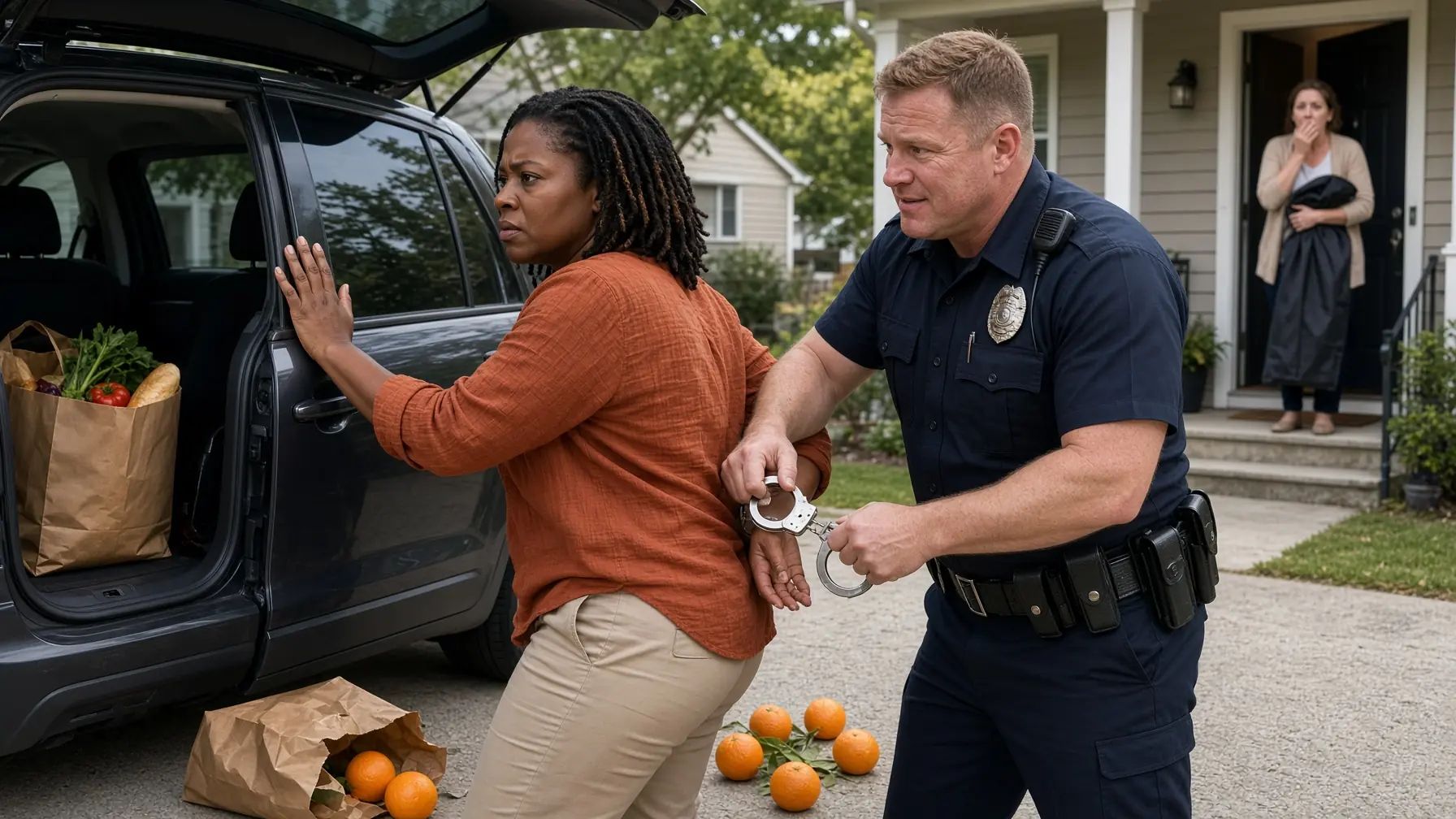
Kesha turned at the sound of the voice.
The officer was still on the sidewalk, several paces from her. One hand pointed toward the concrete as if she had already refused an instruction he had never given.
She stopped moving.
The grocery bag rested against the edge of the open trunk, supported by one hand. She let go of it carefully and raised both palms, empty and visible.
“Resisting what? I’m loading my car.”
He continued toward her.
For a moment, Kesha thought the distance between them would make the misunderstanding obvious. He had not spoken to her before that command. He had not approached closely enough to ask a question. There had been no exchange for her to resist.
Yet his face carried the certainty of a man arriving halfway through an argument he had already decided to win.
Kesha looked at his pointing hand.
Then at the navy uniform.
Then at the street behind him.
There was no one beside her.
No confrontation.
Only her SUV, grocery bags, and a house she had left that morning expecting to return to without incident.
“I’m standing still,” she said.
The officer reached her.
His fingers closed around her wrist.
The day had begun with Kesha trying to remember whether there was enough milk in the refrigerator.
It was a small question, but it had followed her through three rooms while she gathered the things she needed to leave the house. At forty-four, she had learned that keeping a household moving often depended on remembering items too ordinary to deserve much attention until they were missing.
She opened the refrigerator again.
Half a carton.
Enough for the morning.
Not enough for tomorrow.
She added milk to the list on her phone and closed the door.
Outside the kitchen window, the street was quiet. Leafy trees lined the sidewalks, and a light breeze moved through the branches without carrying enough chill to require a jacket.
Kesha had chosen a rust-colored blouse and cream trousers. Her brown flats waited near the back door, and her shoulder-length twists were gathered loosely away from her face while she washed a cup.
She liked mornings when she could move through the house without rushing.
That morning appeared to be one.
She put the cup in the drying rack, checked the shopping list, and added paper towels.
Then she removed paper towels.
She was almost certain there was an unopened package in the cupboard.
She checked.
There was.
The satisfaction of crossing an unnecessary purchase off the list was absurdly small, but she allowed herself to enjoy it. Prices had climbed enough that buying something twice felt less like forgetfulness than a failure of attention.
Her telephone vibrated on the counter.
A message asked whether she would be home later.
Kesha replied that she expected to be back before lunch.
She set the phone down without adding anything else.
There were things to do that afternoon, but none required her to spend the entire morning thinking ahead. She wanted to finish the groceries, put away what belonged in the refrigerator, and give herself a little time before the next part of the day began.
At the doorway, she stepped into her flats and checked the soles.
One had picked up a small stone near the heel.
She removed it with her thumb.
Then she took her keys, her reusable bags, and the list.
The SUV stood in the driveway beneath a patch of moving tree shade. Kesha opened the rear passenger door and placed the empty bags inside before walking around to the driver’s seat.
A neighbor across the street was watering a planter.
“Morning, Kesha.”
“Morning.”
“Beautiful out.”
“Let’s hope it stays that way.”
The neighbor lifted a hand.
Kesha returned the gesture and got into the car.
Later, she would remember that exchange with surprising precision. The hose. The planter. The ordinary greeting spoken without anyone needing to establish who belonged where.
At the time, she barely thought about it.
It was simply home.
The grocery store was busier than she expected.
A delivery had arrived near one entrance, narrowing the path around stacked containers, and several customers were waiting for carts. Kesha took a smaller one because she did not intend to buy much.
She always intended to buy less than she did.
The list helped.
She followed it through produce, dairy, and the dry goods aisles, making practical adjustments when something was unavailable. She selected oranges from a display near the front, checking them one at a time for soft spots.
A little boy beside the display watched her.
“Why do you turn them?”
His mother looked embarrassed.
“Sorry.”
“It’s fine,” Kesha said.
She held one orange gently between her fingers.
“I’m checking whether it’s good.”
“How do you know?”
“You look. And sometimes you feel.”
The boy considered that.
Then he began turning an orange in his own hands with great seriousness.
His mother smiled.
Kesha placed her chosen fruit in a bag and moved on.
Near the dairy case, she saw an older woman trying to reach a container on the upper shelf. Kesha asked which one she wanted and passed it down.
The woman thanked her twice.
Once was enough.
Kesha continued shopping.
She had no idea those small exchanges would later become part of the morning she mentally reviewed, searching for the point at which ordinary life had turned into something she needed to defend.
Nothing had happened.
That was the point.
Nothing had happened.
She bought groceries.
She answered a child.
She reached something for a stranger.
Then she stood in a checkout line and watched the total rise on the register.
The cashier asked whether she wanted cold items grouped together.
“Yes, please.”
Kesha began arranging the bags as they came toward her, placing heavier items beneath lighter ones and keeping glass away from the fruit. One reusable bag had a worn seam near the handle, so she asked that it not be filled too heavily.
The cashier nodded.
Kesha appreciated being heard without needing to repeat herself.
She paid, tucked the receipt into the side of a bag, and pushed the cart outside.
The parking lot had grown brighter while she was inside.
She opened the trunk and packed carefully.
Cold items went together.
The bag containing the oranges sat near the edge because it was light enough to lift first when she got home.
Before closing the trunk, she noticed that one handle had slipped beneath another bag.
She corrected it.
She did not like pulling at groceries once they were wedged into place.
Then she returned the cart and drove away.
The route home was familiar.
A construction crew had closed part of one lane, and she slowed behind a truck while workers guided vehicles past. A driver ahead of her hesitated at the temporary signal, drawing an impatient horn from somewhere behind.
Kesha kept her distance.
There was no benefit in making an uncertain driver more uncertain.
When the road opened again, she turned toward the neighborhood and let her shoulders relax.
She was thinking about lunch.
She had bought bread and something she could heat without much preparation.
The plan was simple enough that she had already begun enjoying it.
At a red light, her phone sounded from inside her handbag.
She did not reach for it.
It could wait until she parked.
The light changed.
She drove the final stretch beneath trees that had grown thick enough to soften the outlines of the houses along the street.
Her driveway was clear.
Her front door was closed.
Everything looked as she had left it.
Kesha pulled in, switched off the engine, and remained seated long enough to check the message.
It was not urgent.
She answered briefly.
Then she opened the driver’s door.
The air smelled faintly of cut grass.
Somewhere down the block, a mower had started.
Kesha walked to the back of the SUV and opened the trunk.
The bags had shifted during the drive, though not enough to damage anything. The cold groceries were trapped behind a heavier bag she did not want to lift with one hand.
She moved that bag aside.
Then she took the fruit bag from the edge, adjusted the way its handles lay, and placed it back into the trunk so she could clear space without catching it beneath the next load.
It was a movement she had made hundreds of times.
Lift.
Shift.
Set down.
Nothing hurried.
Nothing hidden.
She was leaning slightly into the open trunk when she heard footsteps on the sidewalk.
At first, they meant nothing.
People walked dogs.
Delivery workers came and went.
Neighbors passed on their way to other houses.
Kesha continued arranging the bags.
Then the voice came.
“Stop resisting. Get on the ground.”
Now the officer’s hand was around her wrist.
Kesha stared at it.
The grip was so immediate that her mind took a moment to catch up with her body. She had raised her hands. She had stopped moving. She had answered him.
None of those things had created the pause she expected.
“Wait,” she said. “You haven’t told me—”
He pulled.
Her arm moved away from the trunk before the rest of her body was ready. She stepped to keep her balance, and the grocery bag she had left at the edge tipped forward.
The handles slid.
The bag fell.
Oranges struck the driveway and scattered.
One rolled toward the sidewalk.
Another disappeared beneath the SUV.
Kesha heard the soft, irregular impacts and thought of the little boy turning an orange in his hands.
The memory flashed past.
Then the officer turned her.
Her shoulder met the side of the vehicle.
She tried to place her feet where she would not trip over the fallen bag.
“Shut up,” he said. “You don’t get to argue with me.”
Her cheek pressed against the window.
The glass was cool.
That sensation was clearer than anything else for a second: cool glass against skin, a twist in her held arm, the smell of her blouse as the fabric pulled at her shoulder.
She kept her free hand open.
It rested where he could see it.
“I’m not arguing,” she said.
“Then be quiet.”
Kesha closed her mouth.
Not because she accepted what he said.
Because she needed to understand the position of her arm and the pressure against the car before choosing another movement.
The officer was thirty-seven, broad-built, with short blond hair and a navy uniform that looked heavy with equipment at the belt. His name was Brett Cole.
Kesha saw the name when she turned her head enough to look at him.
She made herself remember it.
Brett Cole.
The act gave her mind something specific to hold.
Not just an officer.
Not just a uniform.
A person with a name, standing in her driveway, gripping her wrist.
She could feel him pulling her arm farther behind her.
“Don’t move.”
“I’m trying to stand.”
“You’re standing.”
“My feet aren’t steady.”
He adjusted his own stance.
He did not give her more room.
Kesha looked down as much as the position allowed.
An orange had stopped beside her left shoe.
If she shifted carelessly, it could roll beneath her foot.
She kept still.
The thought made her angry.
She was calculating the safest place for her shoe because he had knocked her groceries to the ground.
Meanwhile, he was speaking as if she had created every difficulty.
“Hands behind you.”
“You have one.”
“The other one.”
Kesha’s free hand remained open against the vehicle.
She did not move it immediately.
The officer’s grip tightened.
“Don’t make me tell you again.”
Kesha breathed in.
The blouse pulled across her back.
She was frightened now.
Not in the distant, hypothetical way people imagine fear before something happens.
It was close and physical.
It lived in the angle of her shoulder, the pressure at her wrist, and the knowledge that any movement he disliked could become another accusation.
She had to make decisions inside that fear.
That was the part people outside such a moment rarely understood.
Fear did not erase thought.
It crowded thought.
It made the simplest choices compete with every possible way they could be misunderstood.
Kesha kept her voice low.
“Tell me what you think I did.”
Cole leaned closer.
“I told you to stop resisting.”
“You said that before you reached me.”
He paused.
Only briefly.
Then he shifted his hand.
“You’re still doing it.”
Kesha felt the absurdity of the sentence like a second pressure.
She could not argue her way out of an accusation that treated the argument as proof.
So she looked at the window.
She could see a faint reflection of the street beyond him.
Trees.
A strip of pavement.
Part of a house across the road.
Everything around them remained ordinary.
The ordinary surroundings made the force feel stranger.
She was not in an unfamiliar place.
She was beside her own vehicle, close enough to the house that she could see the front steps if she turned her eyes.
She had not expected safety to require explanation there.
Cole looked toward the trunk.
“What’s in the bags?”
“Groceries.”
“What else?”
“Groceries.”
His mouth moved into a slight smile.
“Don’t get smart.”
Kesha kept her eyes ahead.
She had not intended the repetition as a joke.
It was the answer.
Milk.
Bread.
Oranges.
Things she had chosen, paid for, and brought home.
The receipt was in a bag.
She could tell him that.
She could offer to show it.
But he had not asked whether she paid.
He had not stated any concern that a receipt could resolve.
Offering random proofs might only give him more questions.
She needed him to name the thing he was doing.
“Am I being detained?”
Cole did not answer immediately.
“You’re going to cooperate.”
“That isn’t an answer.”
His expression hardened.
Kesha saw the change in the reflection before she turned her head.
She regretted the wording.
Not the question.
The question mattered.
She regretted giving him a sentence he could treat as a challenge instead of a request for clarity.
Still, she could not keep making every reasonable word smaller until it disappeared.
“Please tell me why you’re holding my arm,” she said.
Cole looked past her toward the house.
Then he looked at her free hand.
“Keep that where I can see it.”
“It’s open.”
“Then keep it that way.”
She spread her fingers a little farther.
The position was beginning to feel unnatural.
Her wrist trembled.
She did not know whether he noticed.
She hoped, if he did, he would understand that it was strain rather than defiance.
Then she realized how much she was hoping he would understand when he had not yet shown any interest in understanding.
A vehicle passed along the street.
It slowed briefly.
Kesha heard the engine change.
Cole looked toward it.
For a moment, she thought someone might stop.
The vehicle continued.
She could not see the driver.
She told herself not to blame a stranger for failing to recognize a situation in the seconds it took to pass.
The thought was reasonable.
It did not comfort her.
The mower down the block stopped.
Without it, the street felt quieter.
Kesha could hear clothing rustle whenever Cole changed his grip.
She could hear one orange still moving, slowly enough that its uneven roll made a faint sound against the driveway.
It reached a shallow dip and stopped.
That small motion angered her in a way she could barely explain.
Everything he had disturbed was settling into a new position.
The bag.
The fruit.
Her body.
And he seemed satisfied with the arrangement.
“Is this your vehicle?” he asked.
“Yes.”
“You live here?”
“Yes.”
“Identification.”
“It’s in my handbag.”
“Where?”
“In the front seat.”
Cole glanced toward the driver’s door.
Then back at her.
Kesha waited.
The request could have opened a path toward something factual.
He could look at the identification.
He could ask her name.
He could compare what she said with something.
Instead, he remained holding her against the SUV.
“Don’t reach for it.”
“I’m not reaching.”
“Good.”
The word sounded approving.
Kesha hated that.
He had restricted her movement, then praised her for remaining inside the restriction.
She looked at his name again.
Brett Cole.
She would remember it.
Not as a threat she intended to deliver.
As a fact.
The driveway sloped gently toward the street.
Kesha had noticed that slope mostly when rainwater ran along one edge or a child’s ball escaped from the neighboring yard.
Now she felt it beneath her shoes.
Her weight was uneven.
The hand behind her back pulled her shoulder in one direction while the pressure against the SUV held her in another.
She needed to move half a step.
She explained before doing it.
“My left foot is beside an orange. I need to move it.”
Cole looked down.
He saw the fruit.
His eyes returned to her face.
“Slowly.”
Kesha shifted her foot.
The movement was small.
He tightened his grip anyway.
She stopped.
For several seconds, neither spoke.
Kesha thought about the phrase he had used before reaching her.
Stop resisting.
It sounded like a description of something already happening.
It arrived with its own explanation built in.
A person hearing only those words might assume she had struggled.
A person seeing only this position might assume he had needed to put her there.
That was what frightened her most.
He was supplying the story before supplying a reason.
She had no idea whether he believed it.
She knew she could not let his words become the only words remembered.
“I raised my hands when you spoke,” she said.
Cole’s eyes narrowed.
“I saw.”
“I stopped.”
“Then stay stopped.”
“You pulled me.”
He leaned closer.
“You want to keep talking?”
Kesha looked at him.
The question was not really a question.
It offered silence as the only acceptable answer.
She felt anger rise fast enough that she had to wait before speaking again.
Her cheek remained near the window.
She could smell the clean interior through a slight gap where the rear door met the frame, mixed with the warm rubber scent from the vehicle.
She had wiped the inside of that window recently.
There had been fingerprints along the edge.
Now her own face was pressed against it.
The thought nearly made her laugh.
Not because it was funny.
Because the distance between that ordinary act of cleaning and this moment was so grotesque that her mind did not know where to put it.
She swallowed the reaction.
Cole might have mistaken even that for mockery.
The house behind them remained quiet.
The front door was closed.
Kesha did not look toward it for long.
She knew someone might come out.
She also knew she could not make another person responsible for deciding how to approach a man already using force.
Calling for help was not as simple as people imagined.
A name shouted from the driveway could bring someone running.
Someone running could give Cole another movement to interpret.
Kesha needed the scene to remain readable.
Her hands.
His grip.
The spilled groceries.
The distance he had crossed before ever asking a question.
Those facts mattered.
She wanted nothing to obscure them.
Cole moved his free hand toward his duty belt.
Kesha noticed immediately.
The shift changed her breathing.
She tried not to turn too quickly.
He saw her attention.
“Don’t worry about what I’m doing.”
The sentence had the opposite effect.
She kept her free hand open.
“What are you doing?”
“What does it look like?”
Kesha said nothing.
The handcuffs became visible.
He held them with the casual confidence of someone handling an object he used often.
To her, the metal looked startlingly definite.
Until that moment, part of her had still expected him to release her arm and call the encounter a misunderstanding.
The cuffs narrowed that expectation.
She could hear her heartbeat.
She did not want to hear it.
She wanted to hear him say why.
“Before you do that,” she said, “tell me what you’re arresting me for.”
Cole looked at her.
“You should’ve thought about that.”
“About what?”
He did not answer.
His expression carried a satisfaction that made her stomach tighten.
He seemed to believe the sight of the cuffs had accomplished something he wanted.
Perhaps he expected her to plead.
Perhaps he expected anger.
Kesha could not know.
She refused to guess at his private motives when his visible actions already demanded attention.
He had pulled her away from the trunk.
He had pushed her against the vehicle.
He was holding one arm behind her.
He had not named a reason.
She needed to keep those facts separate from the emotions he was provoking.
It was difficult.
Her anger was not calm simply because she had stopped speaking.
It filled her throat.
It made her want to turn fully and force him to look at her as a person rather than a position he had arranged.
She did not turn.
She moved only her head.
Enough to see him clearly.
Cole’s mouth held a satisfied smirk.
He interpreted her silence as surrender.
Kesha saw that interpretation settle across his face.
It changed something in her.
Not the fear.
The fear remained.
But beneath it, she found a steadier place from which to speak.
She had spent much of her life learning when to explain, when to repeat, and when to let a person’s own words remain exposed.
There were times when answering every sentence only gave someone more sentences to hide behind.
This was becoming one of them.
She looked directly at Cole.
“You’d better remember every word you just said.”
He paused.
The cuffs remained in his hand.
For a moment, the smirk lost its easy shape.
“What’s that supposed to mean?”
Kesha held his gaze.
Exactly what she had said.
She did not add a title.
She did not make a promise.
She did not give him a version of herself he could decide deserved better treatment than the woman he had first seen beside the trunk.
He had enough information to know how he ought to behave.
He had had it before touching her.
Her empty hands.
Her stopped movement.
Her answer.
The groceries.
The simple fact that he had never explained what he was doing.
She let the sentence stand.
Cole tightened his grip.
“Don’t threaten me.”
Kesha’s shoulder pulled.
She took a breath through the discomfort.
“I said remember.”
The distinction seemed to irritate him.
He looked toward the street.
No one stood on the sidewalk nearby.
The vehicle that had slowed was gone.
Across the road, the planter sat unattended.
Kesha followed his glance without moving her head farther.
She understood that he was noticing the audience, or the lack of one.
That understanding made her angrier.
A person should not need witnesses to make another person behave as if his actions would be remembered.
Still, witnesses mattered.
She knew that.
She could not see the house behind her properly.
She could see the front window reflected faintly in the SUV glass.
The reflection shifted when Cole moved.
For a second, her own face appeared over it.
Twists loosened near her cheek.
Rust-colored fabric pulled at the shoulder.
Eyes wider than she wanted them to be.
She did not look like the woman who had checked whether she needed milk.
She looked like someone trying to make her body small enough not to provoke another command.
Kesha hated the sight.
She did not blame herself for it.
That distinction was important.
Fear had altered her expression.
It had not made her responsible for the encounter.
She reminded herself of that while Cole changed the position of the cuffs in his free hand.
The metal made a faint sound.
He shifted his stance closer.
Kesha kept her open palm where it could be seen.
If he demanded that hand next, she would need to move it carefully.
She was already planning the motion.
The planning made her feel trapped in a future he was building without answering for the present.
“Officer Cole,” she said.
He looked at her.
Using his name changed his expression.
Only slightly.
But she noticed.
“I’m not moving away from you. I’m asking you to tell me what you believe happened.”
He stared.
“You don’t get to run this.”
“I’m asking a question.”
“And I’m giving you instructions.”
She looked at the cuffs.
Then back at him.
The exchange had reached a point where repeating herself no longer created any possibility of understanding.
He was not misunderstanding the question.
He was declining it.
Kesha became quiet.
This time, the silence was a decision she made consciously.
Cole seemed relieved by it.
His smirk returned, though less completely than before.
He moved the cuffs nearer her held wrist.
Behind them, the front door opened.
The sound was ordinary.
A latch.
A slight movement of hinges.
The kind of sound that belonged to every day Kesha had lived in the house.
It should not have been enough to change the air in the driveway.
Yet it did.
Cole’s eyes moved past her shoulder.
Kesha did not turn.
A woman stood on the porch carrying a garment bag.
She had apparently been about to step outside.
Now she stopped.
The bag hung from one hand, its long shape motionless beside her.
Her face changed as she took in the open trunk, the groceries on the driveway, the officer’s body close to Kesha’s, and the arm held behind her back.
The expression was not uncertainty.
It was horror.
Cole noticed.
His hand remained on Kesha’s wrist.
The cuffs remained open.
The woman did not immediately speak.
She looked at Kesha.
Then at the officer.
Then down at the oranges scattered across the concrete.
One lay near the porch steps.
Another had stopped beside the fallen bag.
The detail seemed to make the scene clearer rather than less serious.
This had begun with groceries.
The woman could see that.
Kesha did not ask her for help.
She did not turn the moment into an introduction.
She did not explain the garment bag or give Cole a new fact to calculate.
Her attention stayed on him.
The officer’s smirk faltered.
He looked back at Kesha.
For the first time since crossing the sidewalk, there was a question in his expression that did not carry an accusation.
He seemed to be trying to understand what her silence meant.
Whether it belonged to fear.
Whether it belonged to anger.
Whether the woman on the porch would speak.
Whether something about the morning had escaped him.
Kesha could answer only one of those questions with certainty.
He had missed the beginning.
Or chosen not to see it.
A woman placing a bag in a car.
An empty driveway.
A command that accused her of resisting before she had even turned.
She looked steadily at him.
Her free hand remained open.
The porch door stood behind the other woman, and the garment bag remained unexplained at her side.
Neither woman supplied him with anything that could make his earlier conduct belong to a different story.
Cole’s fingers held Kesha’s wrist.
The cuff had not closed.
His face lost the last of its easy satisfaction.
And Kesha watched him remember.