The first strike left a white fracture across Naomi Carter’s window.
She screamed before she could stop herself. Until that moment, some part of her had believed Officer Travis Cole was threatening something he would not actually do.
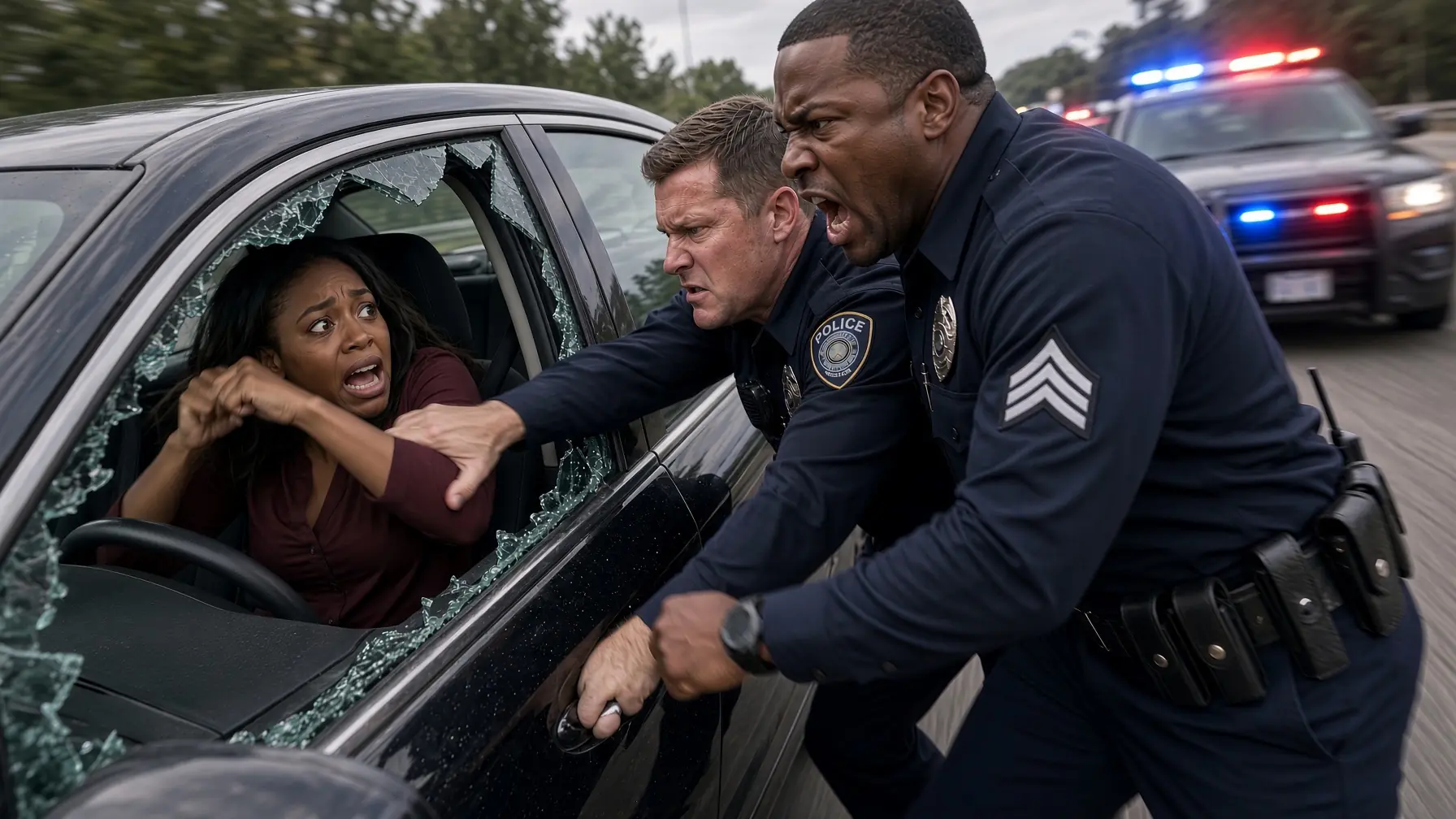
The second strike shattered the glass.
Naomi threw her arms over her face as fragments burst into the car. They struck her burgundy blouse, scattered across the console, and settled into the leather seat beneath her.
Through the speakers, someone was calling her name.
Through the broken window, the officer was shouting.
“Get out!”
His arm came inside.
Naomi recoiled toward the passenger seat, pulling away from the hand reaching for the interior handle.
“What are you doing?”
“Out of the car!”
She could not understand how the evening had become this. She had given him her license, registration, and insurance, and she still had not been told why he stopped her.
Behind the sedan, tires scraped hard against the shoulder.
Another police SUV stopped.
A door opened.
Cole continued reaching through the window, too occupied with the door to notice the man coming toward him.
“Cole!”
The shout cut through everything.
The younger officer froze.
“Back away from her. Now.”
Naomi lowered one arm enough to see a senior officer advancing along the driver’s side. He looked at the empty window frame, the glass across her clothes, and Cole’s hand inside the vehicle.
Then he placed himself between them.
“Step away.”
“Sergeant, she refused—”
“I said step away.”
Cole withdrew his arm.
For the first time since he returned to her window, Naomi had room to breathe.
She tried.
The breath caught halfway in.
The sergeant turned toward her, keeping his hands visible.
“Ma’am, are you hurt?”
“I don’t know.”
A fragment slid from her hair onto her shoulder.
“My face—”
“Don’t touch it yet.”
He spoke more quietly.
“My name is Sergeant Aaron Mitchell. I’m not reaching into the vehicle. Okay?”
Naomi nodded.
The simple explanation almost made her cry.
He had told her what he was doing before doing it.
Thirty-two minutes earlier, she had been leaving work.
Northbridge Architectural Group’s parking garage was cool compared with the afternoon outside, and Naomi had paused beside her sedan to finish a message before getting in.
At 4:06, she finally put the office behind her.
At 4:10, she texted her younger sister.
Leaving now. Dinner around six?
Maya answered almost immediately.
Only if you bring dessert.
Naomi smiled.
Extortion.
The day had already required more patience than she wanted to spend. Five hours of contractor disagreements over a medical-office renovation had left her with a headache and a list of decisions waiting for the next morning.
She was a project manager.
Most days, that meant translating urgency into a sequence people could actually follow. It meant explaining why one person’s change affected another person’s work and why raising a voice did not shorten the time required to solve a problem.
She wanted to stop explaining things.
She wanted food, her sister’s company, and an evening in which nobody used the phrase just one more question.
The black sedan had become one of the few places where her day reliably quieted.
She had bought it after a promotion, following almost three years of saving for the down payment. Her father had warned her about depreciation.
Her mother had told him to let their daughter enjoy something.
Naomi enjoyed the car.
It was comfortable, dependable, and quiet enough that she could hear herself think when she wanted to. She had owned it for eighteen months without imagining that its closed window would ever be the only boundary between her and a man with a baton.
She drove west.
Near the Oakwood intersection, she changed lanes.
Half a mile later, emergency lights appeared in her mirror.
Naomi looked down at her speed, then back at the road.
She did not know what she had done.
She signaled and pulled over as soon as the shoulder widened enough to stop safely.
The patrol vehicle settled behind her.
For a moment, she sat still.
She had been stopped before.
Once for speeding at twenty-two, when the reason had been obvious.
Once for a broken taillight, when the officer explained it before asking for her documents.
She expected this encounter to follow the same ordinary pattern.
Officer Cole approached the driver’s side.
Naomi lowered the window about four inches.
“License and registration.”
There was no greeting.
No reason for the stop.
She looked toward her purse.
“My license is in my wallet.”
“Get it.”
She moved slowly, taking out the wallet and then the documents.
Cole watched her hands.
Naomi handed him the license, registration, and insurance card through the opening. She returned her hands to the steering wheel.
He examined the license.
Then he looked inside the car.
“Where are you coming from?”
“Work.”
“What work?”
“Architecture.”
“You an architect?”
“Project manager.”
Cole glanced across the interior.
“Hm.”
The sound was small enough that Naomi could not say what it meant.
That was part of why it stayed with her.
He looked at her license again.
“You live in Fairmont?”
“Yes.”
“That’s an expensive neighborhood.”
Naomi waited.
The officer offered no explanation for why the neighborhood mattered.
She looked at his face.
“Can I ask why you stopped me?”
His expression changed.
“You can wait.”
“I haven’t been told.”
“I said wait.”
Naomi closed her mouth.
He returned to his cruiser with her documents.
She watched him in the mirror.
He typed.
Looked up.
Typed again.
The car’s air conditioning continued blowing softly against her hands. Outside, traffic moved past in steady bursts, carrying people toward whatever they expected the rest of their day to be.
Naomi began reviewing the drive.
The intersection.
The lane change.
Her speed.
She could not identify a reason.
Six minutes passed.
When Cole returned, he did not carry a citation.
He pushed her documents through the narrow opening.
“Step out of the vehicle.”
Naomi took them and frowned.
“Why?”
“Step out.”
“Am I under arrest?”
He leaned closer to the window.
“Not yet.”
Her fingers tightened around the license.
She set the documents on the console.
“My hands are visible.”
“I didn’t ask where your hands were.”
“I’d like to understand why you’re ordering me out.”
Cole reached for the door handle.
Naomi flinched.
The door was locked.
He pulled again.
“Unlock it.”
She looked at him through the glass.
“Why?”
His voice rose.
“Unlock the damn door.”
The sudden anger made the car feel smaller.
Naomi could see his face more clearly now, close enough that the four-inch opening no longer felt like space through which they were speaking. It felt like a gap he was trying to overcome.
“I want a supervisor,” she said.
Cole looked at her.
“I’m the only officer you need.”
She had not expected that answer.
It did not calm her.
It made the absence of anyone else more apparent.
She asked again.
He repeated the order to unlock the door.
Naomi glanced toward her phone.
Cole followed her eyes.
“Don’t touch that.”
“I’m calling 911.”
“You’re talking to the police.”
“I’m asking for another officer.”
“This isn’t a game.”
“I know.”
She did not reach across the car.
She used the steering-wheel control.
“Call emergency services.”
The hands-free connection began.
Cole stared at her.
Naomi looked straight ahead, keeping both hands where he could see them.
A dispatcher answered.
“911. What’s your emergency?”
“I’m on Route 17 near Oakwood. I’ve been stopped by an officer, and I’m requesting a supervisor.”
Cole slapped the roof.
“I gave you an order.”
Naomi’s shoulders jerked.
The dispatcher heard it.
“Are you in immediate danger?”
Naomi looked toward the officer.
“I don’t know.”
It was the most accurate answer she had.
It also seemed to make him angrier.
“Get out of the vehicle.”
“Officer, I’m asking why.”
“Out.”
“Please call a supervisor.”
The dispatcher asked for information about the patrol vehicle.
Naomi gave what she could see in the mirror.
Cole stepped away.
For one brief second, she believed the call had worked.
He had stopped pulling the handle.
He was no longer shouting through the opening.
Perhaps he was checking with dispatch.
Perhaps someone had told him another officer was coming.
Then he returned carrying the baton.
Naomi’s stomach dropped.
“Officer.”
“Unlock the door.”
“Please wait for your supervisor.”
He raised the baton.
“Last chance.”
She stared at his hand.
“Why are you doing this?”
The first blow landed.
The sound filled the cabin.
Naomi screamed.
The dispatcher said something sharply through the speakers.
Cole struck again.
The glass collapsed.
Now Sergeant Mitchell stood beside the ruined window, asking whether she was hurt.
Cole was still behind him.
“She refused a lawful order to exit.”
Naomi turned toward him.
“That isn’t what happened.”
Cole pointed.
“Stay quiet.”
Mitchell turned his head.
“Cole.”
One word.
The hand lowered.
Naomi watched the exchange closely.
The officer who had ignored her requests responded immediately to a man of higher rank.
She did not know whether to feel relief or something worse.
Mitchell looked back at her.
“What was the original stop for?”
Naomi opened her mouth.
Then stopped.
“I don’t know.”
The sergeant frowned.
Cole answered from behind him.
“Failure to signal.”
Naomi looked at him.
“What?”
“You heard me.”
She turned to Mitchell.
“He never told me that.”
The sergeant’s attention shifted toward the passenger seat.
Her phone lay there, screen lit.
The call was still connected.
“Were you speaking with dispatch?”
“Yes.”
“Why?”
“Because he started yelling. I asked for a supervisor.”
Cole moved forward.
“She was refusing instructions.”
Mitchell faced him.
“Go stand beside your cruiser.”
“Sergeant—”
“Now.”
Naomi watched Cole walk away.
Only when he reached the patrol vehicle did her shoulders begin shaking.
She tried to stop.
She did not want him to see her trembling and decide that it confirmed something he already believed. She did not want fear to become another word in his report.
Hysterical.
Agitated.
Out of control.
She breathed through her nose.
Slowly.
Then out.
At twenty-nine, she knew the difference between looking composed and feeling composed.
She had never felt that difference so sharply.
Mitchell lowered himself beside the door.
“What’s your name?”
“Naomi Carter.”
“Ms. Carter, I need to understand what happened before I arrived.”
She looked past him.
“Is he staying there?”
“Yes.”
“Then I’ll tell you.”
Mitchell nodded.
Naomi began with the road.
She explained passing Oakwood, seeing the lights, and finding enough shoulder to stop.
He asked about the window.
She told him she had lowered it partway.
“Why partway?”
“Because I was nervous.”
He did not argue with the answer.
He asked about the documents.
She had provided all of them.
He asked about the conversation afterward.
She described the questions concerning her job and neighborhood, then her unanswered request to know why she had been stopped.
Mitchell listened without supplying words for her.
That helped.
It also made her aware of how disjointed the memory felt.
The individual moments were clear.
The order sometimes required effort.
“He went back to the cruiser,” she said. “When he returned, he told me to get out.”
“Did he explain why?”
“No.”
“Did you tell him no?”
“I asked why.”
“What did he say?”
“That he was telling me to.”
Naomi swallowed.
“I asked if I was under arrest. He said, ‘Not yet.’”
Mitchell’s jaw tightened.
She described the handle.
The locked door.
The repeated requests for a supervisor.
“How many times?” he asked.
“Three.”
“What did he say?”
“That he was the only officer I needed.”
The sergeant stood slowly.
From the passenger seat, a faint voice came from the phone.
“Ma’am? Are officers with you now?”
Mitchell looked toward it.
“May I speak to dispatch?”
Naomi nodded.
He moved only after receiving her permission and switched the call to speaker.
“This is Sergeant Aaron Mitchell, Unit 412. I’m on scene.”
The dispatcher answered immediately.
“Sergeant, I requested you directly approximately four minutes ago.”
Mitchell glanced toward Cole.
“Tell me why.”
“The caller requested a supervisor multiple times. We were also having difficulty getting the primary unit to acknowledge status checks.”
Naomi closed her eyes briefly.
She had imagined the call might sound different to someone outside the car.
Confused.
Unnecessary.
A frightened driver making too much of an officer’s impatience.
The dispatcher was describing what she had actually done.
Asked for help.
Mitchell continued.
“Was the line open when the window was struck?”
“Yes.”
“Recorded?”
“Affirmative.”
Cole stood close enough to hear.
His head lowered.
Naomi opened her eyes.
The recording did not repair the window.
It did not take the glass out of her hair.
But the truth no longer depended only on her ability to explain it while shaking.
Someone else had heard her.
Mitchell returned the phone to the seat.
“Would you like medical assistance?”
Naomi almost refused automatically.
She wanted to say she was fine.
She wanted the event to become manageable by describing it as manageable.
“No,” she said.
Then she touched her cheek carefully.
A small red spot appeared on her fingertip.
She stared at it.
“Actually, yes.”
Mitchell radioed for paramedics.
Then he walked toward Cole.
Naomi could not hear the first part of their conversation.
She could see the younger officer talking quickly.
Pointing toward the sedan.
Shaking his head.
Mitchell listened.
Then he pointed at Cole’s body camera.
Cole looked down.
The change in his face was visible even across the shoulder.
The anger diminished.
Concern replaced it.
Naomi recognized whose concern it was.
It was not about the glass across her clothes.
It was about the record on his chest.
The paramedics arrived and asked her to remain still.
They removed small fragments from her hair and examined the cut on her cheek. Another shallow cut marked her forearm.
Nothing required stitches.
They told her that carefully, as reassurance.
Naomi nodded.
She understood they were describing injuries.
She still hated how small the words made the incident sound.
Superficial.
Minor.
Nothing serious.
The baton had struck the window twice while her face was close to it.
The absence of a deeper wound did not make the decision harmless.
She did not say that to the paramedics.
They were trying to help.
She let them finish.
When she stepped out of the sedan, glass shifted beneath her shoes.
She stood beside the ambulance with a thin gray blanket around her shoulders, despite the summer heat.
Another lieutenant had arrived.
After speaking with Mitchell, he directed Cole to turn over the baton and sit inside a second police vehicle.
Cole complied.
Naomi watched him lower himself into the seat.
He did not look at her again.
A tow truck was called because the driver’s seat and surrounding area were covered in glass.
Someone asked whether she could move the car a short distance.
She looked at the open window frame.
“No.”
The answer came more firmly than anything she had said to Cole.
She was not sitting there again.
Mitchell approached when the medical examination was finished.
“Ms. Carter, I need to explain what happens next.”
Naomi looked at him.
“That would be nice.”
He accepted the criticism without defending the department.
“Officer Cole is being relieved from field duty pending review.”
“Pending review.”
“Yes.”
“Does that mean he goes home?”
“Today, yes.”
She stared at him.
Mitchell continued.
“The body-camera footage will be preserved. So will the dispatch recording. My vehicle camera captured part of the incident as I arrived.”
“What about my car?”
“We’ll document the damage.”
“That isn’t what I meant.”
He waited.
Naomi pointed toward the window.
“What gave him the right to do that?”
Mitchell did not answer quickly.
She appreciated the pause.
It suggested he was considering the question rather than searching for the shortest defense.
“There are circumstances where an officer can direct a driver out during a traffic stop,” he said. “That doesn’t settle whether the force he used here was justified.”
Naomi folded her arms.
“He never explained anything.”
“I understand.”
“I wasn’t reaching for a weapon.”
“I understand.”
“I didn’t try to drive away.”
“I understand.”
“He hit the window after I asked him to wait for you.”
Mitchell looked toward the second police vehicle.
Then back at her.
“The sequence is going to matter.”
He asked again what reason Cole had given for the stop.
“None.”
“He says you failed to signal.”
“I signaled.”
“You’re certain?”
“Yes.”
Naomi looked at the sedan.
Then something she had been too frightened to remember became clear.
“It records driving data.”
Mitchell followed her gaze.
“The vehicle?”
“Yes. And I have a dashboard camera.”
He looked through the windshield.
The small camera sat behind the mirror.
“Was it recording?”
“Yes.”
“Don’t let anyone remove the card except the investigator handling the evidence.”
Naomi nodded.
She had chosen the camera because she spent so much time on the road for work.
She had imagined it might help after an ordinary collision.
She had never imagined needing it to establish what a police officer had done beside her closed door.
Maya arrived before the tow truck left.
She took one look at the sedan and stopped.
Then she looked at Naomi.
“Are you hurt?”
“Not badly.”
Maya came close and put her arms around her.
Naomi held herself stiff for a second.
Then she leaned in.
She had managed her voice for the officer.
Managed her answers for the sergeant.
Managed her fear while people examined her face.
Her sister’s embrace required nothing.
That was when she began to cry.
The days afterward did not follow the clean rhythm of the roadside intervention.
There was no final shout that made everything normal.
There were calls.
Investigators.
Insurance representatives.
The repair shop.
Department staff.
Each person needed something specific.
A statement.
A photograph.
An authorization.
A description.
Naomi answered until the language began blurring together.
She hired Rachel Kim within the first week.
Rachel was forty-one, precise, and organized in a way Naomi usually appreciated at work but now found almost comforting.
At their first meeting, Rachel set a legal pad between them.
“Before we discuss procedure, I want to address something.”
Naomi nodded.
“People online are trying to decide who you secretly are.”
She frowned.
“Secretly?”
“Judge. Federal agent. Prosecutor. Someone related to a chief.”
Naomi gave a short laugh.
“I manage construction projects.”
“I know.”
“Why would they make that up?”
“Because they expect the reason someone intervened to be a revelation.”
Naomi looked down.
The sergeant had not recognized her.
He had recognized broken glass and an officer reaching into a car.
Rachel leaned forward.
“You don’t need an important title for what happened to matter.”
Naomi sat back.
The sentence reached something the careful official language had not.
She had spent days being described as the driver, the complainant, the woman involved.
Now someone had stated the simplest point without qualification.
Rachel began building a timeline.
They separated what Naomi remembered from what the recordings could confirm.
When she had lowered the window.
When she provided the documents.
When Cole returned.
When he tried the handle.
When the call connected.
When he produced the baton.
Rachel did not ask her to make the account smoother than it was.
“If you don’t remember exactly, say so.”
“What if that makes me sound uncertain?”
“It makes you accurate.”
Naomi nodded.
At work, she was used to reconstructing decisions from emails, schedules, and drawings.
This felt different.
The uncertainty was attached to her own fear.
Rachel helped her keep it from becoming shame.
The recordings were clearer than either officer or driver could have been afterward.
Available traffic footage showed Naomi signaling before the lane change.
Her dashboard camera recorded the indicator clicking inside the cabin.
The vehicle’s data supported the same sequence.
That evidence did not require investigators to assume Cole had knowingly invented the original reason.
An officer could misperceive a movement.
But it did mean his allegation needed examination rather than acceptance simply because he had written it down.
Then there was the stop itself.
His body camera showed Naomi providing the requested documents.
It recorded the questions about her work and address.
It recorded her asking why she had been stopped.
It recorded his refusal to explain.
Investigators watched him return from the cruiser and order her out.
They heard her ask whether she was under arrest.
“Not yet.”
They heard the requests for another officer.
“I’m the only officer you need.”
The 911 recording continued through what happened next.
The roof slap.
The dispatcher’s questions.
Naomi’s uncertain answer about whether she was in danger.
The baton.
Investigators returned repeatedly to the seconds before the first strike.
Naomi asked him to wait.
Cole responded that she did not tell him how to do his job.
Then he hit the window.
The sequence mattered because it allowed the review to examine the decision before the destruction, rather than treating the shattered glass as something that had somehow happened during a difficult encounter.
Naomi knew little of that during the first week.
She knew her sedan was at a repair shop.
She knew the shallow cuts were healing.
She knew she woke at night hearing the first impact again.
Sometimes the memory arrived while she was brushing her teeth.
Sometimes it arrived at a red light in the rental car.
Once, a worker dropped a metal tray in a restaurant, and Naomi’s body jerked before she could decide whether to move.
Maya saw it.
Naomi reached for her water.
Her sister waited.
“You don’t have to act fine.”
“I am fine.”
Maya looked at her.
Naomi sighed.
“Fine-ish.”
“That isn’t a word.”
“It is today.”
Maya reached across the table.
“What do you need?”
Naomi looked at the hand.
She wished she knew.
She did not want to spend every conversation talking about Cole.
She did not want to make the incident the explanation for everything she felt afterward.
She also could not make herself stop feeling it.
“I want the drive before he stopped me,” she said.
Maya nodded slowly.
Naomi continued.
“The part where I was annoyed about work and thinking about dessert.”
Her sister squeezed her hand.
They ordered dessert.
It did not solve anything.
It gave the evening another event to contain besides the dropped tray.
Three weeks after the stop, Naomi attended a formal interview at police headquarters.
Rachel sat beside her.
Mitchell was not present.
Neither was Cole.
Two investigators asked detailed questions.
Where were her hands?
Did she reach toward the glove compartment?
Had she threatened the officer?
Had she used profanity?
When did he touch the door handle?
Was that before the call connected?
Naomi answered carefully.
She did not enjoy the questions.
She understood why details mattered.
Then one investigator asked, “Why didn’t you simply get out when instructed?”
Rachel shifted beside her.
Naomi answered first.
“Because I was afraid.”
The investigator waited.
“He was angry before I knew why he had stopped me. When he tried the door, I became more afraid.”
“Did you think getting out would put you in greater danger?”
“I didn’t know.”
“That was your concern?”
“Yes.”
“Why request a supervisor?”
“I wanted another officer there.”
The investigator made a note.
Naomi watched his pen.
Then she looked at him.
“When another officer arrived, he stopped.”
The pen paused.
“How do you mean?”
“The baton stopped. The shouting stopped. He took his hand out of my car.”
Neither investigator spoke.
Naomi continued.
“That’s why I asked.”
Rachel remained quiet.
There was nothing to improve in the answer.
The internal review expanded beyond Naomi’s stop.
Cole had been an officer for five years.
Three earlier complaints appeared in the records.
One had been dismissed for lack of sufficient video evidence.
One concerned an escalation during a parking dispute.
Another driver had described Cole threatening to break a window after being asked why he wanted the driver out.
That complaint had not produced a sustained finding.
There had been counseling.
Now the similarities required another look.
The existence of a previous complaint did not prove it true.
It did make the department’s earlier response part of the question.
What had been examined?
What had been dismissed?
What had the officer been told?
What had changed afterward?
Naomi learned those details gradually.
She did not want every accusation against Cole treated as established because of what happened to her.
She wanted the records reviewed properly.
Her own case had enough evidence to stand without borrowing certainty from somebody else’s unresolved complaint.
The review compared Cole’s report with the recordings.
His account omitted Naomi’s repeated requests for a supervisor.
His description of her as physically noncompliant did not match her movements before the window broke.
He said he feared she would drive away.
The footage showed the sedan stationary.
Her hands remained visible.
There was no movement toward the gear selector.
No acceleration.
No attempt to escape.
When asked what made flight appear imminent, his explanation changed.
Her attitude.
Her refusal to unlock the door.
His intuition.
The reviewers did not accept those answers as sufficient to justify the force shown.
The department determined that the baton strike violated its use-of-force policy.
Cole was suspended.
After the disciplinary process, he was terminated.
The findings were also referred to the county prosecutor for independent review.
Naomi learned of the termination while she was at work.
A contractor was disputing an electrical change order when her phone vibrated.
Rachel’s message was brief.
Decision is out. Call when you’re free.
Naomi looked at it.
Then she returned to the meeting.
For twenty-seven minutes, she listened, asked questions, and explained what the project required.
She did not know whether continuing was composure or avoidance.
It was simply what she could do.
Afterward, she went into an empty conference room and called Rachel.
The attorney explained the decision.
Naomi listened without interrupting.
Then there was silence.
“You all right?” Rachel asked.
Naomi looked through the window.
Workers below were installing glass panels along a building façade.
“I thought I’d feel more.”
“More what?”
“I don’t know. Relief.”
“Do you?”
“A little.”
Rachel let her answer remain incomplete.
Naomi touched the place on her forearm where the cut had been.
The skin had healed.
The moment had not become equally simple.
“Accountability doesn’t take you back,” Rachel said.
“I know.”
Knowing did not prevent Naomi from wishing it could.
Her car returned from the repair shop with a new driver’s window and repaired interior trim.
The shop had cleaned it carefully.
The seat had been removed.
The tracks had been vacuumed.
The carpets had been detailed.
Still, glass appeared.
A fragment near the console.
Another inside a door pocket.
One beneath the seat where she had dropped a pen.
The first time, she froze.
The second time, she became angry.
She called the shop, then apologized for sounding sharper than she intended.
They offered to clean it again.
She accepted.
After that, each new piece felt like the incident refusing to become past.
It was not enough that the window looked whole.
Something small remained where she had expected it to be gone.
Mitchell saw her two months after the stop.
They were in a coffee shop.
Naomi stood near the pickup counter in a cream jacket and black pants, her hair now cut to her shoulders.
The sergeant noticed her first.
He hesitated.
Then she saw him.
For a fraction of a second, neither moved.
Mitchell lifted a hand.
“Ms. Carter.”
“Sergeant.”
He approached without crowding her.
“How are you?”
She gave a faint smile.
“Everybody asks that.”
“Sorry.”
“No. It’s all right.”
He held his coffee with both hands.
“I heard the full call.”
Naomi looked away.
“All of it?” she asked.
“All of it.”
“I haven’t listened.”
“I understand.”
She looked back.
“What did I sound like?”
Mitchell considered the answer.
“Scared.”
Naomi laughed once, quietly.
“I hoped you’d say calm.”
“You were calm.”
He paused.
“You were also scared.”
She looked at him for a moment.
The distinction felt familiar.
Hearing another person name both parts made it less necessary to choose which one she was allowed to admit.
Mitchell shifted the cup.
“When I arrived, I didn’t know anything about you beyond the call.”
Naomi raised an eyebrow.
“I’d hope not.”
He smiled slightly.
“There wasn’t a special alert. Dispatch said a driver was asking for a supervisor during an escalating stop, and the primary officer wasn’t responding clearly.”
He looked toward the window.
“I was two miles away.”
“So you came.”
“Yes.”
She watched him.
“Thank you.”
Mitchell shook his head.
“I don’t want credit for arriving after he broke your window.”
“You stopped what happened next.”
He became quiet.
Naomi looked at her own cup.
Sometimes she thought about the seconds between the second strike and his shout.
Cole’s arm inside.
The handle.
The command to get out.
She could not know what would have followed.
She knew that his arrival stopped it.
Neither tried to answer the question aloud.
They said goodbye without turning the meeting into a ceremony.
Naomi took her coffee to work.
Mitchell left through the other door.
The city approved several policy changes six months after the stop.
Procedures concerning supervisor requests during escalating encounters were tightened.
Officers received further training on de-escalation and vehicle extraction.
Certain uses of force required supervisory review before an officer returned to regular field duty.
Naomi read the changes.
She did not expect them to solve every problem.
She wanted them to make the next driver’s request harder to ignore.
That was more useful than a statement praising her courage.
She had not wanted to be courageous.
She had wanted someone to explain the stop and let another officer arrive.
Her civil claim was eventually settled without a trial.
The settlement addressed medical care, property damage, legal expenses, and compensation.
It did not contain the dramatic sentence people often imagined an agreement would provide.
Rachel prepared her for that.
“They may never give you the words you want.”
“Which words?”
“We were wrong.”
Naomi considered it.
She thought about the recordings.
The policy finding.
The sequence in the report.
“I already know what happened,” she said.
Rachel nodded.
The settlement did not require Naomi to feel grateful.
It gave her practical resolution to some of the practical damage.
She could appreciate that without pretending it repaired everything else.
One Saturday morning, she found another fragment of glass.
It lay beneath the driver’s mat, a tiny cube catching sunlight from the open door.
She picked it up.
For a moment, she examined it.
Separated from the window and the force that broke it, the piece looked almost harmless.
She could hold it without feeling the baton.
That surprised her.
Naomi walked to the trash bin and dropped it inside.
Then she returned to the car.
She did not search the cabin for more.
She drove to meet Maya.
They argued about who was bringing dessert.
Almost a year after the stop, traffic on the interstate backed up.
Naomi’s navigation offered another route.
Route 17.
She looked at the screen.
For months, she had found reasons to avoid that road.
Five minutes longer.
Eight minutes longer.
An errand that made a different turn seem sensible.
She had not called it avoidance.
Now she had no useful reason to take the slower alternative except that she did not want to pass the shoulder.
She sat at the intersection and considered it.
Then she turned.
Trees moved past.
A gas station.
A church.
The Oakwood intersection.
Her hands tightened around the steering wheel.
She noticed.
She loosened them.
Half a mile later, she recognized the place.
The shoulder was wider there.
Grass edged the pavement.
Cars passed it without slowing.
There was no cruiser.
No ambulance.
No broken window.
The place had continued existing while she carried the event elsewhere.
Naomi expected a dramatic feeling.
Relief.
Anger.
Fear.
For several seconds, she felt only the ordinary work of driving.
She checked the mirror.
Watched the car ahead.
Maintained her speed.
The shoulder passed beside her.
Then behind her.
A vehicle farther ahead changed lanes.
Naomi activated her signal.
Click.
Click.
Click.
She moved over.
And continued.
People online had spent months inventing a different explanation for her story.
Some called her a prosecutor.
Others claimed her father commanded a police department.
One version said Mitchell recognized her and understood that Cole had chosen the wrong woman.
Naomi disliked that version most.
The sergeant had not needed to recognize her.
He had seen the damaged window.
The officer reaching inside.
The woman covered in glass.
He had asked what happened.
That was enough to begin doing what should have been done.
Naomi Carter had no badge in her purse.
She had no private number for the chief.
She was a twenty-nine-year-old project manager who had provided her documents, kept her hands visible, asked a question, and called for help when she became afraid.
The recordings made those facts harder to dispute.
Her job did not make them more important.
Ahead, the road opened into afternoon sunlight.
Naomi’s phone displayed a message from Maya asking when she would arrive.
At the next safe opportunity, she answered.
On my way.
Then she put the phone aside and kept driving.