“GET YOUR HANDS UP! DON'T YOU DARE MOVE!”
The officer's voice exploded across the quiet Georgia highway.
Amara Cole slowly raised both hands beside the open door of her black luxury sedan.
She was forty-four years old, tall, extraordinarily beautiful, and carried herself with the kind of confidence that made people turn their heads before she spoke.
Her deep dark-brown skin glowed beneath the bright afternoon sun.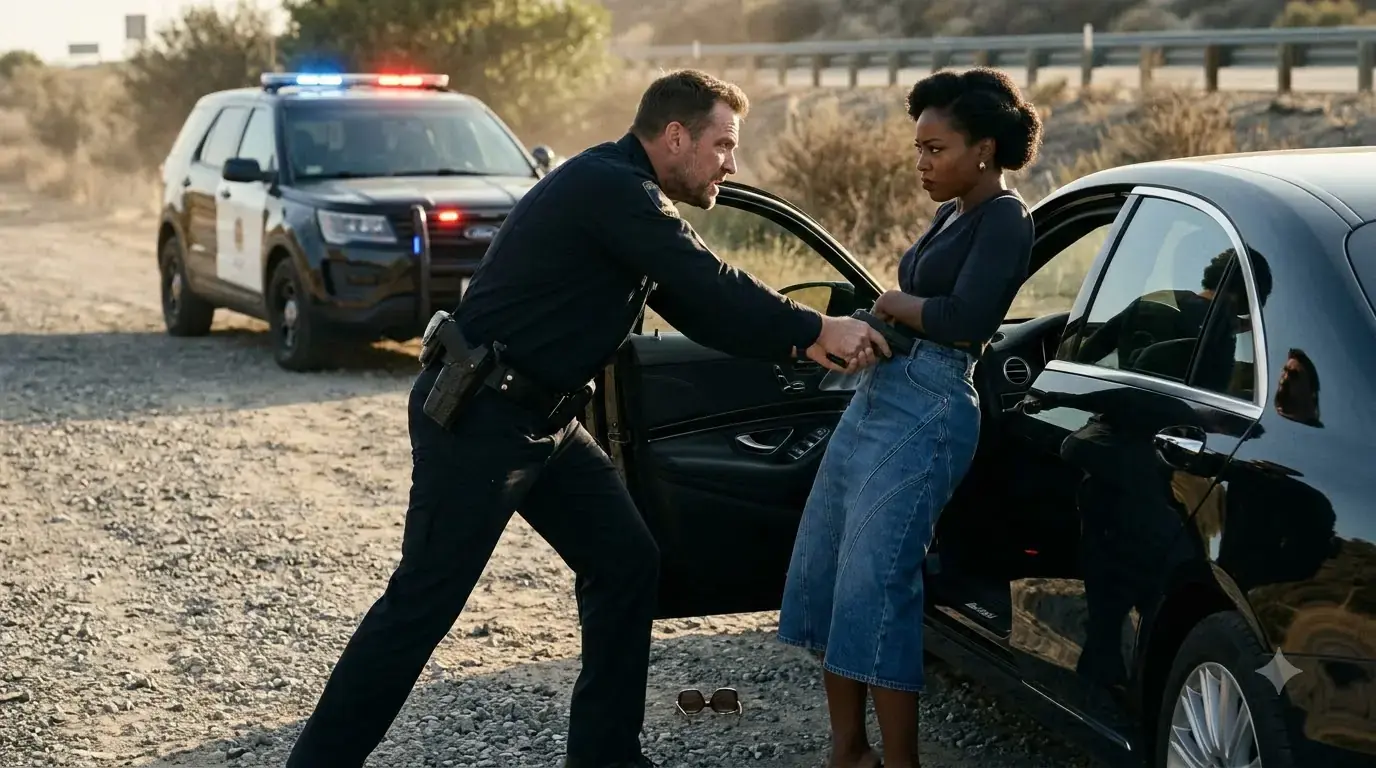
Long, perfectly straight jet-black hair flowed past her waist, with beautiful blunt bangs framing her sculpted cheekbones and dark eyes.
She wore angular designer sunglasses, an enormous polished gold bracelet, elegant heels, and a magnificent denim-blue designer mini dress.
The dress had thin straps, a striking plunging neckline, a structured corset bodice with small gold ring details, and an extraordinary sculptural skirt made of oversized rounded fabric folds.
It was the kind of outfit people expected to see at an exclusive fashion event.
Not on the gravel shoulder of a rural highway.
Standing directly in front of her was Officer Travis Briggs.
Forty-five years old.
White.
Muscular and stocky, with short brown hair, a square jaw, and a face twisted with anger.
His dark navy police uniform stretched across his broad chest.
A pistol remained pointed toward Amara.
Behind him, a marked patrol cruiser flashed red and blue beside the empty road.
A second officer stood near the cruiser, watching nervously.
Her name was Elena Price.
She was twenty-nine and had been with the Calder County Police Department for just eleven months.
What happened over the next ten seconds would change all three of their lives.
“Keep those hands where I can see them!” Briggs shouted.
Amara held her position.
“They're already raised, Officer.”
He stepped closer.
“Don't get smart with me!”
“I'm not resisting.”
Briggs holstered his pistol.
Then suddenly lunged forward.
SLAP!
His open hand struck Amara across the cheek.
Her head snapped sideways.
Her expensive sunglasses slipped down her face.
For a moment, the entire highway seemed to fall silent.
Amara stared at him in disbelief.
“Did you just hit me?”
Briggs grabbed her upper arm.
“YOU HEARD ME! DON'T MOVE!”
He violently shoved her backward.
Her shoulder struck the open sedan door.
The impact made the door swing against its hinges.
Amara caught herself before falling.
Her beautiful denim dress shifted beneath the force of the shove.
She straightened immediately, refusing to let him see her frightened.
“Take your hands off me!”
Briggs laughed.
“You think your fancy clothes make you special?”
He snatched the fallen sunglasses from her hand.
Then threw them onto the roadside gravel.
They bounced against a small stone.
One lens cracked.
Amara slowly turned her head toward the broken glasses.
Then looked back at him.
Her expression changed.
The shock disappeared.
Something colder replaced it.
She had spent nearly twenty years dealing with dangerous people.
She knew the difference between confidence and cruelty.
And she recognized a man who believed humiliation was part of his authority.
Briggs saw her expression and became angrier.
“What's that look for?”
Amara answered quietly.
“I'm remembering exactly what you're doing.”
He stepped closer.
“Remember this, then.”
His hand moved toward her waist.
He spotted the discreetly holstered handgun beneath the edge of her structured dress.
His eyes widened.
“A GUN?”
Amara remained still.
“Officer, I'm lawfully armed. Please keep your hands away from the trigger.”
Briggs drew the holstered weapon clear and secured it.
Then held it away from her.
A triumphant grin crossed his face.
“I KNEW YOU WERE TROUBLE!”
Officer Price approached.
“Briggs, we should verify her identification.”
He snapped his head toward her.
“Stay out of it!”
The younger officer stopped.
Amara looked at her.
For the briefest moment, their eyes met.
Price's expression was troubled.
Briggs began searching for identification.
His hand found a small concealed pocket in the structured fabric of Amara's dress.
Inside was a black leather credential wallet.
He pulled it out.
Then laughed.
“What's this? Another fake designer accessory?”
Amara slowly straightened.
“Open it.”
Briggs smirked.
“Giving orders now?”
She looked directly into his eyes.
“Read the badge.”
He flipped the wallet open.
And froze.
A gold official shield gleamed beneath the sunlight.
Beside it was an identification card bearing the seal of the State of Georgia.
The sheriff's department officer stared.
Then read the name.
AMARA COLE.
Beneath it were words that made his stomach turn.
GEORGIA BUREAU OF INVESTIGATION.
SPECIAL AGENT IN CHARGE.
PUBLIC CORRUPTION INVESTIGATIONS.
For three seconds, Officer Travis Briggs couldn't breathe.
He looked at the badge.
Then at the beautiful Black woman standing before him.
Then back at the badge.
His mouth opened.
Nothing came out.
Officer Price stepped closer.
“What is it?”
Briggs didn't answer.
Amara slowly lifted her chin.
Her voice was almost a whisper.
“Now you know who I am.”
The young officer looked over his shoulder.
Her face changed instantly.
“Sir…”
Briggs snapped the wallet closed.
His hands were trembling.
“That's fake.”
Amara didn't move.
He swallowed.
“That's got to be fake.”
She looked toward his body camera.
“Then verify it.”
Briggs stared.
For the first time that afternoon, he seemed genuinely frightened.
Because Amara Cole wasn't merely a wealthy woman driving through the Georgia countryside.
She was the senior state investigator responsible for examining a corruption case that had been quietly developing for eight months.
And Officer Travis Briggs had just assaulted her beside a police cruiser with its recording systems operating.
But that wasn't the worst part.
The worst part was something Briggs had no way of knowing.
Amara had been traveling through Calder County to meet a witness connected to the disappearance of dozens of confiscated vehicles.
Her black sedan wasn't on the road by accident.
And the officer who stopped her had just revealed something that no investigator had been able to prove.
He was personally involved in the scheme.
Eight months earlier, a woman named Nia Washington had walked into a Georgia Bureau of Investigation field office carrying a folder of photographs.
Nia was thirty-six, a Black registered nurse who worked twelve-hour shifts at a hospital near Savannah.
She was raising two children alone.
Her mother lived with her following a stroke.
And for years, Nia had been saving to purchase a reliable vehicle large enough to transport her family.
Eventually, she bought a used black SUV.
It wasn't new.
It wasn't particularly expensive.
But she was proud of it.
She kept the interior spotless.
Made every payment on time.
And treated it like something much more valuable than transportation.
It represented independence.
One evening, while driving home after a hospital shift, Nia was stopped by an officer from the Calder County Police Department.
The officer claimed the vehicle matched the description of an SUV involved in a theft.
Nia provided her driver's license.
Registration.
Insurance.
And proof of purchase.
The officer examined the documents.
Then told her to step out.
She complied.
Twenty minutes later, her SUV was being loaded onto a tow truck.
Nia stood beside the highway watching the vehicle disappear.
She asked where it was going.
The officer handed her a printed receipt.
“Pinecrest Recovery.”
She looked at the document.
“But that's my car.”
The officer shrugged.
“Then you can pick it up when the investigation's finished.”
No one explained what evidence connected her vehicle to the alleged theft.
No one gave her a clear date when it would be released.
And when she called the department the following morning, she was told the matter remained under review.
Three days later, Pinecrest Recovery informed her that the vehicle had accumulated towing, administrative, and storage charges.
Five days later, the amount had grown again.
Nia tried to pay.
She was told a police hold prevented release.
Then she contacted the police department.
An employee told her to speak with the towing company.
The two organizations sent her back and forth until she no longer knew whom to believe.
During that time, she missed work.
Her children missed activities.
And her mother had to postpone a medical appointment.
Eventually, Nia received a letter stating that her vehicle might be subjected to a lien sale unless outstanding charges were resolved.
She stared at the notice.
For several minutes, she couldn't move.
Then she began crying.
Not because she didn't understand paperwork.
But because the paperwork seemed designed to make recovering her own vehicle impossible.
She hired a lawyer with money she'd been saving for her daughter's education.
The lawyer began examining the situation.
And discovered that Nia wasn't the only person reporting the same problem.
There were others.
A construction worker.
A retired teacher.
A college student.
And a delivery driver whose truck had been impounded after a disputed roadside inspection.
The names were different.
The circumstances varied.
But one company appeared repeatedly.
Pinecrest Recovery Services.
And so did one police officer.
Travis Briggs.
The GBI had received complaints about Calder County before Nia arrived.
Most concerned property seizures.
Some involved allegations of improper searches.
Others described police officers who became threatening whenever motorists questioned why they were being detained.
At first, the cases appeared unrelated.
Different vehicles.
Different roads.
Different dates.
But Special Agent Amara Cole had learned that patterns rarely announced themselves.
Sometimes they appeared in small details.
A towing company receiving an unusual number of police referrals.
A series of vehicle releases delayed without clearly documented reasons.
Or a group of officers whose reports used almost identical language to describe drivers who had supposedly become uncooperative.
Amara had been assigned to review the allegations after several attorneys asked the state to examine Calder County's practices.
She didn't immediately assume corruption.
A complaint wasn't proof.
And a police officer didn't become guilty simply because someone disliked a traffic stop.
But the allegations were serious enough to investigate.
Her team began requesting records through the appropriate procedures.
They reviewed towing contracts.
Evidence logs.
Arrest reports.
And financial documents.
They interviewed complainants.
Compared dates.
And examined whether the same officers appeared repeatedly in questionable incidents.
The results troubled her.
Pinecrest Recovery Services received far more business from the department than other local towing operators.
The company was owned by Charles Danner, a wealthy businessman who frequently attended county political events.
Danner donated generously to law enforcement charities.
Sponsored police fundraisers.
And appeared in photographs beside the chief of police, Raymond Kessler.
The relationship wasn't automatically improper.
Business owners could support community organizations.
And police departments could contract with towing companies.
But investigators discovered that certain impounded vehicles entered Pinecrest's inventory with incomplete paperwork.