"What about Kenneth Briggs?" I asked, looking at the photograph of the portly, balding county inspector.
"Briggs was the key to their entire legal defense," Torres took over, opening a physical ledger. "Whenever a resident questioned the legitimacy of the drainage problems at the retention pond, Renata would produce an official, stamped 'Notice of Critical Municipal Drainage Hazard' issued by the County Department of Public Works, signed by Chief Inspector Briggs. That notice legally mandated emergency remediation—which conveniently justified hiring Verdant Crest LLC at twelve hundred dollars a day without competitive bidding."
Torres tapped the screen, pulling up the GPS data logs I had extracted from Briggs’s county-issued fleet vehicle.
"Your optical time-lapse records from Camera 03 were the smoking gun, Victor," Torres said, shaking his head in admiration. "You proved that for three years, no county inspection vehicle ever entered Whispering Pines on the dates Briggs claimed to have conducted physical on-site soil and water assessments. In fact, your GPS cross-referencing showed that during four of the certified inspection times, Briggs’s official truck was parked outside a sports bar eight miles away."
"Briggs broke fifteen minutes after we showed him the split-screen comparison between your 4K video log and his forged inspection certificates," Vance-Wells added. "He resigned his municipal post this morning, surrendered his county pension, and pleaded guilty to three counts of official misconduct and falsification of public records. He’s looking at four to six years in state custody."
Vance-Wells shut her laptop, took off her reading glasses, and looked across the table at me with profound, professional respect.
"Victor," she said quietly. "In white-collar and financial crime prosecution, the biggest obstacle we face is always plausible deniability. Corrupt officials hide behind corporate bureaucracy, lost paper files, and claims of simple administrative negligence. They assume that if they make the web complicated enough, nobody will have the time, the expertise, or the courage to untangle it."
She smiled, gesturing to the glowing screens.
"You didn't just untangle it. You built an impenetrable digital cage that trapped them by their own digital footprints. You saved thirty-eight families from financial ruin, and you permanently dismantled the most sophisticated municipal extortion network this county has seen in fifty years."
"I just wanted to protect my house, Deborah," I said honestly.
"You protected a community, Victor," she said, sliding a thick manila envelope across the table to me. "And the state is officially closing the file."
I picked up the envelope.
Inside was the certified, gold-stamped decree signed by Judge Marcus Harrison:
FINAL DECREE OF JUDICIAL TERMINATION AND DISCHARGE OF RECEIVERSHIP.
Whispering Pines Homeowners Association fully restored to civilian governance.
All liens permanently expunged.
Restitution fund successfully distributed: $2,410,000.00.
Special Master Victor Vance formally discharged with highest commendation of the court.
I stood up, shook hands with Vance-Wells, Torres, and Miller, packed my drives into my Pelican case, and walked out of the Justice Complex into the warm, bright afternoon.
By 2:00 PM, I was back in Whispering Pines.
The cul-de-sac was humming with the sweet, ordinary sounds of suburban life.
Down at number 1410, Harold Jenkins was standing in his side yard, wearing a wide-brimmed straw hat and a canvas apron. Beside him, David and Sarah Miller’s two young daughters were kneeling on the grass with small plastic hand trowels, helping Harold plant bright yellow daffodils along the border of his stone birdbath.
"Dig a little deeper, girls!" Harold’s warm, booming laughter floated across the asphalt. "The roots need good, rich soil to drink up the spring rain!"
Across the street, at number 1445, the moving truck for the Miller family was backed up to the garage. Several neighbors—including Dr. Patel and young teenagers from Sycamore Lane—were carrying dining room chairs, boxes of books, and rolled-up rugs into the front hallway of the grand colonial.
Mrs. Gable was standing on the porch, handing out cold bottles of lemonade and freshly baked sugar cookies to the volunteers, her face radiant with happiness.
I stepped out of my truck, carrying my toolbox.
Harold looked up, saw me walking down his driveway, and waved his trowel in the air. "Victor! Come over here! Look what we found under the old azalea bed!"
I walked across the lawn and knelt beside the old man.
In his hand, he held a rusted, small brass plate from an old watering can, stamped with the date 1984—the year he and his late wife Mary had moved into Whispering Pines when the neighborhood was first founded.
"Thirty-two years, Victor," Harold said softly, his voice thick with wonder. "Mary and I buried this when we finished the front walkway. I thought it was gone forever when that monster took my home."
He looked up at the sunny sky, tears glistening in the corners of his eyes, but his smile was radiant.
"The soil remembers, Victor," Harold whispered. "No matter how much concrete and greed people pour over it... the good things always find a way to grow back."
"They certainly do, Harold," I said, gently clapping the old man on his shoulder.
Down the block, Deputy Carl Rays’ cruiser pulled up to the curb. He stepped out of the vehicle, not with his citation pad or his tactical gear, but holding an official wooden plaque wrapped in brown paper.
"Gather round, folks!" Rays called out, waving the neighborhood together. "I’ve got an official delivery from the County Commissioners' Office!"
The neighbors hurried over, gathering in a semi-circle around Harold’s front walkway. David and Sarah Miller came down from the porch, holding hands, while their daughters ran to hug Harold’s legs.
Deputy Rays tore the paper away to reveal a beautifully carved mahogany and brass plaque:
WHISPERING PINES MEMORIAL ARBORETUM & SANCTUARY.
DEDICATED TO HAROLD AND MARY JENKINS, AND THE CITIZENS OF WHISPERING PINES.
FOUNDED ON TRUTH, NEIGHBORLY DECENCY, AND THE UNYIELDING DEFENSE OF LIBERTY.
MARCH 2026.
The crowd broke into spontaneous cheers and applause. Harold wiped his eyes with the back of his dirty gardening glove, smiling so hard his cheeks turned crimson.
I stood at the edge of the circle, watching them celebrate.
For the first time since I had bought my house, I didn't feel like a systems engineer maintaining a perimeter against a hostile world. I didn't feel the need to calculate angles, verify optical redundancies, or monitor digital buffers.
I felt like a neighbor.
I walked back across the street to number 1442, climbed my porch steps, and looked up at Camera 02.
Its white aluminum body caught the golden rays of the afternoon sun, a silent, humble guardian watching over the laughter, the flowers, and the children playing on the curb.
I didn't turn it off. A good engineer never takes down a working network.
But as I stepped inside my home, leaving the front door wide open to let the warm spring breeze fill the hallway, I knew that some things in life don't need a screen to be seen.
The truth had won.
The neighborhood was free.
And Whispering Pines was finally whole.
Chapter 13 - The New Charter and the Block Party
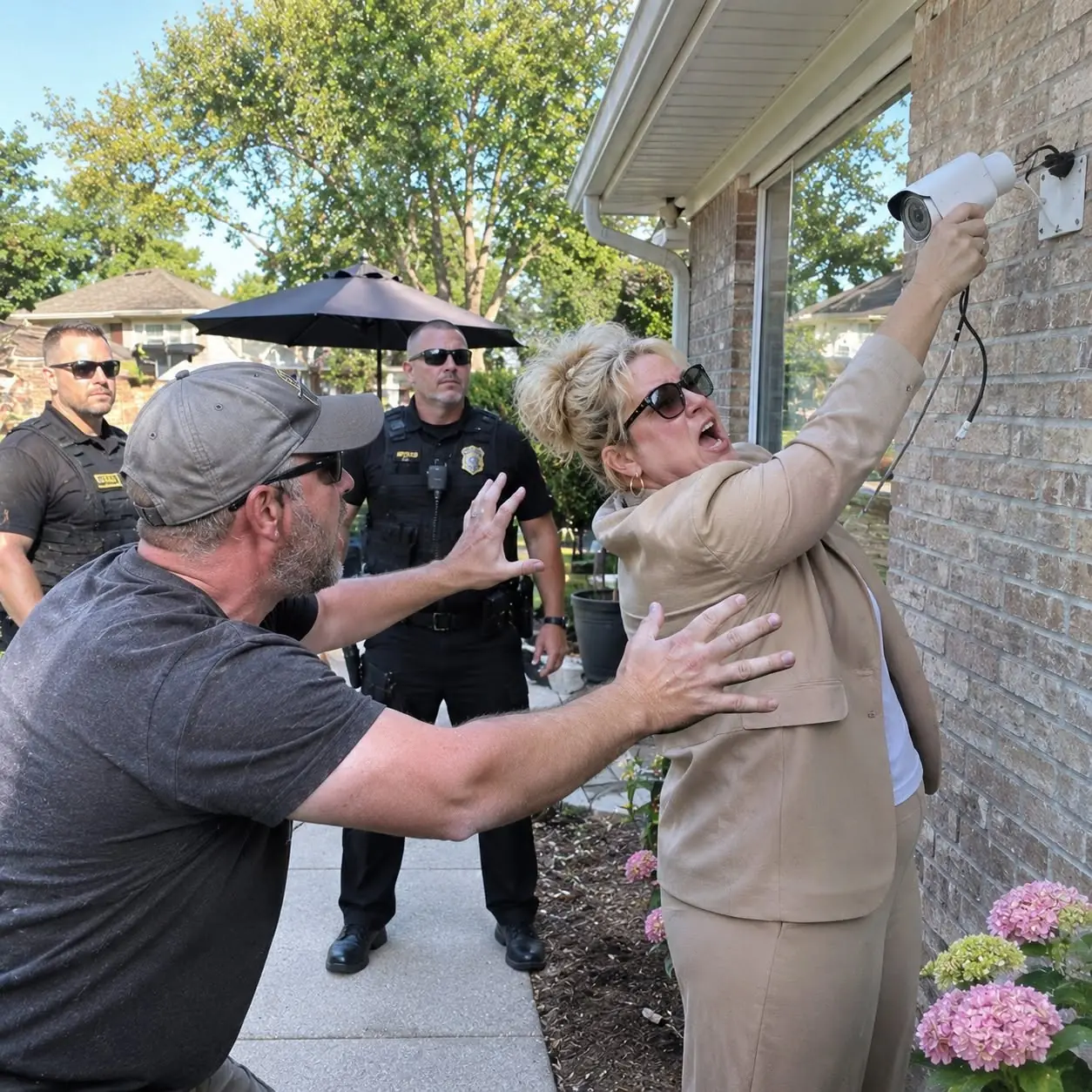
By the second Saturday of April, Whispering Pines was unrecognizable to anyone who had known it under the cold reign of the previous regime. The sterile, militaristic silence had been replaced by the rich, warm soundtrack of genuine community. The scent of hickory woodsmoke and sizzling barbecue ribs drifted through the warm spring breeze, mingling with the sweet fragrance of blooming cherry blossoms along the curbs.
Down at the head of the cul-de-sac, right in front of number 1410, two long banquet tables were set up end-to-end under colorful pop-up canopies.