The knock came at 7:48 on a Monday morning, which I know exactly because I was standing at the kitchen island with a peanut butter sandwich in one hand and a lunch bag in the other, and the microwave clock was the last thing I looked at before everything tipped sideways.
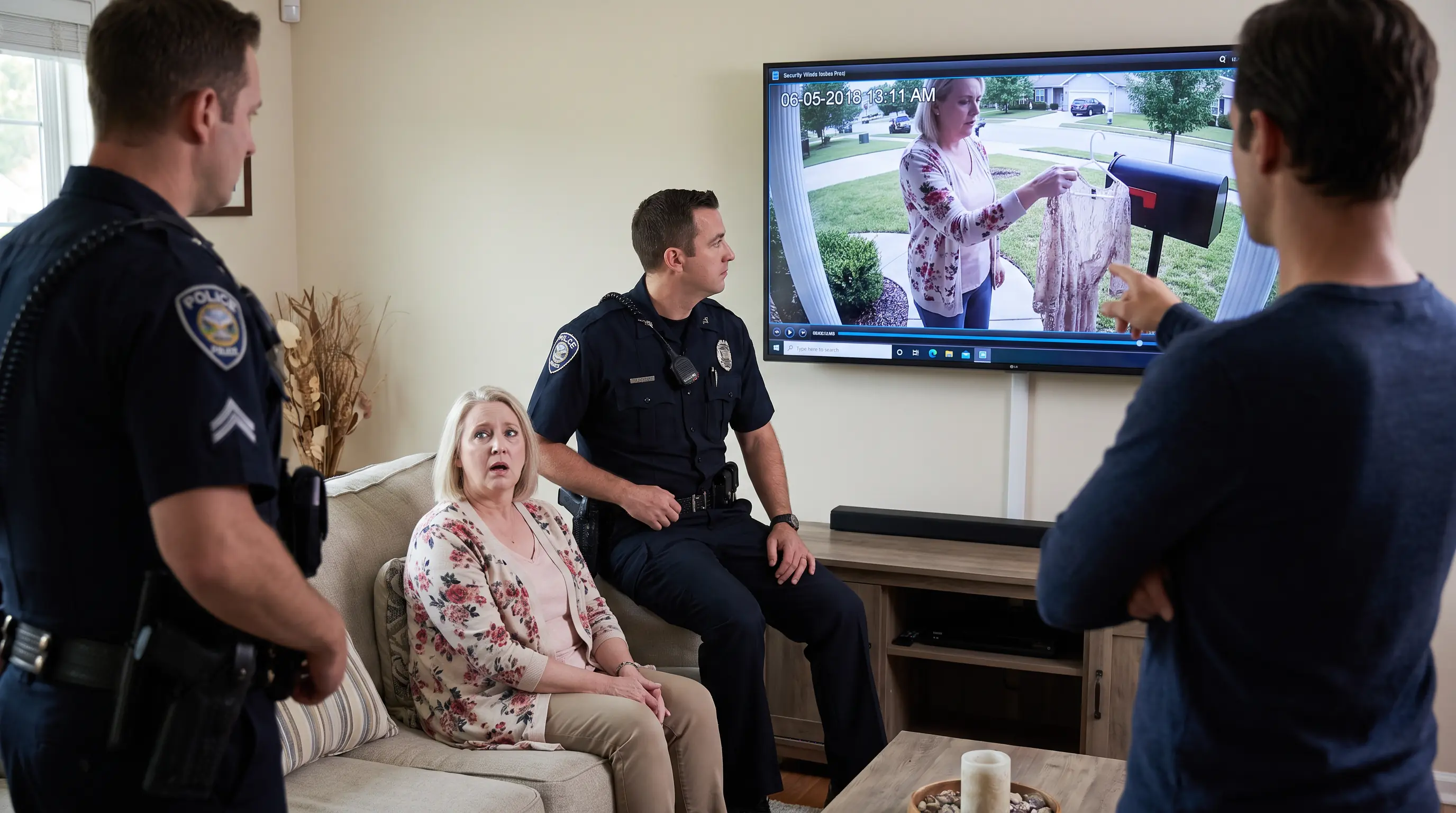
It wasn't a neighbor knock. Neighbors knock twice and then ring the bell, as if they're apologizing for knocking. This was three flat raps, evenly spaced, the kind of knock that already knows you're home.
"Dad," my daughter called from the stairs, "there's a police car in front of our house."
Pippa was ten that fall, and she said it the way she'd have said there's a heron in the retention pond, interested and unalarmed, because nothing in her life up to that point had given her a reason to think a police car could be about us.
I put the sandwich down. I zipped the lunch bag, because some part of my brain had decided that if the lunch was finished, the morning was still a normal morning. Then I opened the door.
There were two officers on my porch. The one in front was young and very tall, with a shaved head and a name tag that said MORELAND, and he had his thumbs hooked in his vest in a way that I think was meant to look relaxed. The one behind him was older, a woman with gray in her braid, who was looking not at me but past me, into my front hall, at the coat hooks and the shoe pile and Pippa's science fair trifold leaning against the wall.
"Mr. Overbeck?" Moreland said. "Grady Overbeck?"
"That's me."
"Sir, we've had a report of a theft from the residence next door. Do you mind if we ask you a couple of questions?"
And over his shoulder, at the end of my driveway, standing in a quilted pink robe with her arms folded and her phone held up against her chest like a hymnal, was Sheryl Kinsella.
I should explain who Sheryl Kinsella was to me at that moment, because she became a great deal more later, and I want you to understand where we started.
Sheryl was the president of the Kestrel Run Homeowners Association, a position she had held for seven years and which she described on the neighborhood page, without any irony that I ever detected, as "a calling." She lived at 112 Kestrel Court, in a gray two-story with white shutters and a flagpole that flew, depending on the season, an American flag, a pumpkin flag, a snowman flag, or a flag that said BLESS THIS NEST. Her lawn looked like it had been ironed. She was sixty-one years old and walked four miles every morning in a matching tracksuit and a visor that said KESTREL RUN 20TH ANNIVERSARY, and she knew the name of every dog in the subdivision and the expiration date of every temporary storage pod permit.
I lived at 114. Our side yards met at a split-rail fence that was more suggestion than barrier, with a gap at the back corner where a pair of old climbing roses had pulled two rails loose years before I ever arrived.
I had bought 114 Kestrel Court eighteen months earlier. It was a small brick ranch, the oldest house on the street, built before the subdivision grew up around it, and it had been sold by the estate of a woman named Hildur Engstrom, who had lived in it for forty-four years. I'd liked it because it was one floor, because it was ten minutes from the middle school where I teach seventh-grade life science, and because the backyard backed onto a strip of protected wetland where, on the evening I first walked the property, I'd heard an eastern screech owl doing its little descending whinny in the dark. I bid on it that night. I was told later there had been another bidder, a family, but I didn't think much about that at the time. You don't, when you win.