“THIS CHECK IS FAKE, AND YOU NEED TO GET OUT OF MY BANK!”
The sound of tearing paper echoed through the magnificent marble lobby of Harbor Bank's flagship branch in Manhattan.
Celeste Ray, the forty-seven-year-old branch manager, held a cashier's check worth $3.2 million between her perfectly manicured fingers.
She looked directly into the eyes of the beautiful Black woman standing across the glass counter.
Then she ripped the check in half.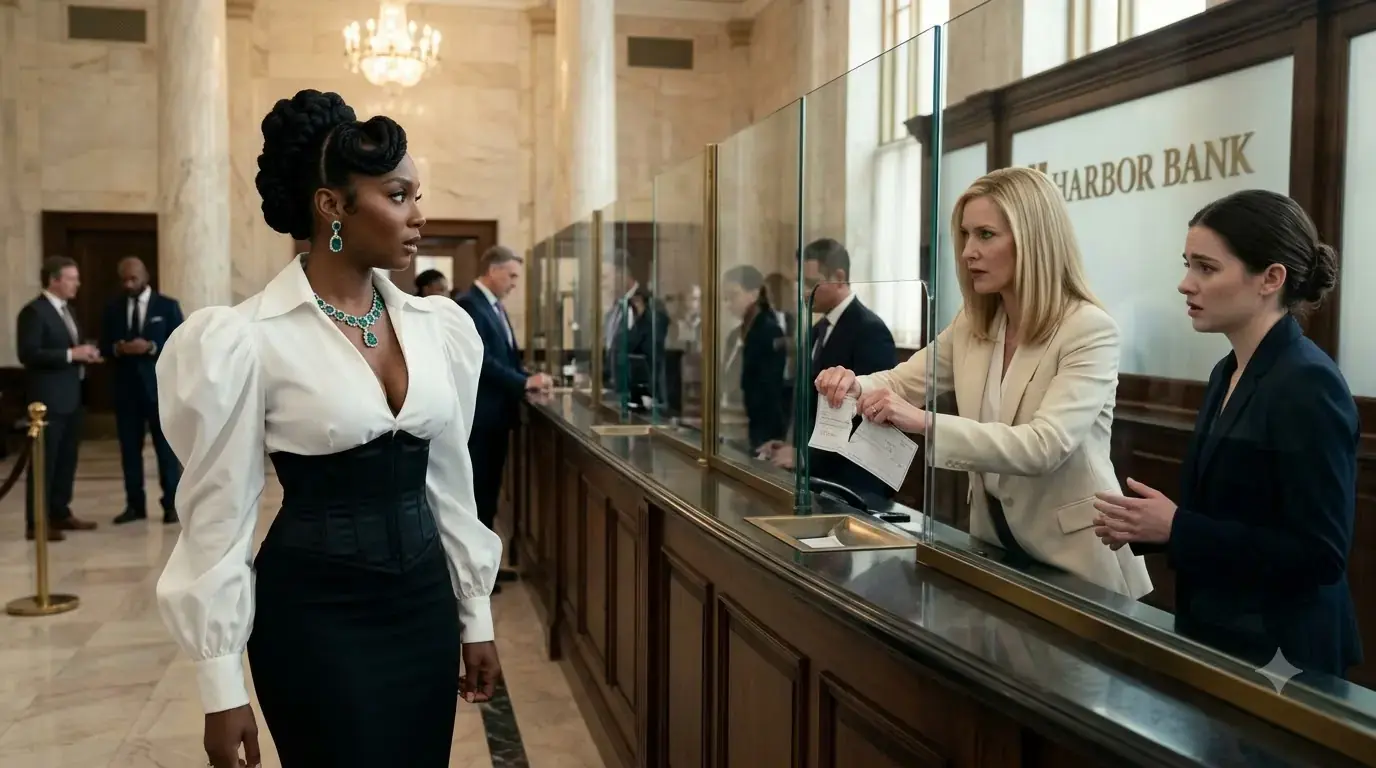
The sound was sharp.
Final.
Deliberate.
Several customers turned.
A security guard near the entrance straightened his shoulders.
And twenty-six-year-old bank teller Tess Moore stared at her supervisor in absolute disbelief.
“Ma'am,” Tess whispered, “that check has already been verified.”
Celeste ignored her.
She placed the two torn halves into the transaction tray and shoved them toward the customer.
“There. Take your little scam somewhere else.”
For a moment, nobody moved.
The woman standing on the other side of the counter was thirty-eight-year-old Amara Hayes.
She was extraordinarily beautiful, with rich deep-brown skin, elegant almond-shaped brown eyes, full lips, high cheekbones, and a graceful, curving figure.
Her glossy black hair was arranged in an intricate braided updo, with a carefully sculpted curl resting against her forehead.
She wore a magnificent white blouse with a dramatically wide pointed collar, voluminous puffed sleeves, and oversized flowing cuffs.
A structured black corset-style waistband emphasized her waist above a fitted black pencil skirt.
But the most striking feature of her appearance was the jewelry.
An exquisite emerald necklace rested around her neck, its large green gemstones surrounded by diamonds.
Matching emerald earrings caught the morning light.
The entire ensemble looked as though it belonged at a private fashion exhibition rather than an ordinary banking appointment.
Amara had been invited to a charitable foundation luncheon later that morning.
She had dressed carefully for the occasion.
Now she was standing in the lobby of a bank whose manager had just destroyed an authentic financial document and accused her of fraud.
For several seconds, Amara stared at the torn check.
Then she slowly raised her eyes.
“Mrs. Ray, I would appreciate an explanation for why you destroyed a verified financial instrument.”
Celeste gave a contemptuous laugh.
“Because I know what a scam looks like when I see one.”
Tess looked horrified.
She leaned closer to her manager.
“MA'AM, OUR SYSTEM CONFIRMED THAT CHECK IS VALID!”
Celeste turned sharply.
“I didn't ask for your opinion.”
“But the issuing record matched the serial number, the amount, and the beneficiary information.”
Celeste's face reddened.
She slapped Tess's outstretched hand away from the transaction tray.
“I DON'T CARE. SECURITY, REMOVE THIS WOMAN!”
The sound of the slap startled an elderly customer standing at the next counter.
Tess stepped backward.
Her eyes filled with tears.
Amara remained perfectly still.
She looked at Tess.
Then at the pieces of paper.
Then back at Celeste.
“LEAVE THOSE PIECES. THEY ARE EVIDENCE NOW!”
Her voice was no longer pleading.
It was quiet, controlled, and unmistakably authoritative.
Celeste laughed.
“Evidence? Of what? Your attempted fraud?”
Amara didn't answer.
She carefully retrieved her identification from the counter, leaving the torn check in place.
Then she turned and walked toward the bank's glass entrance vestibule.
Several customers watched her.
A middle-aged man in an expensive gray suit shook his head and returned to his phone.
A woman holding a designer handbag looked uncomfortable.
The security guard, Leon Brooks, took one step toward Amara.
But when he saw her calm expression, he hesitated.
“Ma'am, is there anything I can help you with?”
Amara looked at him.
“Yes. Please make sure no one discards those documents or alters the incident record.”
Leon blinked.
Then nodded cautiously.
“I can notify the appropriate supervisor.”
“Thank you.”
Amara stepped into the glass vestibule.
She took out her phone.
Then dialed a number that wasn't listed in the bank's customer service directory.
The call connected almost immediately.
“Ruth Bell speaking.”
Amara looked through the glass toward Celeste, who was already smiling at the next customer as though nothing unusual had happened.
“RUTH, YOUR NEW CEO NEEDS THAT LOBBY FOOTAGE!”
The woman on the other end stopped speaking.
For one second, the line was completely silent.
Then Ruth Bell, chairwoman of Harbor Bank's board of directors, asked a question that would change the course of the morning.
“Amara, what happened?”
Amara watched Celeste brush an invisible speck from her cream-beige blazer.
“The manager at your Manhattan flagship branch just destroyed a verified cashier's check and accused me of attempting fraud.”
Ruth took a sharp breath.
“Did she recognize you?”
“No.”
“Did you identify yourself?”
“No.”
Ruth was silent again.
Then she asked, “Are you safe?”
“Yes. I'm standing in the entrance vestibule.”
“Stay somewhere you're comfortable while I contact the appropriate people. I want the original footage preserved, not a convenient summary.”
Amara closed her eyes briefly.
“Thank you.”
Ruth's voice became harder.
“And Amara?”
“Yes?”
“Do not let anyone convince you this is a simple misunderstanding.”
Through the glass, Amara watched Tess Moore wipe her eyes and return to her computer.
Celeste was talking to the next customer.
Her smile was perfectly professional.
The contrast was almost unbelievable.
Amara lowered her phone.
Then she looked toward the polished marble floor beneath her heels.
She had spent twelve years building a financial technology company that helped smaller businesses access capital.
She had negotiated international acquisitions.
Led thousands of employees.
And recently completed a transaction that gave her controlling voting ownership of Harbor Bank's parent holding company.
In three days, the bank would formally introduce her to its staff as the new chief executive officer.
But before that announcement, she had decided to visit several branches without using her title.
She wanted to understand what ordinary customers experienced.
She had expected delays.
Confusing procedures.
Perhaps an employee who didn't know the answers to a complicated question.
What she hadn't expected was to watch a manager tear apart a verified $3.2 million cashier's check simply because she had decided the woman standing across from her didn't deserve to be believed.
Amara looked back toward the counter.
And then she noticed something.
Celeste had not yet realized that the person she'd ordered out of the bank was the woman who would soon be responsible for reviewing her performance.
But Tess Moore was staring at Amara through the glass.
Her expression had changed.
She had heard the last sentence of the phone call.
And her eyes were widening.
Across the lobby, Celeste followed Tess's gaze.
For the first time that morning, the arrogant manager looked uncertain.
Three weeks earlier, Amara Hayes had sat in a conference room overlooking the East River while Ruth Bell explained why Harbor Bank desperately needed new leadership.
The room was elegant but understated.
A long walnut table stood beneath recessed lights.
Floor-to-ceiling windows revealed the Manhattan skyline.
On one wall hung a photograph of the institution's first branch, established nearly a century earlier.
Ruth was sixty-seven, white, with neatly styled silver hair, thoughtful blue eyes, and the quiet authority of someone who had spent four decades navigating financial crises.
She had served as Harbor Bank's chairwoman for nine years.
She knew the institution intimately.
Its strengths.
Its weaknesses.
And the troubling ways those weaknesses had become easier to ignore.
Across the table, Amara reviewed a stack of reports.
Harbor Bank operated dozens of branches across New York, New Jersey, and Connecticut.
Its commercial lending division was respected.
Its wealth management business attracted prominent clients.
And its corporate banking relationships generated substantial revenue.
But its consumer banking division had been struggling.
Customer complaints were rising.
Employee turnover had increased.
Several branches reported excellent productivity figures while generating unusually high numbers of unresolved service disputes.
And the company's reputation among younger customers was deteriorating.
Ruth looked toward Amara.
“The board believes we need a complete operational reset.”
Amara turned another page.
“The complaints are concentrated in certain branches.”
“Yes.”
“Why?”
Ruth sighed.
“That's what we're having difficulty establishing.”
Amara studied the figures.
One location stood out.
Harbor Bank Manhattan Flagship — Midtown.
According to internal reports, the branch had one of the highest sales conversion rates in the network.
It also had unusually high complaint-dismissal figures.
A large proportion of disputes were being categorized as customer misunderstanding, insufficient documentation, or suspected fraud.
Amara frowned.
“Who manages Midtown?”
Ruth consulted the report.
“Celeste Ray.”
“How long has she been there?”
“Eight years.”
Amara looked up.
“And who supervises her?”
“Regional director Philip Kane.”
“Has anyone independently examined the complaints?”
Ruth hesitated.
“Internal compliance reviewed samples.”
“Did they interview the affected customers?”
“Not consistently.”
“Did they examine the original transaction logs?”
“Some.”
Amara leaned back.
“That isn't enough.”
Ruth nodded slowly.
“I agree.”
For several moments, they looked toward the city.
Then Ruth said, “I know what you're thinking.”
Amara smiled faintly.
“Do you?”
“You're wondering whether I knew the bank had these problems before inviting you to lead it.”
Amara met her eyes.
“Yes.”
Ruth didn't look offended.
“I knew we were losing trust. I didn't understand how deeply.”
Amara closed the report.
“Then we need to find out.”
She had not agreed to become Harbor Bank's CEO because she needed another title.
She already had more money than she could reasonably spend.
Her financial technology company, Meridian Bridge, had transformed how small businesses accessed payment services and credit assessments.
When Meridian Bridge entered a major acquisition transaction, Amara's ownership stake made her a billionaire.
The proceeds allowed her to establish an investment holding company.
That company later acquired a controlling interest in Harbor Bank's parent organization through a transaction reviewed and approved under the applicable regulatory process.
Amara accepted the chief executive role only after the board agreed to a broader governance and operations plan.
She wanted Harbor Bank to become stronger.
But she also wanted it to become fairer.
Her interest in that issue wasn't theoretical.
It began with her father.
Gabriel Hayes had owned a small printing business in Brooklyn when Amara was a child.
He printed invitations, restaurant menus, church programs, and promotional materials for local businesses.
He wasn't wealthy.
But he worked hard.
He paid his employees on time.
And he believed that reputation mattered more than appearances.
When Amara was twelve, Gabriel tried to secure a business loan to purchase updated printing equipment.
He had financial statements.
A record of steady revenue.
And a detailed repayment plan.
But the lending officer he met treated him as though he were wasting the bank's time.
The man barely examined the documents.
He questioned whether Gabriel understood the cost of the equipment.
Then suggested he return with someone more experienced in business.
Gabriel left without an offer.
Amara remembered the way he carried himself afterward.
Her father had always stood tall.
That evening, he seemed smaller.
She found him sitting at the kitchen table with his paperwork spread before him.
“Daddy?”
He looked up.
“Yes, sweetheart?”
“Did they give you the money?”
He shook his head.
“Not today.”
She sat beside him.
“Why?”
Gabriel hesitated.
Then smiled sadly.
“Sometimes people decide what you're capable of before they've given you a chance to show them.”
Amara frowned.
“That isn't fair.”
“No.”
He looked toward the papers.
“But we're going to keep working.”
Eventually, Gabriel found financing through a community lender that took the time to examine his business.
The equipment helped his company grow.
He later expanded into commercial printing contracts and created stable jobs for several employees.
But he never forgot the humiliation of that first meeting.
Neither did his daughter.
Amara studied finance in college.
Then computer science.
She became fascinated by the way information systems could improve lending decisions when designed carefully and evaluated for unfair outcomes.
She believed technology could help institutions examine reliable business data rather than relying excessively on subjective assumptions.
But she also learned that technology wasn't automatically fair.
Poorly designed systems could reproduce the prejudices of the people who created or used them.
That lesson shaped Meridian Bridge.
And it shaped her approach to Harbor Bank.
During her final meeting with Ruth, Amara made one unusual request.
“I want to visit branches before the formal staff introduction.”
Ruth raised an eyebrow.
“Without announcing yourself?”
“Yes.”
“Why?”
Amara looked toward the complaint reports.
“Because people change their behavior when they know the CEO is watching.”
Ruth considered that.
Amara continued.
“I don't want to stage confrontations. I don't want to deceive employees about transactions. I simply want to use the bank as a customer and observe how the staff handles ordinary situations.”
Ruth nodded slowly.
“Do you understand that some services have security and verification requirements?”
“Of course.”
“High-value transactions especially.”
“I expect those requirements to be followed.”
She paused.
“But I also expect employees to distinguish legitimate verification from arbitrary humiliation.”
Ruth looked toward the report.
Then nodded.
“All right.”
Amara smiled.
“Thank you.”
The first two visits were uneventful.
At a branch in Queens, a teller patiently helped an elderly customer understand an electronic statement.
At another location in Brooklyn, an assistant manager explained a delayed transfer without making the customer feel foolish.
Amara took notes.
She also noticed staffing challenges.
Long lines.
Confusing forms.
And employees trying to manage too many responsibilities at once.
She didn't interpret every inconvenience as misconduct.
Banks were complicated organizations.
People made mistakes.
Technology failed.
Customers arrived frightened or frustrated.
But she wanted to understand whether the bank's culture helped employees solve problems or encouraged them to silence complaints.
Then she scheduled her visit to Midtown.
She had a legitimate $3.2 million cashier's check payable to her personally, issued by Harbor Bank in connection with the completed sale of a privately held investment asset.
She intended to present it for deposit into an account she controlled, with the funds ultimately supporting a planned charitable initiative.
The transaction would appropriately require verification and standard controls.
That was fine.
She had identification.
Supporting documentation.
And every reason to expect the bank to follow its procedures.
She had no intention of demanding special treatment.
In fact, she wanted precisely the opposite.
She wanted to know what happened when an employee saw a high-value transaction without knowing the customer's title.
At 8:30 on Tuesday morning, she walked into the Midtown flagship branch.
And Celeste Ray decided that the woman wearing the emerald necklace didn't belong there.
Celeste Ray first noticed Amara because of the emeralds.
The morning sunlight struck the necklace as Amara passed through the glass entrance, sending green reflections across her white blouse.
Several customers glanced in her direction.
Celeste saw them looking.
Then she examined Amara with the practiced suspicion she reserved for people whose appearance didn't match her expectations.
The jewelry was too dramatic.
The blouse too luxurious.
The woman's confidence too effortless.
Celeste had seen wealthy customers before.
She'd spent years serving Manhattan executives, real estate investors, and people who expected immediate attention because their families had banked with Harbor for generations.
But for reasons she never openly acknowledged, she found Amara's appearance irritating rather than impressive.
She assumed the emeralds were imitation.
She assumed the clothing had been chosen to create an impression.
And when she saw the amount on the cashier's check, her assumptions hardened into certainty.
The trouble began before Amara even reached Celeste.
Tess Moore was working at the second teller window.
She was twenty-six, white, with dark-brown hair tied neatly behind her head and a navy blazer over a white blouse.
She had been employed at Harbor Bank for just over two years.
Tess wasn't from a wealthy family.
Her mother worked in a pharmacy.
Her father had been a transit mechanic before developing health problems that forced him to stop working.
Tess helped pay the household bills.
She couldn't afford to lose her job.
That fact influenced almost every decision she made at the bank.
She arrived early.
Double-checked her work.
Avoided arguments.
And tolerated Celeste's temper because she'd seen what happened to employees who challenged the manager publicly.
Two previous tellers had left after difficult performance reviews.
A third had been transferred to a branch more than an hour from her home.
Tess had learned to stay quiet.
But she hadn't learned to ignore the truth.
When Amara approached her counter, she smiled.
“Good morning, ma'am. How may I assist you?”
Amara returned the smile.
“Good morning. I'd like to deposit a cashier's check into my account, and I understand the amount will require verification.”
Tess looked at the document.
Her eyebrows rose slightly.
Three million, two hundred thousand dollars.
She kept her expression professional.
“Of course. May I see your identification and the account information?”
Amara provided both.
Tess examined the check carefully.
The security features were consistent with the bank's issued instruments.
The serial number matched the expected format.
The payee information matched the identification Amara had provided.
But the amount exceeded Tess's ordinary authorization level.
She followed the bank's procedure and initiated verification through the internal system.
The issuing record appeared.
The check was authentic.
Its amount matched.
The beneficiary was correct.
There was no indication that the document had been canceled or altered.
Tess felt relieved.
Then she checked the account details.
Everything matched.
She turned back toward Amara.
“Ms. Hayes, the check has been verified. Because of the amount, I'll need a supervisor to complete the required review before we accept it for deposit.”
Amara nodded.
“That's perfectly reasonable.”
Tess smiled.
“Thank you for your patience.”
She contacted Celeste through the internal system.
The manager arrived three minutes later.
Celeste wore a perfectly fitted cream-beige blazer and matching trousers.
Her shoulder-length blonde hair had been straightened so carefully that not one strand seemed out of place.
Pearl earrings framed her face.
She looked toward the amount on Tess's screen.
Then toward Amara.
Her smile disappeared.
“What exactly are we doing here?”
Tess spoke quietly.
“Ms. Hayes is depositing a cashier's check. I've completed the issuing-bank verification, and the system confirms the instrument is authentic.”
Celeste stared at the amount.
Then she looked at Amara again.
“Where did you get this?”
Amara remained polite.
“It was issued to me in connection with a completed private asset sale.”
Celeste gave a skeptical laugh.
“A private asset sale?”
“Yes.”
“What kind of asset?”
Amara hesitated.
She was willing to provide information necessary for the transaction.
But she wasn't going to discuss confidential financial details in front of a crowded lobby simply because the manager sounded suspicious.
“I can provide the supporting documents through the appropriate review process.”
Celeste narrowed her eyes.
“That's not an answer.”
“It is an offer to provide the documentation your bank requires.”
Tess looked between them.
She could feel the conversation changing.
Celeste stepped closer to the glass partition.
“Do you understand how much money this check represents?”
Amara looked at her.
“Yes.”
“Then surely you understand why I find this unusual.”
Amara took a breath.
“A large transaction deserves careful verification. That's why I brought the requested identification and supporting materials.”
Celeste's expression hardened.
“People come in here every week trying to pass counterfeit documents.”
Tess interrupted gently.
“Mrs. Ray, the verification result is positive.”
Celeste turned.
“I can read the screen.”
Tess lowered her eyes.
But the manager continued questioning Amara.
She asked about the issuing branch.
The account.
The transaction date.
Amara answered every relevant question.
Then Celeste asked where she worked.
Amara paused.
“I'm in financial services.”
The manager gave a short laugh.
“Of course you are.”
Tess looked up.
Something in Celeste's tone made the answer sound like an insult.
Amara noticed too.
“Mrs. Ray, if there is an unresolved verification requirement, please identify it.”
Celeste glanced toward the emerald necklace.
Then toward Amara's face.
For several seconds, she appeared to be deciding whether to continue the review.
Instead, she made a decision that changed her career.
She reached for the cashier's check.
Tess instinctively moved closer.
“Mrs. Ray, the document is valid.”
Celeste took the check with both hands.
Then ripped it in half.
The entire lobby seemed to stop.
Amara stared.
Tess gasped.
Several customers turned.
Celeste shoved the torn halves into the tray.
“THIS CHECK IS FAKE. GET OUT OF MY BANK!”
That was the moment Amara understood that her visit had uncovered something far more serious than a confused employee.
It wasn't merely that the manager had made an incorrect judgment.
It was that she had rejected a verified result, destroyed a customer's document, publicly accused the customer of fraud, and attempted to use security personnel to end the conversation before anyone could challenge her.
Then she slapped Tess's hand away when the young teller tried to preserve the evidence.
Amara raised her head.
“LEAVE THOSE PIECES. THEY ARE EVIDENCE NOW!”
She didn't shout.
She didn't threaten to have Celeste fired.
She didn't reveal that she was the incoming CEO.
She simply walked toward the vestibule and made the call.
Now, nearly ten minutes later, she was watching the bank operate as if nothing had happened.
Behind the counter, Tess was struggling to continue serving customers.
Her fingers were trembling.
Celeste stood beside her, speaking in a low voice.
Amara couldn't hear every word.
But she saw the manager point toward the computer.
Then toward the transaction tray.
Then toward Tess.
The young teller shook her head.
Celeste's expression became harder.
Amara moved closer to the glass.
She could hear enough to understand what was happening.
“I want that verification entry corrected,” Celeste said.
Tess stared.
“Mrs. Ray, I can't change the result. The system confirmed the check.”
Celeste leaned toward her.
“Then classify the transaction as suspicious and close the incident.”
Tess swallowed.
“There's no evidence supporting that classification.”
The manager's smile disappeared.
“Tess, do you enjoy working here?”
The young woman looked down.
“Yes.”
“Then stop making this difficult.”
Amara felt cold.
The issue was no longer limited to how Celeste treated customers.
She was pressuring an employee to make the bank's records support her personal judgment.
Amara returned to the vestibule.
Then called Ruth again.
“There's another problem.”
Ruth answered immediately.
“Tell me.”
“The teller verified the check. Now the manager is pressuring her to change the transaction record.”
Ruth became very quiet.
“Do you know whether anything has been altered?”
“Not yet.”
“All right. We're preserving the original system logs and restricting the relevant administrative changes through the proper channels.”
Amara looked toward the counter.
“Tess Moore is the teller. She tried to stop the manager from destroying the document.”
“Understood.”
Amara continued.
“I don't want her punished for telling the truth.”
Ruth's voice softened.
“Neither do I.”
Then she added, “Our chief compliance officer and legal counsel are on their way. I'm coming too.”
Amara looked toward the glass doors.
“You don't need to leave your meeting for this.”
Ruth answered firmly.
“Yes, I do.”
The call ended.
Amara remained standing in the vestibule.
For a moment, she thought about her father.
Gabriel Hayes had died four years earlier, shortly before Meridian Bridge completed the transaction that made his daughter enormously wealthy.
He'd seen her become successful.
But he hadn't lived to see her acquire a controlling interest in a bank.
She wished he were there now.
Not because she wanted him to witness Celeste's humiliation.
Because he would have understood how familiar the experience felt.
A financial institution.
A legitimate transaction.
A customer prepared to provide documentation.
And someone behind the counter deciding that appearances mattered more than evidence.
Her phone vibrated.
A message from Ruth.
The footage and transaction records are being preserved. Please don't feel obligated to remain in a situation that makes you unsafe.
Amara read it.
Then looked toward Tess.
The young teller was still behind the glass.
Celeste had moved to her office.
Leon Brooks stood near the entrance.
He appeared uncomfortable.
Amara considered leaving.
She had already collected enough evidence to justify a serious review.
But she also wanted to know what would happen to the people who couldn't call the chairwoman.
People who needed their paychecks deposited.
Their benefits processed.
Their savings protected.
People who might feel they had no choice but to apologize when a manager falsely accused them.
So she walked back toward the counter.
Tess looked up.
“Ms. Hayes?”
Amara smiled gently.
“May I speak with you for a moment?”
Tess glanced toward Celeste's office.
Then nodded.
“Of course.”
Amara looked at her.
“You verified the check correctly.”
Tess's eyes filled.
“Yes, ma'am.”
“And you tried to preserve the document.”
The young woman swallowed.
“I did.”
Amara paused.
“Please don't let anyone persuade you to change what the system actually showed.”
Tess looked frightened.
Then she whispered, “I don't want to lose my job.”
Amara felt something tighten in her chest.
She didn't know the young woman's circumstances yet.
But she recognized the fear.
The fear of a person who knew the truth and wasn't sure anyone powerful would protect her for telling it.
Amara spoke carefully.
“You shouldn't have to choose between an accurate record and your livelihood.”
Tess lowered her eyes.
Then nodded.
“Thank you.”
Before Amara could say anything else, Celeste emerged from her office.
She stopped when she saw the two women speaking.
Her face reddened.
“Ms. Moore, why are you still entertaining this customer?”
Tess froze.
Amara turned calmly.
“Mrs. Ray, I haven't finished conducting my business.”
Celeste laughed.
“Yes, you have.”
She pointed toward the door.
“I have already told you to leave.”
Amara looked directly into her eyes.
“Then I'd like that refusal documented accurately, including the verification result and what happened to the check.”
Celeste's expression hardened.
“You are not in a position to give me instructions.”
Amara held her gaze.
“Not yet.”
For the first time, Celeste appeared confused.
“What is that supposed to mean?”
Amara didn't answer.
At that moment, the glass entrance doors opened.
A tall man in a dark suit stepped inside, followed by a woman carrying a leather portfolio.
Celeste recognized him immediately.
Philip Kane.
Harbor Bank's regional director.
The man whose approval had helped keep her in the flagship position for eight years.
Relief flooded her face.
“Philip! Thank goodness you're here.”
She hurried toward him.
Then pointed back at Amara.
“We have a customer attempting to create a scene over a fraudulent check.”
Philip looked toward the counter.
Then toward Amara.
His expression changed.
For a fraction of a second, the regional director appeared to recognize her.
And Amara noticed.
Celeste didn't.
She continued speaking.
“This woman refused to accept our fraud procedures, and now she's threatening to involve corporate leadership.”
Philip slowly straightened his jacket.
Then asked, “What name did she give?”
Celeste glanced toward Tess.
“Hayes.”
The regional director became very still.
“First name?”
Tess answered quietly.
“Amara.”
Philip's eyes widened.
For several seconds, he couldn't speak.
Then he turned toward Celeste.
And whispered, “Tell me you didn't just accuse Amara Hayes of fraud.”
Celeste stared at Philip Kane.
The regional director was fifty-four, tall, silver-haired, and usually so confident that employees joked he could make an apology sound like a sales presentation.
Now he looked ill.
Celeste forced a laugh.
“Philip, she's just an aggressive customer trying to deposit a suspicious check.”
He didn't respond.
She continued.
“Tess made a verification error, and I corrected it.”
Tess looked up sharply.
“Sir, I did not make a verification error.”
Celeste turned toward her.
“Be quiet.”
Philip raised one hand.
“Celeste, stop.”
She blinked.
“What?”
He looked toward Amara.
Then took a careful step forward.
“Ms. Hayes, I apologize for whatever inconvenience has occurred.”
Amara didn't smile.
“Inconvenience?”
Philip swallowed.
“I understand there was a misunderstanding involving a high-value transaction.”
She looked toward the torn pieces still resting in the transaction tray.
“Mrs. Ray destroyed a verified cashier's check.”
Philip's eyes moved toward the counter.
Then back at her.
“I see.”
“She accused me of fraud in front of customers.”
His jaw tightened.
“And she slapped the teller's hand when the teller attempted to preserve the document.”
Tess lowered her eyes.
Philip turned toward Celeste.
“Is that accurate?”
The manager looked furious.
“Philip, you know how these situations can become exaggerated.”
Amara remained calm.
“The footage will establish what happened.”
Philip looked toward the security cameras.
Then rubbed his forehead.
For years, Celeste had been one of his highest-rated branch managers.
She consistently met revenue targets.
Her customer acquisition numbers looked excellent.
And she rarely brought him problems that required unpleasant conversations with senior leadership.
Whenever complaints appeared, Celeste resolved them quickly.
At least, that's what he had believed.
But now he was facing the woman whose appointment he'd learned about during a confidential executive briefing the previous week.
He knew exactly who Amara was.
He also knew that the formal staff announcement hadn't yet occurred.
The regional director turned toward Celeste.
“We need to speak privately.”
Amara shook her head.
“Not before the relevant evidence is secured.”
Philip hesitated.
“Ms. Hayes, perhaps we can resolve this in my office.”
She looked at him.
“Mr. Kane, I would like the transaction record preserved, the original video retained, and the two pieces of the check handled appropriately.”
The regional director stared.
Then asked quietly, “How did you know my name?”
Amara didn't answer.
At that moment, Ruth Bell entered the branch.
She was accompanied by Harbor Bank's chief compliance officer, Dr. Mei Chen, and general counsel, Nadia Sterling.
Ruth wore a beautifully tailored charcoal suit.
Her silver hair was neatly arranged.
Her expression was serious.
The moment Philip saw her, he straightened.
“Madam Chairwoman.”
Celeste turned.
Her face changed.
Ruth Bell rarely visited individual branches without advance notice.
When she did, managers received detailed preparations.
Senior staff cleaned conference rooms.
Customer-service teams rehearsed presentations.
And regional directors ensured performance reports were ready.
Today, Ruth had arrived without warning.
Celeste instinctively smiled.
“Mrs. Bell, what a wonderful surprise.”
Ruth looked at her.
Then toward Amara.
The two women exchanged a quiet nod.
Celeste noticed.
Her smile weakened.
Ruth approached the counter.
“Ms. Ray, I understand there has been an incident involving a customer and a cashier's check.”
Celeste nodded quickly.
“Yes, ma'am. We detected a suspicious document.”
Mei Chen looked toward Tess.
“Was the instrument verified?”
The young teller hesitated.
Celeste immediately interrupted.
“There were irregularities.”
Mei remained calm.
“What did the issuing-bank verification return?”
Tess swallowed.
Then answered.
“Valid. The serial number, amount, beneficiary, and issuing record all matched.”
Celeste turned angrily.
“Tess!”
Ruth raised one hand.
“Ms. Ray, let her answer.”
The room became silent.
Mei looked toward the young teller.
“Were there unresolved verification alerts?”
“No, ma'am.”
“Did you complete the required initial procedures?”
“Yes.”
“Did the manager direct you to change the transaction classification afterward?”
Tess's face went pale.
For several seconds, she didn't answer.
Then she glanced toward Amara.
The beautiful woman in the white blouse gave her a small, reassuring nod.
Tess took a breath.
“Yes.”
Celeste stepped backward.
“That's not what happened!”
Ruth looked toward Mei.
“Please ensure the logs are preserved through the appropriate evidence procedures.”
Mei nodded.
“They've already been placed under independent retention controls.”
Then Ruth turned toward Amara.
“Are you all right?”
Amara nodded.
“Yes.”
“I'm sorry you experienced this.”
The two women spoke naturally.
Like colleagues.
Not like a chairwoman addressing an unfamiliar customer.
Celeste stared at them.
Then she looked toward Philip.
He wouldn't meet her eyes.
Something in her expression changed.
“Philip?”
He remained silent.
Celeste turned toward Ruth.
“Mrs. Bell, do you know this woman?”
Ruth looked directly at her.
“Yes.”
Celeste swallowed.
“Is she one of our private banking clients?”
Ruth glanced toward Amara.
Then answered.
“She is the incoming chief executive officer of Harbor Bank.”
For several seconds, the entire lobby seemed to stop.
Tess covered her mouth.
Leon Brooks looked toward Amara in disbelief.
Philip lowered his head.
But Celeste stood perfectly still.
Her lips parted.
Then she whispered, “No.”
Ruth's expression didn't change.
“Amara Hayes was appointed by the board and will formally assume her role after the scheduled transition.”
Celeste slowly turned toward Amara.
The emerald necklace.
The white blouse.
The calm voice.
The woman she'd ordered out of the bank.
Now every detail appeared different to her.
Not because Amara had changed.
But because Celeste finally understood that she had misjudged the person standing across from her.
Her voice trembled.
“Ms. Hayes, I didn't realize…”
Amara looked at her.
“Didn't realize what?”
Celeste swallowed.
“That you were…”
She couldn't finish.
Amara waited.
Then asked softly, “Would you have treated me differently if I'd introduced myself as your CEO?”
Celeste's eyes filled.
“Of course.”
The answer came too quickly.
Amara's expression hardened.
“Then you've just explained the problem.”
No one spoke.
Celeste looked toward Ruth.
“Mrs. Bell, surely you understand. I was trying to protect the bank from fraud.”
Mei Chen stepped forward.
“Protecting the bank requires following the established verification process.”
Celeste began shaking her head.
“But the amount was enormous!”
Ruth looked at her.
“Then the amount justified careful review.”
She glanced toward the torn check.
“It did not justify destroying a verified instrument.”
Celeste's face reddened.
She turned toward Philip.
“Tell them how many fraudulent checks we've stopped this year.”
The regional director hesitated.
Then said quietly, “Celeste, this isn't about our fraud statistics.”
She stared at him.
For the first time, she appeared to understand that he wasn't going to defend her publicly.
Her voice rose.
“You've always told me to be aggressive with suspicious customers!”
Philip's expression changed.
“That's not what I meant.”
She looked toward Ruth.
“He told us the flagship branch needed to stop wasting time on customers who couldn't support profitable relationships!”
The lobby became silent again.
Amara slowly turned toward the regional director.
“Did you give that instruction?”
Philip swallowed.
“Not in those words.”
Celeste laughed bitterly.
“Oh, please.”
She pointed toward him.
“You praised me every quarter for reducing unnecessary customer interactions!”
Amara studied them both.
Then looked toward Mei.
“I think this requires a broader review than one transaction.”
The compliance officer nodded.
“I agree.”
Ruth turned toward Celeste.
“Ms. Ray, you will be placed on administrative leave while the relevant conduct is independently reviewed.”
Celeste stared.
“Administrative leave?”
Ruth remained calm.
“This is not a final determination. You'll have an opportunity to respond through the established process.”
Celeste's face twisted.
“You can't do this because of one difficult customer!”
Amara looked toward the torn check.
“I'm not asking anyone to reach conclusions without evidence.”
She turned toward Celeste.
“But there are already several people here who witnessed what happened, and your own records can be examined.”
Celeste looked around the lobby.
Several customers had stopped pretending not to listen.
One elderly woman standing near the seating area was shaking her head.
A younger man held his phone loosely at his side.
Leon stood beside the entrance with a serious expression.
Tess remained behind the teller counter.
And Philip looked as though he wished he could disappear.
For the first time in eight years, Celeste Ray realized that her confidence alone wasn't going to control the outcome.
The two pieces of the cashier's check were carefully documented and secured.
Amara was assured that the damaged paper did not automatically erase the underlying funds or the bank's obligation associated with a valid instrument.
The proper replacement or processing arrangements could be handled after the record was preserved and the required verification completed.
She appreciated the explanation.
She also understood the practical reality.
A customer without access to the chairwoman might have spent days trying to resolve the damage.
Someone who needed the money urgently could have faced serious consequences from Celeste's decision.
That was what troubled her most.
Not the inconvenience to herself.
The possibility that the same behavior had harmed people who lacked the resources to challenge it.
When Ruth offered to move the discussion upstairs, Amara declined.
“Before we leave, I want to speak with Tess.”
The young teller looked startled.
“Me?”
Amara smiled.
“Yes.”
Tess stepped away from the counter with permission from the independent supervisor temporarily assigned to oversee the branch.
Her hands were still trembling.
Amara looked at her gently.
“Thank you for verifying the document properly.”
Tess swallowed.
“I was just doing my job.”
“Yes.”
Amara paused.
“And doing your job correctly shouldn't require arguing with someone who controls your employment.”
The young woman looked down.
For several seconds, she seemed unable to speak.
Then she whispered, “I thought she was going to fire me.”
Amara's expression softened.
“Why?”
Tess glanced toward Celeste's office.
“She doesn't like being contradicted.”
Amara waited.
Tess continued.
“When customers complain, she tells us we should have controlled the conversation better.”
She swallowed.
“Sometimes she makes us feel like explaining a problem is worse than the problem itself.”
Mei Chen stepped closer.
“Ms. Moore, would you be comfortable describing those concerns in a private interview?”
Tess looked frightened.
“Will Mrs. Ray see what I say?”
Mei answered carefully.
“The review will be conducted through appropriate procedures, and retaliation for raising good-faith concerns is prohibited. We'll explain the confidentiality limits and protections before beginning.”
Tess took a breath.
Then nodded.
“All right.”
Amara looked toward her.
“You don't have to tell me everything right now.”
The young woman smiled weakly.
“Thank you.”
Then she surprised Amara by asking a question.
“Why didn't you tell her who you were?”
Amara considered the answer.
“Because I wanted to know how she treated someone without the power to affect her career.”
Tess's eyes filled again.
She looked toward the counter.
Then whispered, “I wish someone had come sooner.”
Amara felt a sharp ache in her chest.
She wanted to promise the young woman that everything would change immediately.
That no manager would ever intimidate an employee again.
That every complaint would receive a perfect response.
But she had spent enough years leading organizations to understand that promises like those were easy to make and difficult to keep.
So she told Tess something more useful.
“I can't change what happened before today.”
She paused.
“But I can make sure this bank examines it honestly.”
Tess nodded.
Then returned to her workstation with the temporary supervisor.
Amara watched her go.
Ruth approached.
“You've given her hope.”
Amara shook her head slightly.
“Then we'd better give her a reason to keep it.”
The chairwoman looked toward the marble lobby.
For years, this branch had been a symbol of Harbor Bank's prestige.
Its enormous columns.
Its polished counters.
Its wealthy clients.
Its impressive quarterly reports.
Now Ruth was beginning to wonder how much suffering had been hidden behind that polished appearance.
She looked toward Amara.
“What do you want to do first?”
Amara glanced toward the customers waiting in line.
“Keep the branch operating safely while the independent review begins.”
Then she added, “And ask whether anyone else has a story we should have listened to earlier.”
Ruth nodded.
Neither woman realized that one of those stories was already waiting in the seating area.
The elderly customer who had watched Celeste tear the check was named Gloria Whitmore.
She was seventy-four.
A retired nurse.
And six months earlier, Celeste Ray had accused her of attempting to withdraw money that didn't belong to her.
Gloria had spent half a year trying to clear a warning from her banking record.
Now she had just watched the same manager humiliate another Black woman in front of an entire lobby.
And for the first time, she believed somebody important might finally listen.
Gloria Whitmore had spent thirty-eight years working as a nurse in New York City hospitals.
She had raised two children.
Helped care for three grandchildren.
And saved carefully throughout her career because she never wanted to become financially dependent on anyone.
After retirement, she moved into a modest apartment in Harlem.
She wasn't rich.
But she was comfortable.
Her pension covered her expenses.
Her savings provided security.
And she had enough money to help her youngest granddaughter attend college.
Six months earlier, Gloria visited Harbor Bank's Midtown branch to withdraw funds for a major repair to her apartment.
A contractor needed an initial payment.
Gloria had identification, her account details, and documentation explaining the transaction.
But Celeste Ray questioned her aggressively.
She asked why a retired nurse needed such a large withdrawal.
Then suggested someone might be pressuring her to remove money from her account.
Gloria understood that banks sometimes needed to investigate potential financial exploitation, especially when older customers made unusual transactions.
She appreciated that protecting vulnerable customers was important.
But Celeste didn't conduct the conversation respectfully.
She spoke loudly enough for other people to hear.
She repeatedly questioned whether Gloria understood her own finances.
And when Gloria asked for a private explanation of the hold, Celeste accused her of becoming uncooperative.
The transaction was delayed for review.
That might have been appropriate if supported by legitimate concerns.
But Gloria later discovered that the manager had entered comments describing her as confused, possibly manipulated, and unable to explain the purpose of her withdrawal.
Gloria disputed those descriptions.
She had been clear about the repair.
She wasn't confused.
And nobody was forcing her to withdraw money.
Yet the inaccurate comments remained associated with the service incident for months.
Whenever she attempted to resolve the matter, staff referred her back to the original review.
Her written complaint received a generic response.
No one interviewed her in detail.
No one explained which facts supported the most troubling statements.
Finally, exhausted, Gloria stopped pursuing the complaint.
The repair was completed later through another arrangement.
Her money remained hers.
But the experience changed how she felt about entering the bank.
Now she stood near the seating area watching Amara Hayes speak with Ruth Bell.
For several minutes, Gloria considered leaving.
She didn't enjoy confrontations.
She didn't want attention.
But the sight of Celeste tearing another woman's check had brought back every moment of humiliation she'd experienced.
So when Amara approached the waiting customers, Gloria stood.
“Excuse me, miss?”
Amara turned.
“Yes, ma'am?”
Gloria hesitated.
“Are you really going to be the new CEO?”
Amara smiled gently.
“Yes.”
The older woman looked toward the counter.
Then back at her.
“Could I tell you something?”
Amara's expression softened.
“Of course.”
They sat in a quiet consultation area with the appropriate privacy protections.
Gloria described the disputed withdrawal, the inaccurate service notes, and the months she'd spent trying to correct the record.
Amara listened without interrupting.
She asked whether Gloria still had the complaint reference.
Gloria did.
She carried it in a small envelope.
Amara examined the number.
Then asked permission to have an independent reviewer contact her.
Gloria nodded.
“Please.”
Her eyes filled.
“I worked my whole life.”
Amara waited.
Gloria continued.
“I've helped doctors understand frightened patients. I've held people's hands while they waited for surgery. I've spent nights in emergency rooms when everyone else wanted to go home.”
Her voice broke.
“I never thought I'd feel ashamed just trying to use my own savings.”
Amara took a breath.
She wanted to say something comforting.
But she knew comfort without accountability could become another form of dismissal.
So she answered carefully.
“Mrs. Whitmore, the bank may have legitimate reasons to review an unusual withdrawal.”
Gloria nodded.
“I understand that.”
“But it also has a responsibility to document the facts accurately and treat you with dignity.”
A tear slid down the older woman's cheek.
Amara continued.
“We'll review what happened, including the basis for those comments and how your complaint was handled.”
Gloria looked up.
“Thank you.”
Amara smiled.
“Thank you for telling me.”
The encounter became an important turning point.
It suggested that the problem wasn't confined to one cashier's check.
It involved how Celeste used supervisory discretion, how complaints were documented, and whether customers had a meaningful opportunity to correct inaccurate information.
The review expanded.
Under Mei Chen's leadership, Harbor Bank's compliance team worked with independent specialists to examine a defined sample of Midtown branch complaints and service incidents.
They didn't begin by assuming every customer had been treated unfairly.
They evaluated each case against its actual facts and the relevant procedures.
Some complaints concerned ordinary processing delays.
Some involved legitimate fraud-prevention reviews.
Others reflected poor communication rather than deliberate mistreatment.
But a troubling pattern emerged.
Celeste had repeatedly overridden or disregarded verification results without adequate explanation.
She had entered subjective comments about customers' credibility that weren't supported by the transaction evidence.
And she had discouraged staff from escalating complaints when doing so might reduce the branch's reported service performance.
Several emails were especially disturbing.
One instructed tellers to stop spending time on customers who appeared unlikely to maintain profitable relationships.
Another advised staff not to let difficult customers create formal complaints.
A third criticized employees for challenging management decisions after a customer provided additional documentation.
Philip Kane appeared in several conversations.
He'd praised the branch for reducing recorded complaints and maintaining strong efficiency figures.
The investigators found that he had received warnings about how those numbers were being achieved.
He hadn't adequately followed up.
The review also raised serious concerns about differences in treatment affecting some Black customers and other people whose appearances or circumstances led staff to make unsupported assumptions.
The evidence required careful analysis rather than dramatic conclusions based on a handful of examples.
But the findings were substantial enough to require corrective measures, further review, and appropriate reporting to oversight bodies.
When Amara read the preliminary findings, she felt sick.
Not because she hadn't expected organizational problems.
But because the reports showed how easily an institution could reward the wrong behavior.
Celeste had made the branch appear efficient by minimizing recorded complaints.
Philip had celebrated the numbers.
Senior leaders had accepted the summaries.
And customers who needed assistance had paid the price.
At a board meeting two weeks after the incident, Ruth sat beside Amara while Mei presented the findings.
One director asked whether the problem could be solved by replacing the branch manager.
Amara shook her head.
“Removing one manager may be necessary.”
She paused.
“But if our performance measures rewarded that manager for suppressing complaints, we need to change the measures too.”
The director frowned.
“Are you suggesting the entire customer-service model is flawed?”
“I'm suggesting we examine whether it measures what we claim it measures.”
She looked toward the screen.
“A low complaint count doesn't prove customers are satisfied if employees are discouraged from recording complaints.”
Ruth nodded.
Amara continued.
“And high transaction efficiency doesn't mean much if legitimate customers are being turned away or subjected to arbitrary obstacles.”
Another director asked about the financial consequences of implementing the reforms.
Amara took a breath.
“They will cost money.”
The room became quiet.
She continued.
“But so does losing trust.”
She looked directly at the board.
“Customers don't become valuable only after an executive recognizes their names.”
For several seconds, no one spoke.
Then Ruth slowly nodded.
“Let's build the corrective plan.”
The work began immediately.
Branch employees received clearer guidance on verification procedures and respectful communication.
Complaint systems were redesigned so that managers couldn't make legitimate concerns disappear through unsupported classifications.
Independent reviews became more accessible.
And retaliation concerns could be reported outside the immediate management chain.
The bank also began reviewing whether staff performance measures unintentionally encouraged unfair treatment or inaccurate recordkeeping.
Amara insisted the improvements be tested.
Not merely announced.
She had seen too many companies celebrate policy changes in presentations while failing to check whether anything actually improved.
Tess Moore became an important witness during the process.
She described what happened at the counter.
She explained how Celeste had pressured her to change the transaction classification.
And she provided examples of previous situations where employees felt discouraged from challenging unsupported decisions.
Her account was consistent with the preserved video, the original system logs, and other witnesses.
During one interview, Tess began crying.
She apologized repeatedly.
Mei handed her a tissue.
“You don't need to apologize for being upset.”
Tess wiped her eyes.
“I kept thinking I should've stopped her.”
Mei studied her.
“You tried to intervene.”
“I didn't stop the check from being torn.”
The compliance officer remained calm.
“Mrs. Ray made that decision. You aren't responsible for controlling every choice your manager made.”
Tess looked down.
Then whispered, “I was afraid she'd fire me.”
Mei nodded.
“That's important information for us to understand.”
Tess took a breath.
“I still am.”
The investigator looked at her.
“Then we'll make sure you know how to report any concern about retaliation, and we'll document the protections and limits that apply.”
For the first time, Tess began to believe that telling the truth might not cost her career.
The process wasn't easy.
Some colleagues were uncomfortable speaking openly.
Others defended Celeste, describing her as demanding but effective.
Several employees said she had helped them develop professionally.
Those accounts were considered too.
A fair investigation didn't require pretending the manager had never done anything well.
It required examining the allegations accurately.
But the evidence concerning the torn check, the treatment of Tess, the unsupported accusations, and the pressure to alter records was clear.
Celeste had crossed serious professional boundaries.
And the bank's review reached that conclusion without needing to rely on Amara's wealth or title.
Celeste Ray's final disciplinary hearing took place twenty-three days after she tore Amara Hayes's cashier's check.
She arrived wearing a dark beige suit, carrying a leather handbag and a folder of documents prepared with the assistance of her attorney.
She looked exhausted.
Her blonde hair was neatly arranged, but the confidence that once defined her presence at Harbor Bank had faded.
Across the table sat an independent employee-relations representative, a compliance officer, and legal counsel.
Amara did not attend.
She had deliberately removed herself from the decision-making process concerning Celeste's individual employment outcome.
The incident affected her personally, and she wanted the findings to rest on the evidence and established standards rather than the CEO's anger.
Celeste was given an opportunity to respond.
She acknowledged tearing the check.
She acknowledged ordering Amara to leave.
She also acknowledged that she had slapped Tess's hand.
But she continued insisting that she'd acted because the transaction looked suspicious.
The investigator asked why she ignored the positive verification result.
Celeste paused.
Then answered, “I believed the system might be wrong.”
“Did you identify any evidence that the system was wrong?”
She hesitated.
“No.”
“Did you request a secondary verification before destroying the check?”
“No.”
“Did bank procedures authorize you to destroy a customer's financial instrument under those circumstances?”
Celeste lowered her eyes.
“No.”
The investigator continued.
“Why did you ask the teller to change the transaction classification?”
Celeste stared at the table.
For several seconds, she didn't speak.
Then she whispered, “I thought it would support my decision.”
The room became very quiet.
That answer mattered more than her previous explanations.
She hadn't asked Tess to correct a documented technical error.
She'd wanted the record changed to agree with a conclusion she'd already reached.
The investigator reviewed the other evidence.
The video.
The transaction logs.
The customer accounts.
The employee statements.
And the manager's communications concerning disputed transactions.
When the review concluded, Harbor Bank terminated Celeste's employment for serious misconduct.
Philip Kane's actions were examined separately.
He had not ordered Celeste to tear the check.
And the evidence did not establish that he knew Amara would be visiting the branch before the incident occurred.
But he had failed to respond appropriately to repeated warnings about complaint handling.
He had rewarded performance figures without adequately examining the methods used to produce them.
And he had encouraged a culture in which employees believed avoiding complaints mattered more than resolving them.
He was removed from his regional leadership responsibilities, and his employment ended following the applicable review process.
The bank reported relevant findings to regulators and other authorities where required.
It also offered appropriate remedies and corrective reviews to affected customers.
The changes didn't erase the bank's failures.
But they established that those failures would no longer be treated as ordinary inconveniences.
Several weeks after Celeste's termination, she requested an opportunity to apologize to Amara.
The request came through the appropriate channels.
Amara considered declining.
She had no obligation to provide Celeste with emotional closure.
But she also wanted to understand whether the former manager had learned anything from the experience.
They met in a conference room at Harbor Bank's headquarters.
Celeste looked different without the polished marble counter separating them.
She seemed smaller.
Less certain.
And much more aware that the person across from her was entitled to finish speaking.
Amara wore a navy tailored dress, black heels, and the emerald earrings her father had given her years earlier.
The necklace remained at home.
She didn't need it to make a point.
Celeste sat opposite her.
For several seconds, neither woman spoke.
Finally, Celeste said, “Ms. Hayes, I'm sorry for what happened.”
Amara waited.
The former manager continued.
“I shouldn't have torn your check.”
“No.”
“I shouldn't have accused you of fraud.”
“No.”
Celeste looked down.
“And I shouldn't have treated Tess that way.”
Amara nodded.
“That is true.”
For a long moment, silence filled the room.
Then Celeste swallowed.
“I didn't know you were the CEO.”
Amara's expression changed.
“Celeste, that's exactly what worries me.”
The older woman looked up.
Amara continued.
“You keep returning to the fact that you didn't know who I was.”
Celeste hesitated.
“Because I would have handled things differently.”
Amara leaned forward.
“And what about the people who aren't CEOs?”
The former manager stared.
“What about a retired nurse trying to access her savings?”
Celeste lowered her eyes.
“What about a young teller who knows the verification result is correct but is frightened to contradict you?”
Her voice remained controlled.
“What about the customer who doesn't own a financial technology company, doesn't know the chairwoman, and can't afford to spend weeks arguing over a mistake you refuse to acknowledge?”
Celeste's eyes filled.
Amara waited.
Finally, the former manager whispered, “I didn't think about them that way.”
Amara considered the answer.
Then said something Celeste would remember long afterward.
“That's the part you need to understand.”
For several seconds, neither spoke.
Celeste wiped her eyes.
“I thought I was protecting the bank.”
Amara looked at her.
“Protecting the bank from fraud is an important responsibility.”
She paused.
“But you cannot protect an institution by abandoning the standards that make people trust it.”
Celeste nodded slowly.
Amara continued.
“You weren't dismissed because you failed to recognize a billionaire.”
The former manager looked up.
“You were dismissed because the evidence showed serious misconduct toward a customer and an employee.”
Her voice softened slightly.
“Your next decisions will determine whether you've learned from that.”
Celeste began crying.
Amara didn't humiliate her.
She didn't celebrate.
And she didn't offer a false promise that one apology could repair everything.
She simply stood when the conversation ended.
Celeste stood too.
“Thank you for hearing me.”
Amara nodded.
“I hope you take the opportunity to do better.”
Then she left the room.
She didn't know whether Celeste would change.
That choice belonged to Celeste.
What Amara could control was the culture of the bank she now led.
And that work was far from finished.
Six months later, Harbor Bank's customer-service reports looked very different.
The recorded number of complaints had initially increased.
Some executives became nervous.
One board member asked whether the reforms were making the bank appear worse.
Amara understood the concern.
But she reminded the directors that an increase in recorded complaints didn't necessarily mean more people were being mistreated.
It could also mean employees had stopped hiding problems.
The bank needed to examine what the complaints showed, how quickly legitimate issues were resolved, and whether similar problems continued recurring.
It couldn't measure success simply by counting how many customers stopped talking.
That distinction gradually changed the organization.
Branch managers received training focused on evidence-based decision-making.
Employees were encouraged to document concerns accurately.
Supervisory overrides required explanations that could withstand independent review.
And complaints involving potential discrimination or retaliation were routed for appropriate scrutiny.
The bank also began examining the customer experience through more than internal statistics.
Independent reviewers observed service interactions.
Customers were invited to provide detailed feedback.
And employee surveys asked whether staff felt safe reporting mistakes or challenging unsupported decisions.
Not every result was encouraging.
Some departments struggled.
Some managers resisted.
Some systems required expensive upgrades.
But the bank was finally identifying problems it had previously rewarded people for concealing.
Tess Moore watched the changes carefully.
For months, she'd worried that her involvement in the incident would follow her career.
She'd seen how easily managers could describe an employee as difficult.
How a poor performance review could make a transfer or promotion impossible.
And how quickly a teller's reputation could be damaged by someone with authority.
But the investigation had documented her conduct accurately.
She had verified the check.
She had tried to prevent the document from being destroyed.
And she had refused to alter the transaction record when pressured.
Her performance was reviewed on its merits.
She continued working at Harbor Bank.
Then she applied for an internal training position supporting new tellers.
The position involved teaching employees how to follow transaction procedures, handle disputes respectfully, and document verification decisions.
Tess wasn't automatically selected because she had defended Amara.
She completed the interviews and assessments required for the role.
Her knowledge of the systems and her ability to explain complicated processes helped her succeed.
When she received the offer, she called her mother.
“Mom?”
Her mother answered from work.
“Tess?”
“I got the training job.”
For a moment, there was silence.
Then her mother began laughing.
“Oh, sweetheart!”
Tess closed her eyes.
Her face filled with tears.
“I got it.”
“I'm so proud of you.”
Tess sat down.
She remembered the day Celeste slapped her hand.
The fear of losing her job.
The way her voice trembled when she told the compliance officer what happened.
And the terrifying uncertainty of speaking against a manager who had controlled her work life for years.
Now she was being offered the opportunity to teach other employees how to handle situations properly.
She laughed through her tears.
“Mom, I really got it.”
Her mother answered softly.
“You earned it.”
For the first time in months, Tess believed that.
Gloria Whitmore also received an important letter.
The independent review of her earlier withdrawal confirmed that the service record contained unsupported and inaccurate characterizations.
The bank corrected the relevant customer-service information and provided a written explanation of the findings and remedies.
Gloria received an apology from Harbor Bank's leadership.
She also met with a representative who helped her understand how to obtain an independent review if a future transaction required additional verification.
The bank didn't promise that every large withdrawal would be approved immediately.
It did promise to apply its procedures fairly and document the actual reasons for its decisions.
For Gloria, that distinction mattered.
One afternoon, she called Amara's office.
The assistant offered to take a message.
Gloria hesitated.
Then said, “Please just tell Ms. Hayes that I received the letter.”
The assistant agreed.
A few minutes later, Amara returned the call.
“Mrs. Whitmore?”
Gloria gasped.
“Oh, my goodness. I didn't expect you to call.”
Amara smiled.
“I was told you received the review findings.”
“Yes.”
“How are you feeling?”
Gloria looked toward the letter resting on her dining table.
For several seconds, she couldn't speak.
Then she answered.
“Relieved.”
Amara waited.
The older woman's voice trembled.
“I spent six months wondering whether I'd done something wrong by asking to use my own savings.”
Amara closed her eyes.
Gloria continued.
“Now I know the record was wrong.”
She paused.
“That's all I wanted somebody to understand.”
Amara's eyes filled.
“I'm sorry it took so long.”
Gloria smiled through tears.
“Thank you for listening.”
The call ended.
Amara remained sitting at her desk.
Outside the window, Manhattan traffic moved steadily along the streets.
She'd spent years negotiating transactions worth hundreds of millions of dollars.
She had spoken with investors, regulators, and financial leaders.
But that brief conversation with a retired nurse left her more emotional than many of the largest achievements of her career.
Because Gloria hadn't asked for special treatment.
She'd asked to be believed when the evidence supported her account.
And that was something a bank should have been capable of providing without a CEO's personal intervention.
Nearly a year after the incident, Amara returned to Harbor Bank's Midtown flagship branch.
This time, her visit wasn't secret.
The staff knew who she was.
The bank's new manager, Eleanor Price, greeted her near the entrance.
Eleanor was forty-nine, Black, with short natural hair, an elegant navy suit, and a calm manner that reminded Amara of the best supervisors she'd known.
She had been appointed after an extensive selection process.
Her professional record included strong operational performance, employee development, and careful handling of complex customer concerns.
Amara liked her.
But she didn't assume Eleanor's appointment meant every problem had been solved.
That was why she'd returned.
They walked through the familiar marble lobby.
The towering columns remained.
The polished counters gleamed.
Sunlight entered through the enormous glass doors.
Customers stood in line.
Employees worked behind transparent partitions.
Everything looked much as it had on the morning Celeste tore the cashier's check.
But the atmosphere felt different.
Near the entrance, a teller was helping an elderly customer complete a transaction.
The customer asked the same question twice.
The employee answered patiently both times.
At another counter, a young man was explaining a missing deposit to an assistant manager.
The manager wasn't dismissing him.
She was reviewing the transaction history and explaining what would happen next.
Amara watched quietly.
Eleanor noticed.
“You're checking whether the improvements are visible.”
Amara smiled.
“I'm checking whether they're real.”
The manager nodded.
“That's fair.”
They continued walking.
Then someone called from behind a counter.
“Ms. Hayes!”
Amara turned.
Tess Moore was standing beside a young trainee.
She wore a navy blazer, a white blouse, and a small badge identifying her as a training specialist.
Her dark-brown hair was neatly tied back.
And she was smiling.
Amara approached.
“Tess.”
The younger woman looked delighted.
“It's wonderful to see you.”
Amara smiled.
“How are you enjoying the new role?”
Tess glanced toward the trainee.
“More than I expected.”
The young employee laughed.
“She makes us explain every verification result before she'll let us move on.”
Amara raised an eyebrow.
“Does she?”
Tess grinned.
“I learned the importance of that the hard way.”
The three women laughed softly.
Then Tess's expression became serious.
“Can I tell you something?”
Amara nodded.
“Of course.”
Tess looked toward the counter.
“Before that day, I used to think being a good employee meant never disagreeing with my manager.”
She paused.
“Now I understand that being professional sometimes means asking someone to explain a decision, even when it's uncomfortable.”
Amara smiled.
“That's an important lesson.”
Tess nodded.
“And I'm teaching it.”
The words made Amara's eyes fill.
For several seconds, she couldn't speak.
Then she reached across the counter and gently squeezed Tess's hand.
“I'm glad.”
They said goodbye.
Amara continued through the lobby.
As she approached the original transaction window, she stopped.
The counter had been refurbished.
The transaction tray had been replaced.
A new computer screen stood behind the glass.
Nothing remained of the torn cashier's check.
But Amara remembered exactly where it happened.
Celeste's expression.
The sound of tearing paper.
The two pieces sliding toward her.
Tess trying to intervene.
And the moment she'd decided not to let the incident end with an accusation of fraud.
Eleanor stood beside her.
“Are you all right?”
Amara nodded.
“Yes.”
For a moment, she considered telling the manager what she was remembering.
Then she smiled faintly.
“Let's continue.”
They walked toward a private meeting room.
On the way, Amara noticed a new display near the entrance.
It explained how customers could raise service concerns, request reviews, and obtain accessible assistance.
The information was clear.
Not hidden in a lengthy document.
Not written in threatening language.
And not designed to discourage people from complaining.
Amara looked at it.
Then nodded.
“That belongs where people can see it.”
Eleanor smiled.
“I agree.”
Later that afternoon, Amara traveled to Brooklyn for the opening of a new community resource center.
The project had been supported by a charitable initiative she established using part of the proceeds represented by the original $3.2 million cashier's check.
The funds had been deposited through the proper banking process after the original document was preserved and the necessary replacement arrangements completed.
The resource center offered financial education, small-business mentoring, computer access, and practical support for people who wanted to understand borrowing, savings, and basic business planning.
It didn't promise that every loan application would be approved.
It didn't teach people that wealth could be created through wishful thinking.
Instead, it helped families understand financial documents, prepare reliable information, and ask informed questions before making decisions.
Amara named the building the Gabriel Hayes Community Resource Center.
Her father's photograph hung near the entrance.
He stood beside the printing press he'd purchased after finally obtaining financing for his business.
He was smiling.
His sleeves were rolled up.
And his hands were stained with ink.
Amara stared at the photograph before the opening ceremony.
For a moment, she felt like a twelve-year-old girl again.
Sitting beside her father at the kitchen table.
Watching him study paperwork after a bank officer dismissed him without meaningfully examining his business.
She remembered asking why.
And she remembered his answer.
Sometimes people decide what you're capable of before they've given you a chance to show them.
Her eyes filled.
Ruth Bell approached quietly.
“Thinking about your father?”
Amara nodded.
“Yes.”
Ruth looked toward the photograph.
“He would have been proud.”
Amara smiled sadly.
“I hope so.”
The chairwoman touched her shoulder.
“You've built something that will help people long after both of us leave Harbor Bank.”
Amara looked toward the entrance.
Families were arriving.
Small-business owners.
Students.
Retirees.
And people who wanted a safe place to ask questions about financial decisions.
Among them was Gloria Whitmore.
She wore a beautiful emerald-green blouse and carried a small handbag.
When she saw Amara, she smiled.
“Ms. Hayes!”
Amara turned.
“Mrs. Whitmore!”
They embraced.
Gloria looked toward the building.
“This is wonderful.”
Amara smiled.
“Thank you.”
The older woman studied the photograph of Gabriel.
“Your father?”
“Yes.”
Gloria nodded.
“He looks kind.”
Amara's expression softened.
“He was.”
For a moment, the two women stood together.
Then Gloria smiled.
“Do you know what I like most about this place?”
Amara shook her head.
“What?”
“People can come in here without feeling ashamed that they don't know something.”
Amara felt tears rise.
She looked toward the entrance.
A volunteer was helping an elderly man complete a registration form.
A mother stood beside her teenage son, asking about a financial literacy class.
Two young entrepreneurs were studying a workshop schedule.
Nobody was being laughed at.
Nobody was being ordered to leave.
And nobody was being told they didn't belong simply because someone had made assumptions about their appearance.
Amara took a slow breath.
“That was the idea.”
Gloria squeezed her hand.
“Then you've done something good.”
When the ceremony began, Amara stepped toward the microphone.
She wore the same magnificent white blouse she'd worn at Harbor Bank nearly a year earlier.
Its dramatic sleeves framed her arms.
The black structured waistband and elegant pencil skirt gave her the same striking silhouette.
And around her neck rested the emerald necklace that had attracted Celeste's attention.
Amara had chosen the outfit deliberately.
She didn't want the memory of that morning to make her afraid of wearing something she loved.
The emeralds had been a gift from her father on her thirtieth birthday.
Gabriel had commissioned the necklace after his business finally reached the success he'd worked toward for decades.
He'd told her the green stones reminded him of growth.
Of beginnings.
And of the belief that something beautiful could emerge from years of patient work.
When he gave it to her, he'd smiled and said, “Don't ever let anyone convince you that you have to become smaller to make them comfortable.”
Now Amara stood beneath the bright lights of a new community center, wearing those emeralds proudly.
She looked toward the audience.
Then began.
“My father believed that a person's future should never be decided by someone else's first impression.”
The room became quiet.
She continued.
“He taught me to work hard, prepare carefully, and ask questions when an answer didn't make sense.”
Her voice softened.
“He also taught me that dignity isn't something a powerful person gives you when they approve of your appearance.”
She paused.
“It's something every person deserves.”
Several people nodded.
Amara looked toward Ruth.
Then toward Gloria.
And finally toward the photograph of her father.
“Nearly a year ago, I walked into a bank with a valid financial document.”
She took a breath.
“The employee responsible for helping me decided the document couldn't be legitimate before completing a fair assessment of the evidence.”
She paused.
“Another employee knew the truth but was afraid to challenge that decision.”
The room remained silent.
Amara continued.
“That experience reminded me that systems don't become fair merely because the people leading them make speeches about fairness.”
She looked toward the audience.
“They become fair when we build processes that allow the truth to be heard, mistakes to be corrected, and people to be treated with dignity even when they have no special title.”
Applause began.
Amara waited.
Then she smiled.
“This center is one small part of that work.”
The applause grew.
Ruth stood.
Gloria wiped tears from her eyes.
And Amara looked toward her father's photograph one final time.
For years, she'd wanted to build something that honored his belief in opportunity.
Not the kind of opportunity that existed only for people with wealthy families or influential connections.
But the kind that began when someone was willing to examine the facts and give another person a fair chance.
After the ceremony, Amara remained in the lobby speaking with visitors.
A young woman approached.
She was twenty-two, Black, with long braids and a nervous smile.
“Ms. Hayes?”
Amara turned.
“Yes?”
“I saw the news about what happened at the bank.”
Amara nodded.
The young woman hesitated.
“Were you scared?”
The question surprised her.
For a moment, she thought about Celeste tearing the check.
The customers staring.
The security guard moving toward her.
And the sudden uncertainty of standing in a public place while someone with authority accused her of fraud.
Then she answered honestly.
“Yes.”
The young woman looked startled.
“But you're a billionaire.”
Amara smiled faintly.
“That didn't make the moment pleasant.”
The woman nodded.
Then asked, “How did you stay so calm?”
Amara considered the question.
“I reminded myself that the manager's accusation didn't change the facts.”
She paused.
“The check was authentic. The system had verified it. And I didn't need to become cruel to insist that the record reflect what happened.”
The young woman smiled.
“That's powerful.”
Amara shook her head gently.
“It's something you can practice.”
She looked toward the workshops inside the center.
“Ask questions. Keep accurate records. Seek help when you need it. And don't assume somebody is right simply because they're standing behind a desk.”
The woman laughed softly.
Then thanked her.
After she left, Amara stepped outside.
The afternoon sunlight illuminated the Brooklyn street.
Children were walking home from school.
A delivery truck passed.
A man hurried toward the subway with a briefcase tucked beneath his arm.
Life continued.
Amara looked toward the emeralds resting against her white blouse.
Then she thought about that morning in Manhattan.
The bank manager who believed she could determine a customer's legitimacy from an impression.
The teller who followed the verification procedure despite being frightened.
The chairwoman who took the complaint seriously.
The retired nurse whose record had remained wrong for six months.
And the bank employees who were finally learning that professionalism meant more than making their performance numbers look impressive.
Amara smiled faintly.
She knew her work wasn't finished.
There would be more difficult decisions.
More uncomfortable conversations.
More policies to revise.
And more mistakes to acknowledge.
But she also knew the bank was beginning to change.
Not because its new CEO wore expensive jewelry.
Not because she had controlling ownership.
And not because she could call the chairwoman directly.
It was changing because the institution had finally begun examining how it treated people who possessed none of those advantages.
Amara turned toward the community center.
Then walked back inside to help the volunteers welcome the next group of visitors.
Celeste Ray thought tearing up a Black woman's $3.2 million cashier's check would prove that she controlled who belonged inside Harbor Bank. Instead, the two pieces of that verified document exposed a culture of intimidation, revealed customers whose complaints had been ignored, and forced the bank to confront the difference between protecting its reputation and earning the public's trust.