Morning began in a Chicago hotel room on the thirty-first floor, with light coming through the gap in the curtains like a blade laid across the carpet. Dr. Keisha Morgan woke before her alarm, as she always did when a speech was coming, and lay still for a moment with her eyes open, listening to the low hum of the city waking up below her. Thirty-one floors down, Lake Michigan was a flat gray line. Taxis moved along the avenue like beads on a string. She could hear, faintly, the siren of something far away, and then it was gone, swallowed by the morning.
She sat up and put her feet on the carpet and pressed her palms together and breathed. This was the ritual. Five breaths, slow, before the phone, before the notes, before the day. Her mother had taught her the breathing when Keisha was nine and terrified of a spelling bee, and she had used it before every bar of consequence since: the dissertation defense, the first investor pitch, the night the company nearly ran out of money and she sat in a borrowed office in Atlanta and told her three employees that she would not let them go.
The speech was tonight. The New York Global Education Summit. A thousand people in a ballroom, and a keynote that would be recorded and quoted and argued over. BrightPath Learning had started in a spare bedroom with a secondhand laptop, and now its reading platform was in four thousand schools. The invitation had come on heavy paper with a gold seal, and Keisha had read it twice, and then set it on her desk where she could see it while she worked, because she wanted to remember that it was real.
The title of the keynote was "The Children We Overlook." She had written it herself, and rewritten it, and rewritten it again. The argument was simple and, she hoped, difficult to dismiss: that the country kept measuring potential the way it measured everything else — by what was easiest to see — and that every year millions of children paid for the convenience of that mistake. She had numbers. She had studies. She had graphs that her team had made beautiful and damning. But the part she had rewritten most was the opening story, because the opening story was not a study. It was hers.
She stood and went to the window and pulled the curtain back fully. The light came in hard and honest. She had chosen the fitted black suit the night before — she always laid out the suit the night before, a habit from the years when mornings had belonged to other people. She showered, she pinned her hair back the way she had worn it since graduate school, neat and severe and practical, and she stood in front of the mirror and looked at herself the way she imagined the audience would look at her that evening. The suit was armor and invitation at once. She wanted the girl in the back row of a classroom somewhere, watching on a livestream, to see a woman who looked like her and to think, that could be me. She also wanted the men on the panels to think, I should have known about her sooner. She did not see these as contradictions. They were both true, and both mattered.
The gray suitcase was already packed. She checked it the way a pilot checks instruments: laptop, clicker, printed notes, charger, the small framed photograph she always traveled with — her mother at sixty, laughing in a kitchen, flour on her hands — and the letter from a teacher in Mississippi that she had carried to every keynote for three years. The letter said, "One of my students read your story and asked if she could be like you. I told her she already was." Keisha had read it so many times the creases were soft. She zipped the suitcase and set it by the door.
Before the phone, before the coffee, there was always the letter. She took it from the nightstand drawer where she kept it when she traveled, unfolded it carefully along the soft creases, and read it again, though she knew it by heart. It was from a teacher in Mississippi, written three years ago on lined paper in blue ink, the handwriting hurried and earnest. "Dr. Morgan," it began, "I don't know if this will reach you. One of my students, a girl named Tanya, read about you in the library and asked me if she could be like you someday. I told her she already was, she just didn't know it yet. She cried. Then she laughed. Then she asked for extra reading. Thank you for existing where she can see you." Keisha had answered the letter the same week, and she and Tanya had exchanged letters since — Tanya was in seventh grade now, reading two grades ahead, writing stories about scientists who looked like her grandmother. The letter was the reason the suitcase had a front pocket. It traveled better than the notes. The notes were what she would say. The letter was why she would say it.
BrightPath had begun, she sometimes told interviewers, with a question her mother asked at a kitchen table in Atlanta: "Who decides which children get to be brilliant?" Her mother had been a nurse who worked nights and graded Keisha's homework at the kitchen table at two in the morning, red pen in hand, merciless and tender. The company had begun in truth much earlier than the spare bedroom — it had begun the day the fourth-grade teacher said "let's not waste the gifted slot," and Keisha, nine years old, had gone home and asked her mother what the word "waste" meant in that sentence, and her mother had set down her coffee and said, "It means she was wrong, baby. It doesn't mean you are." Twenty years of work had followed: the scholarship, the doctorate, the years teaching in underfunded schools where the copier was always broken and the children were never broken, the nights building the first version of the reading platform while her own daughter — no, she had no daughter; she had Jordan, and her sister's children, and now Tanya in Mississippi, and four thousand schools full of other people's children who were hers in the way that mattered. She had built BrightPath for the girl she had been, and for every version of that girl still sitting in a classroom waiting for someone to say the slot was hers.
Her phone lit up on the nightstand. A text from Jordan Carter, her nephew, twenty-nine, a civil-rights lawyer in D.C. who texted like he argued — in full paragraphs, with feeling.
"Aunt K — I know the speech is tonight and I know you have it handled. But I want to say something. You always tell the story about being passed over, and you tell it kindly, and people clap. I love you for that. But this time — don't soften it. Don't make it comfortable for them. Tell them what it cost. You don't owe anyone your silence. Not anymore. Proud of you. Go get them."
Keisha read it twice. She smiled, and then her eyes stung, and she pressed her thumb to the screen as if she could press it to his shoulder.
She typed back: "I hear you, baby. I promise — this time, all of it."
She set the phone down and stood at the window a moment longer. Jordan had been eleven when his father died, and Keisha had been the one to sit with him on the porch that summer and tell him that grief was not a debt you owed anyone, that you could carry it and still run. Now he was the one reminding her. That was the strange mathematics of family. You raised someone up and then one day they held the door open for you and you walked through it taller than before.
She left the hotel at seven-forty. The lobby was all marble and hush, a doorman nodding her through, a bellhop reaching for the gray suitcase before she could. She let him take it. There were battles worth fighting and there were mornings worth keeping simple, and she had learned to tell them apart.
O'Hare at eight-fifteen was a river in flood. Keisha moved through it the way she moved through all crowded places: unhurried, upright, her eyes forward, her body making no apology for the space it occupied. She had been traveling for twenty years and she knew the choreography — the shoes off, the laptop out, the line that curled back on itself like a question nobody wanted to answer. A TSA agent glanced at her boarding pass and said, "Have a good flight," without looking up. A woman with two children smiled at her in the way strangers smile at women they have decided are kind. Keisha smiled back. She liked airports in the morning. They were full of people going somewhere on purpose, and she had always been a person going somewhere on purpose.
She bought coffee at a kiosk near the gate and found a seat where she could see the planes. The coffee was too hot and she held it in both hands and let it warm her. Her gate was B22. The flight to New York. First class, seat 2C.
The departure board flickered and a gate agent announced a delay for another flight, her voice fraying at the edges in the practiced way of people who apologize for weather. Near the window, an elderly man in a veteran's cap was trying to fold a newspaper with arthritic hands, and the pages kept escaping him. Keisha watched him struggle for a moment, then got up, walked over, and held the paper steady while he folded it. He looked up at her, surprised,
and then his whole face rearranged itself into gratitude. "Thank you, young lady," he said. "My hands don't listen like they used to." "Mine don't either before coffee," Keisha said, and he laughed, a real laugh, and they sat for a minute talking about nothing — the weather in New York, the price of coffee, his grandson's graduation. When she went back to her seat, a woman across the aisle was watching her with an expression Keisha knew well: the look of someone revising an assumption. Keisha smiled at her, mildly, and returned to her notes.
A few minutes later, the veteran made his way over with his folded newspaper under his arm and lowered himself into the seat beside her, moving with the careful deliberateness of a man who had learned not to trust his own knees. "Walter Banks," he said, offering a hand that trembled slightly and gripped like iron. "Seventy-eight years old, U.S. Army, retired. I didn't get your name."
"Keisha Morgan." She shook his hand. "It's nice to meet you, Mr. Banks."
He nodded toward the printed pages on her lap. "I saw you reading those back there. Looked like a speech. Big letters, lots of crossing out." He smiled. "My wife used to do that with her church programs. Cross out half of it at the last minute."
Keisha laughed. "It's a keynote. Tonight, in New York. At an education summit."
"Education." He leaned back, considering the word. "What's it about? Your speech."
"It's about children being seen," she said. "The ones who get overlooked. I run a company that builds reading software for schools, and the speech is about making sure no child gets decided about before she gets a chance."
He was quiet a moment, turning his newspaper over in his hands. "My grandson," he said finally. "Marcus. Graduates high school this spring. Eighteen years old, and that boy can take apart anything with a motor and put it back together better than it was. Wants to be an engineer." He looked at her. "His counselor told him to be realistic."
Something moved behind Keisha's eyes — a quiet fire, banked but unmistakable, the kind of heat that doesn't raise its voice. "Realistic," she repeated.
"Said engineering programs are competitive. Said maybe he should look at something more attainable." He shook his head. "Boy came home and didn't say a word at dinner. Just pushed his food around. Broke my heart."
Keisha set her notes down. "Mr. Banks, when I was nine, my fourth-grade teacher told my mother the gifted slot shouldn't be wasted on me. That word — wasted. I remember it like it was this morning. My mother told me the teacher was wrong. But I spent the next twenty years collecting proof, just in case."
Walter watched her closely. "And Marcus?"
"Marcus doesn't need to be realistic. He needs someone to tell him it will be hard and that he belongs in every room anyway." She leaned forward. "There's a difference between preparing a child for the climb and telling him not to climb. That counselor told your grandson not to climb."
The old man exhaled slowly, his eyes bright. "My wife — God rest her — used to say a word can be a door or a wall, and most people don't know which one they're building." He reached over and patted Keisha's hand once, firmly. "You go tell them, young lady. You go tell them tonight. You tell them about Marcus."
"I will," Keisha said, and she meant it, and she took out her pen and wrote in the margin of her notes: "Marcus — told to be realistic." She underlined it twice.
He stood then, with effort, and saluted her — a real salute, crisp despite the tremor. "Carry on, Dr. Morgan," he said, and walked back to his seat, and Keisha sat very still, her throat tight, the pen still in her hand.
At the gate counter, a harried agent was rebooking a family of four, and a businessman in a hurry kept stepping forward to interrupt, as if the line were a suggestion. Keisha watched the agent handle it all with a tired, professional grace, and she thought about how much of the world ran on the patience of people nobody thanked. She made a note in the margin of her speech — "the gate agent" — because the keynote was about overlooked people, and she had promised Jordan the whole truth, and the truth included everyone. When her group was called she stood, rolled her shoulders once, and picked up the gray suitcase. The jet bridge would be next. The speech was tonight. But first, the flight, two quiet hours to review the opening story and decide, finally, how much of it to tell. She had booked it herself, the way she booked everything, because BrightPath's travel policy allowed it for keynotes and because she had earned the right to arrive rested. She took out her printed notes and read the opening story once more, quietly, her lips barely moving.
The story was about a fourth-grade classroom in Georgia and a teacher who had looked at a little girl's test scores and said, "Let's not waste the gifted slot." The little girl was Keisha. She had told the story a dozen times, always kindly, always with the teacher's name omitted, always with the ending about forgiveness. Jordan's text sat in her chest like a warm stone. This time, all of it. She took out a pen and crossed out two sentences in the middle — the kindest ones, the ones that let the room off the hook — and wrote in the margin: "Say what it cost." She underlined it twice.
Boarding was called at nine-ten. First class first. Keisha stood, slung her bag over her shoulder, picked up the gray suitcase by its handle, and joined the line. The jet bridge smelled like recycled air and coffee. She handed her pass to the agent at the door, who scanned it and smiled and said, "Welcome aboard, Dr. Morgan."
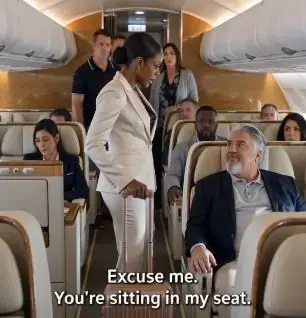
She stepped into the first-class cabin and felt the familiar small lift of it — the wide seats, the quiet, the sense that the day had been arranged in her favor. She walked the aisle counting rows. One. Two.
And stopped.
Seat 2C was occupied.
A man sat in it — white, early fifties, silver at the temples, a crisp blue shirt with the sleeves rolled to the elbow, a leather briefcase already stowed beneath the seat in front of him as if he had been there for an hour. He had a newspaper folded open on his lap and a coffee from the lounge in the cupholder of Keisha's seat. He looked up as she stopped, and his eyes did a quick inventory — her face, her suit, her suitcase — and then went back to the newspaper.
"Excuse me," Keisha said. "I think you're in my seat."
He didn't look up. "I'm sure there's another one."
Keisha held her boarding pass where he could see it. "Two C. That's this seat."
He sighed, the sigh of a man being asked to explain something obvious to someone slow. He folded the newspaper in half, precisely, and looked at her fully now. "Listen," he said, not unkindly, in the way of a man who believed unkindness and honesty were the same thing. "I got here early. I need the aisle — I've got a tight connection and I can't be climbing over people to get out. You can take mine. Two D, window. It's basically the same seat."
A few heads turned. The woman across the aisle, reading a magazine, lowered it an inch. A man two rows up took out one earbud.
Keisha did not move. "I'd like my assigned seat, please."
The man — Grant Whitfield, though she did not know his name yet — laughed a short laugh. "Come on. Don't make this a thing." He gestured at the cabin, at the empty aisle seat a few feet away. "It's a two-hour flight. I'm asking for a small courtesy."
"You've already taken the seat," Keisha said. Her voice was even. She had spent twenty years learning how to keep it even, and it cost her something every time, and she was thinking of Jordan's text, of the stone in her chest, warm and heavy. "The courtesy would have been asking."
Something flickered across his face — surprise, then irritation, then the particular confidence of a man who had never once been told no by a system he trusted. "I fly this route every week," he said. "I know the crew. Honestly, you'd be more comfortable in the aisle anyway. Easier in and out."
"I don't want the aisle," Keisha said. "I want two C. It's on my boarding pass."
He leaned back in her seat — her seat, the one she had booked, the one with her name attached to it in the airline's system — and spread his hands. "Look, I get it. You booked first. Good for you. But some of us actually have to work on these flights, and the aisle —" He gestured at the open aisle beside him. "Being able to get up matters. I'm not going to argue about it."
The woman across the aisle had put her magazine down entirely now. The man with the earbud had taken out the other one. A teenager near the front was watching with the frank, unblinking interest of the young. The cabin had gone quiet in the particular way cabins go quiet when everyone has decided to listen without appearing to.
Keisha stood in the aisle with her gray suitcase at her side and her boarding pass in her hand, and she felt the old familiar calculus begin — the one she had run a thousand times in rooms like this one. How much will it cost to insist? How much will it cost not to? The teacher in Georgia. The investor who had called her "articulate." The conference where she had been handed someone else's name badge and told the green room was down the hall. She had a speech tonight about exactly this, about the children who learned, before they learned long division, that some seats were not for them. She had crossed out the kindest sentences. She had underlined, twice: say what it cost.
"I understand you fly this route every week," she said, and her voice was still even, and that was the achievement, that was the whole architecture of her life holding. "But this is my seat. I'm not asking you to move as a favor. I'm asking you to move because it's mine."
Grant Whitfield looked at her for a long moment. Then he picked up his newspaper again and shook it once, crisply, the way men do when a conversation is over. "I'm already settled," he said to the paper. "Take the aisle. You'll survive."
The cabin held its breath.