The homeless man tore the helmet from Hammer Dawson’s hands and smashed it against the curb while thirty people watched, and before anyone saw the crack hidden inside, three bikers had already thrown him facedown on the pavement.
I was standing outside Dawson Cycle Repair in Flagstaff when it happened, holding two coffees and arguing with a parts supplier on my phone. The August sun had turned Route 66 white with glare, the air smelled of hot asphalt and motor oil, and eight Harley engines were warming along the curb with that uneven V-twin pulse you feel through your shoes.
Ray “Hammer” Dawson was leading the ride.
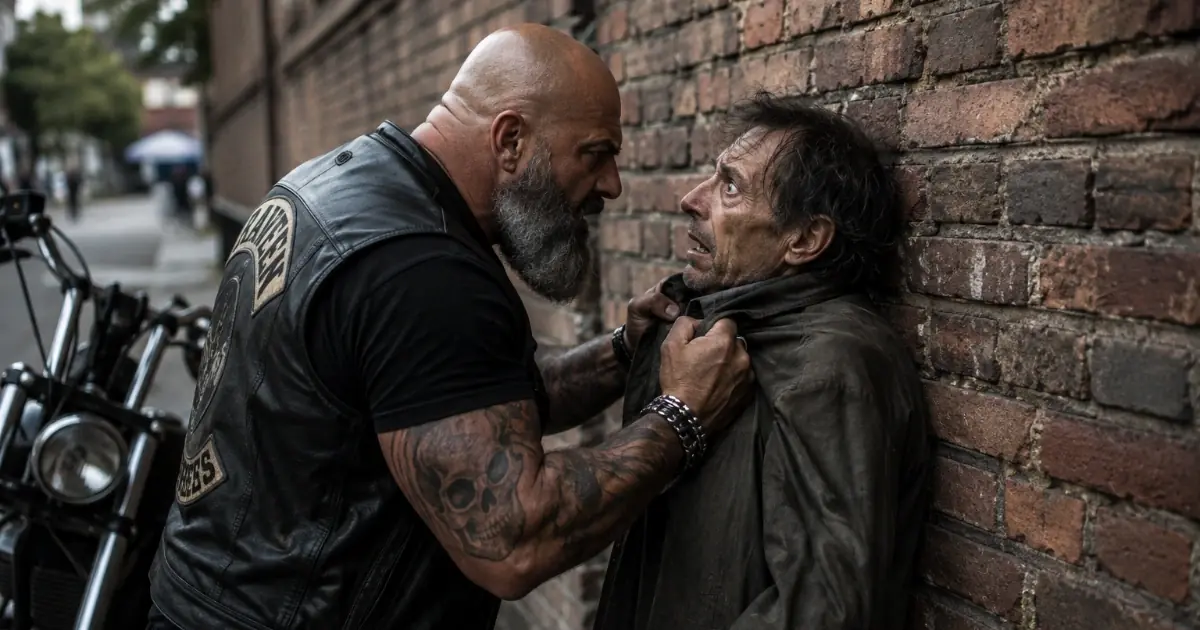
He was fifty-six, six-foot-four, nearly 285 pounds, with a shaved head, a thick black-and-gray beard, scarred knuckles, and ravens tattooed from his wrists to his shoulders. His plain black leather cut had no readable club name on the back, but strangers still moved aside when he walked toward them.
Hammer had one boot beside his Road Glide when a thin man in a dirty army coat came running from the bus shelter.
The man’s hair was gray and tangled. One sleeve had been repaired with silver tape, his boots were split at the toes, and a canvas tool pouch hung from his belt even though he appeared to own no tools.
He pointed at Hammer’s helmet.
“Don’t put that on.”
Hammer looked at him once, then reached for the chin strap.
The stranger lunged.
He snatched the helmet with both hands, stumbled backward, and struck it against the curb so hard that the black outer shell tore loose near the temple. Gasps came from the sidewalk. Someone screamed. A woman lifted her phone while two riders named Boone and Preacher seized the stranger from behind.
They drove him to his knees.
“What the hell is wrong with you?” Boone shouted.
The man did not fight back. He kept staring at the broken helmet as Preacher forced his arms behind him.
Hammer’s face went still.
That was worse than anger.
The helmet had belonged to his younger brother, Tommy, who died seven years earlier. Hammer had replaced the padding and visor, but he had preserved a tiny hand-painted red line along the back—the last mark Tommy had put on it before his final ride.
The stranger had no way of knowing that.
“You got three seconds,” Hammer said.
The man raised his cheek from the pavement. Bloodless. Calm.
“Pull the shell farther back.”
Nobody moved.
“Do it,” he said. “Look above the right temple.”
I set down the coffees and knelt beside the helmet. Beneath the separated shell, the gray impact liner was visible. At first it looked ordinary.
Then I pressed it lightly.
The foam opened along a hairline split running from the crown toward the temple, deep enough that two sections moved independently beneath my thumb. The damage had been concealed by the shell and comfort padding. From the outside, the helmet had shown nothing more than a faint scuff.
Hammer crouched beside me.
His scarred fingers stopped an inch from the fracture.
“That happened when you hit it,” Boone said.
The stranger shook his head against the concrete.
“No. My strike separated the shell. That crush line was already there. See the white powder inside the split? See the flattened cell wall? Old damage.”
Hammer looked toward me because I managed the garage records.
“Was it dropped?”
I remembered one of our teenage helpers carrying helmets inside after closing the previous afternoon. I remembered a crash from the storage room, followed by the boy calling that everything was fine.
I had never checked.
The homeless man whispered one more sentence while Preacher still held him down.
“If he wore that at highway speed, the helmet could have opened where his head needed it most.”
By then, the crowd had stopped shouting. Phones remained raised, but no one seemed certain who the dangerous man was anymore.
Hammer ordered Preacher to release him.
The stranger stood, collected his torn canvas pouch, and walked away without asking for money, thanks, or even an apology. Hammer watched him disappear toward the railroad underpass, then picked up the two pieces of his brother’s helmet.
He did not start his Harley again.
The following morning, Hammer closed the garage for the first time in eleven years, loaded the broken helmet into his truck, and went searching for the man everyone had mistaken for a vandal.
What Hammer found beneath that railroad bridge explained how a homeless stranger had recognized the invisible fracture—and why he refused the cash Hammer offered him.
Part 2 — The Man Beside the Bus Shelter