Boone’s voice came out barely above a breath.
“You said almost real was enough.”
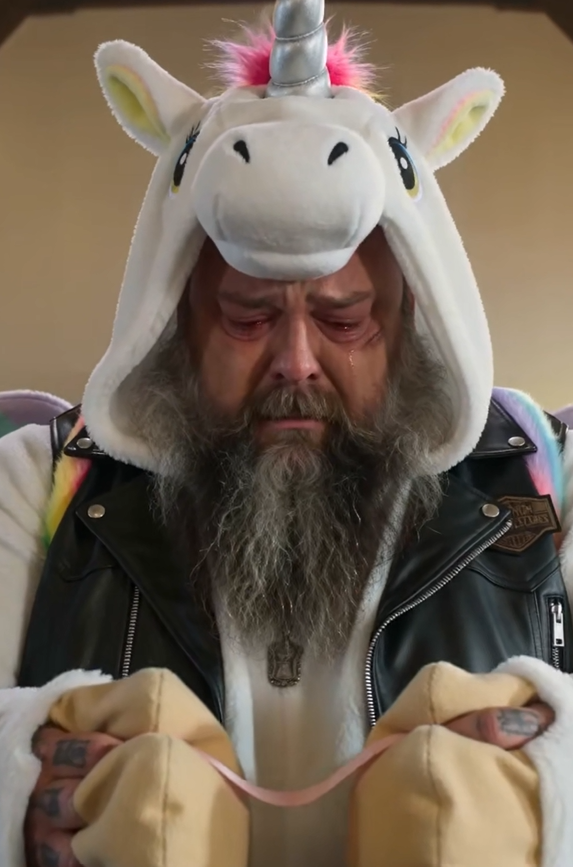
My sister Claire began sobbing.
Tanya Brooks, Lily’s nurse, who had come straight from a night shift still wearing tired eyes and a black dress, pressed both hands to her mouth.
Mark covered his face.
And I understood that Boone had not come to make a scene.
He had come to make sure my daughter’s last impossible wish did not leave this world unanswered.
PART 5 — THE CHURCH THAT STOOD UP
After Boone tied the ribbon, he tried to leave.
That was the part few people remember when they retell the story.
They remember the entrance. The costume. The shock. The pink ribbon. They forget that Boone turned toward the side aisle like a man who believed he had done what he came to do and should disappear before his presence hurt anyone more.
He took two steps.
Then Mark stopped him.
Not with anger this time.
With one hand on the unicorn costume’s padded shoulder.
Boone froze.
Mark tried to speak, but grief had him by the throat. He looked at Boone, then at the casket, then at the pink ribbon tied to the horn.
Finally, he said, “Stay.”
Boone shook his head.
“I didn’t come to be looked at.”
“I know.”
“I can stand in the back.”
Mark’s voice broke.
“She would want you up front.”
The church heard that.
Every pew heard it.
Boone looked suddenly terrified, which was strange because I had seen him face hospital elevators full of crying families without flinching. But kindness in public can frighten a man who is used to being judged.
He followed Mark back to the front pew.
There was no space.
My father stood.
Then my mother.
Then Claire.
One by one, people shifted until there was room for a 285-pound biker in a unicorn costume to sit near the family of the little girl who had asked him to become something impossible.
He sat carefully, shoulders hunched, hooves folded in his lap.
The pastor closed his eyes for a moment before continuing.
His voice was different when he spoke again.
Less formal.
More human.
He said Lily had believed tenderness should be dramatic sometimes. He said children understand symbols better than adults, because adults are always trying to make love look reasonable. He said we had all just witnessed a promise kept in the only language a child had chosen.
Then he looked at Boone.
“Thank you,” he said.
Boone stared at the floor.
During the final song, something happened I still cannot explain without feeling my chest tighten.
Children near the back began standing.
Not all at once.
First Lily’s cousin Mia, a six-year-old white American girl with red curls, freckles, and a purple dress, stood clutching Queen Sprinkles. Then two classmates stood. Then more children. They did not understand every adult layer of grief, but they understood that Lily had wanted a unicorn and one had come.
Adults followed.
Soon, the whole church was standing.
Not applauding.
Not cheering.
Just standing.